


- A Historical, Economic and Comparative Perspective
THE PHILIPPINES’ economic and political journey has been shaped by centuries of colonial rule, a struggle for independence, post-war reconstruction, periods of authoritarian government, democratic restoration, and successive efforts at economic modernization. From its pre-colonial trading communities to its emergence as an upper-middle-income economy, the country has undergone profound structural and institutional changes. Yet its development remains uneven: strong services-sector expansion, overseas remittances, and a globally competitive workforce coexist with persistent productivity constraints, regional inequalities, infrastructure gaps, agricultural vulnerabilities, and inadequate employment opportunities.
As the Philippines assumes the ASEAN Chairship in 2026, its development trajectory acquires a wider regional significance. Its responsibilities extend beyond hosting diplomatic meetings to helping shape ASEAN’s economic integration, strategic balance, and institutional relevance. Its relationship with India, its participation in the Regional Comprehensive Economic Partnership (RCEP), and its longstanding security alliance with the United States are important dimensions of this changing regional position.
This essay traces the historical evolution of the Philippine economy, compares selected aspects of its experience with India’s, and examines the opportunities and challenges that will influence its future development.
Keywords: Philippines; economic development; colonialism; independence; ASEAN; RCEP; India–Philippines relations; structural transformation; upper-middle-income economy.
1. Introduction: A Nation Shaped by History and Geography
The Philippines occupies a distinctive position in Southeast Asia. An archipelago of more than 7,600 islands, it lies at the intersection of major maritime routes connecting East Asia, Southeast Asia, and the wider Pacific. Its geography has shaped its commercial history, cultural influences, political institutions, and economic possibilities.
The country’s modern economic structure cannot be understood without examining its colonial experience. Spanish rule established a centralized colonial administration and connected the islands to global trade through the Manila–Acapulco Galleon Trade. The American administration subsequently introduced a different institutional, educational, and commercial framework. Independence in 1946 brought the responsibility of building a sovereign economy but also the burden of war destruction, unequal economic structures, and institutional dependence.
Over the decades, the Philippines has experienced periods of impressive growth as well as prolonged economic difficulties. Its services sector, electronics industry, overseas Filipino workers, and business-process outsourcing industry have become important sources of income and foreign exchange. However, the transformation of growth into broad-based improvements in productivity, wages, and living standards remains incomplete.
The central question is therefore not simply how much the economy grows, but how effectively growth creates productive employment, reduces regional disparities, and strengthens the foundations of long-term prosperity.
2. The Pre-Colonial Philippines: Commerce, Communities, and Maritime Connections
Before Spanish colonization, the Philippine archipelago was not an isolated collection of islands. It consisted of diverse communities, including barangays governed by local chiefs, with established systems of trade, agriculture, fishing, craft production, and social organization.
Maritime commerce connected these communities with China, the Malay world, Borneo, Indonesia, and other parts of Southeast Asia. Traders exchanged ceramics, textiles, metals, forest products, agricultural commodities, and other goods. The communities around Manila Bay, the Visayas, and Mindanao participated in regional trading networks, although their political organization and economic systems varied considerably.
Agriculture, fishing, boat-building, and local manufacturing supported livelihoods. Rice cultivation was important in several areas, while other communities relied on maritime resources and forest products.
This pre-colonial history is significant because it demonstrates that economic exchange, regional connectivity, and commercial enterprise existed long before European rule. The Philippines’ present-day role in ASEAN therefore has historical foundations in the archipelago’s longstanding links with neighboring Asian societies.
3. Spanish Rule, 1565–1898: Colonial Administration and the Galleon Trade
Spanish colonization began with the establishment of a permanent colonial administration in 1565, following Ferdinand Magellan’s arrival in 1521. Manila became the center of colonial government and commerce.
The Manila–Acapulco Galleon Trade, operating from 1565 to 1815, connected Asia with the Americas and Europe. Manila became an important trading center through which Chinese and other Asian products were exchanged for Mexican silver and goods from the Spanish empire. This gave the Philippines a place in an early global trading network.
However, the benefits of this trade were unevenly distributed. The colonial economy was structured primarily around imperial commercial interests rather than broad-based domestic industrial development. Agricultural production, local trade, and small-scale manufacturing continued, but the economy did not develop a strong, diversified industrial base.
During the nineteenth century, the opening of Manila to international trade in 1834 and the expansion of agricultural exports brought greater commercial activity. Sugar, tobacco, abaca, and other commodities became important. The Tobacco Monopoly, which had constrained production and trade, was abolished in 1882.
A growing Filipino commercial class emerged, while access to education and exposure to liberal ideas contributed to the development of a national consciousness. These changes helped create the social and intellectual conditions for the independence movement.
Spanish rule left a lasting imprint on religion, language, landholding, institutions, and social organization. It also created economic structures whose effects continued long after independence.
4. The Independence Movement and the Revolution of 1896
The emergence of Filipino nationalism during the nineteenth century was closely associated with the work of reformists and revolutionary organizations. José Rizal’s writings exposed the inequalities and abuses of colonial rule and helped articulate a vision of national identity. The reform movement sought greater political representation and equality, while the Katipunan, founded by Andrés Bonifacio in 1892, pursued independence through revolution.
The Philippine Revolution began in 1896. Following years of resistance and political upheaval, Emilio Aguinaldo proclaimed Philippine independence on 12 June 1898.
However, this declaration did not result in internationally recognized sovereignty. The Spanish-American War transformed the political situation. Under the Treaty of Paris of December 1898, Spain ceded the Philippines to the United States in exchange for US$20 million. Filipino aspirations for independence were therefore frustrated by the transfer of colonial authority.
The Philippine–American War began in 1899, and the United States established control over the archipelago. The struggle demonstrated that the achievement of independence required not only a declaration of sovereignty but also international recognition and the capacity to exercise political control.
5. American Administration, 1898–1946: Institutions, Education, and Economic Integration
The American administration brought substantial institutional changes. An English-language public education system was established, roads and ports were developed, and administrative and legal structures were reorganised. These changes contributed to the emergence of a modern public administration and a more integrated national economy.
The introduction of English had long-term consequences. It facilitated access to international commerce, education, and later the development of the business-process outsourcing industry. American influence also shaped the legal system, public institutions, and political practices.
The economic relationship with the United States, however, was not entirely balanced. Preferential access to the American market encouraged exports of agricultural commodities but also reinforced patterns of dependence. Domestic manufacturing did not develop as rapidly or as broadly as it might have under a more diversified industrial strategy.
The Jones Act of 1916 indicated a gradual movement towards self-government. The Tydings–McDuffie Act of 1934 provided for a transitional Commonwealth government, which was inaugurated in 1935. Full independence was envisaged after a ten-year transition.
The Japanese occupation during the Second World War, from 1942 to 1945, disrupted economic activity and caused extensive human and physical destruction. Manila suffered particularly severe damage. The war left the country with an enormous reconstruction challenge even before formal independence was achieved.
6. Independence in 1946: Reconstruction and the Development Challenge
The Philippines became formally independent on 4 July 1946. The new republic inherited a devastated economy, damaged infrastructure, fiscal pressures, and a production structure heavily influenced by its colonial past.
Post-war reconstruction was supported by American assistance and continuing economic links with the United States. Agriculture remained important, while manufacturing gradually expanded through import-substitution policies. The country initially enjoyed relatively favorable economic conditions compared with several neighboring Southeast Asian economies.
However, structural weaknesses persisted. Land ownership remained concentrated, rural poverty was widespread, and industrial development depended significantly on imported machinery, technology, and intermediate goods. The domestic market was also constrained by income inequality.
The early decades of independence therefore combined economic recovery with the unfinished task of creating a diversified and competitive production base.
7. The Marcos Era: Authoritarianism, Debt, and Economic Crisis
Ferdinand Marcos assumed the presidency in 1965 and declared martial law in September 1972. The period witnessed substantial state involvement in infrastructure, agriculture, and selected industries. Some projects expanded productive capacity, while the government also pursued ambitious development programs.
However, political centralization, patronage, corruption, and weak institutional accountability undermined the sustainability of economic management. Foreign borrowing increased, and the economy became increasingly vulnerable to external shocks and domestic policy distortions.
The assassination of opposition leader Benigno Aquino Jr. in 1983 intensified political opposition and investor uncertainty. Economic activity weakened, debt-servicing pressures increased, and confidence deteriorated.
The People Power Revolution of February 1986 ended Marcos’s rule and restored democratic government under Corazon Aquino. The transition was historically important, but the new administration inherited a deeply troubled economy and weakened institutions.
The experience illustrates a broader development lesson: infrastructure investment and state-led projects cannot substitute for accountable institutions, sound public finances, and competitive markets.
8. Liberalization and the Expansion of Services
From the late 1980s onwards, successive administrations pursued economic liberalization, financial-sector reform, trade opening, and greater participation by private investors. The Philippines also sought to attract foreign direct investment and integrate more deeply into regional and global production networks.
The services sector became an increasingly important driver of growth. Overseas Filipino workers generated substantial remittances, supporting household consumption, housing, education, and foreign-exchange availability. The business-process outsourcing industry expanded by drawing on the country’s English-speaking workforce, educational institutions, and cultural familiarity with Western markets.
Electronics and electrical equipment became significant export industries, linking the Philippines to regional and global supply chains. Tourism, retail, finance, telecommunications, and other services also expanded.
These developments improved the country’s capacity to earn foreign exchange and created new employment opportunities. Nevertheless, the expansion of services did not automatically generate sufficient high-productivity employment across the economy. Many workers continued to depend on informal, low-wage, or insecure occupations.
The challenge has been to ensure that services-sector success complements rather than substitutes for a broader expansion of manufacturing, modern agriculture, and technology-intensive production.
9. The Twenty-First Century: Growth, Resilience, and Structural Constraints
The Philippine economy has recorded periods of relatively strong growth in the twenty-first century. Domestic consumption, remittances, infrastructure investment, services exports and a young workforce have supported economic expansion.
The country has also demonstrated resilience in the face of major external shocks, including the global financial crisis and the COVID-19 pandemic. The pandemic caused a severe contraction in 2020, particularly affecting tourism, transport, retail, and other contact-intensive services. Subsequent recovery was supported by the reopening of the economy, household spending, and government measures.
Yet the quality and composition of growth remain important concerns. Agriculture continues to face low productivity, fragmented landholdings, inadequate irrigation, post-harvest losses, and exposure to extreme weather. Manufacturing has not expanded sufficiently to absorb the growing labor force into stable, productive employment.
Infrastructure and logistics costs remain significant constraints, particularly in an archipelago where inter-island connectivity is essential. Energy costs, power reliability, skills mismatches, and regional inequality also affect the competitiveness of businesses.
The World Bank’s work on Philippine growth and jobs has highlighted the importance of raising productivity, improving competition, and strengthening the contribution of investment and technology to economic expansion. The central challenge is to move beyond growth driven mainly by consumption and factor accumulation towards sustained productivity improvement.
10. Upper-Middle-Income Status: A Milestone, Not the Destination
The Philippines has entered the World Bank’s upper-middle-income category under the income classification applicable from July 2026. The classification is based on gross national income per capita using the Atlas method. The World Bank’s published 2025 figure for Philippine GNI per capita is approximately US$4,850, above the upper-middle-income threshold of US$4,636.
This is an important development milestone. It reflects the cumulative effects of economic growth, remittances, services-sector expansion, improved human capital, and greater integration with international markets.
However, income classification should not be confused with the achievement of broad-based prosperity. A national average can conceal substantial differences between regions, households, and occupational groups. Poverty, underemployment, informal work, unequal access to quality education and healthcare, and vulnerability to food and energy price increases remain significant concerns.
The distinction between becoming an upper-middle-income economy and achieving high-income status is therefore important. Sustained productivity growth, stronger manufacturing, agricultural modernization, better-quality jobs, and more effective public institutions will determine whether the Philippines can progress further.
11. The Philippines as ASEAN Chair in 2026
The Philippines’ ASEAN Chairship in 2026 provides an opportunity to shape regional priorities at a time of considerable geopolitical and economic uncertainty. ASEAN now comprises eleven member states, following Timor-Leste’s admission in 2025. Its collective economic weight, strategic location, and centrality in the Indo-Pacific make it an important regional institution.
The Philippine Chairship theme, “Navigating Our Future, Together,” captures the need for collective responses to economic, security, and technological challenges.
The Philippines will host the 49th ASEAN Summit and Related Meetings in Metro Manila. The related meetings are scheduled for 15–18 November 2026, while the main summit is scheduled for 16–18 November 2026.
The Chairship’s responsibilities extend beyond the organization of high-level meetings. They include helping member states maintain regional unity, advance economic integration, strengthen maritime cooperation, improve disaster resilience, and preserve ASEAN centrality amid intensifying competition among major powers.
The Philippines has an opportunity to give particular attention to practical outcomes: better regional connectivity, more resilient supply chains, digital cooperation, energy security, food security, and opportunities for small and medium-sized enterprises.
The success of a chairship should ultimately be assessed not by the number of meetings held but by the extent to which it produces agreements, institutions, and programs that continue to deliver benefits after the chairmanship ends.
12. RCEP and the Future of Regional Economic Integration
The Regional Comprehensive Economic Partnership is one of the most important trade and economic cooperation frameworks in the Asia-Pacific. It brings together the ten original ASEAN members and five regional partners: China, Japan, South Korea, Australia and New Zealand.
The agreement seeks to facilitate trade and investment through tariff reductions, common rules of origin, customs cooperation, services commitments, and other measures. It entered into force for the Philippines on 2 June 2023.
For the Philippines, RCEP offers opportunities to attract investment, participate in regional value chains, expand exports, and improve access to intermediate goods and production networks. Its benefits, however, will depend on the ability of domestic enterprises—particularly small and medium-sized firms—to meet standards, improve productivity, and compete in regional markets.
India participated in the RCEP negotiations but withdrew in November 2019, citing concerns about market access, import surges, and the protection of domestic producers and farmers. India is therefore not a member of the agreement.
This difference creates an important dimension in India–Philippines economic relations. Both countries can nevertheless expand bilateral trade, investment, and supply-chain cooperation while exploring areas where their economic interests complement one another.
13. The United States Alliance: Security and Economic Dimensions
The Philippines’ relationship with the United States is rooted in its colonial history and post-independence security arrangements. The Mutual Defense Treaty was signed on 30 August 1951. Subsequent arrangements, including the Visiting Forces Agreement of 1998 and the Enhanced Defense Cooperation Agreement of 2014, have strengthened defense cooperation.
The alliance remains particularly important in the context of maritime security and tensions in the South China Sea. The Philippines has a direct interest in preserving freedom of navigation, respect for international law, and peaceful resolution of disputes.
The relationship also has economic dimensions. The United States is an important trading, investment, technology, and development partner. American companies have contributed to employment and export activity, while educational and people-to-people links remain substantial.
At the same time, the Philippines must maintain constructive relations with other major powers, including China, Japan, South Korea, India, and Australia. Its economic and security interests are best served by a foreign policy that protects national sovereignty while avoiding unnecessary economic dependence on any single partner.
ASEAN provides a platform for this approach. Regional cooperation can help smaller and middle-sized economies strengthen their collective bargaining position and preserve strategic autonomy.
14. India and the Philippines: Different Colonial Experiences, Shared Aspirations
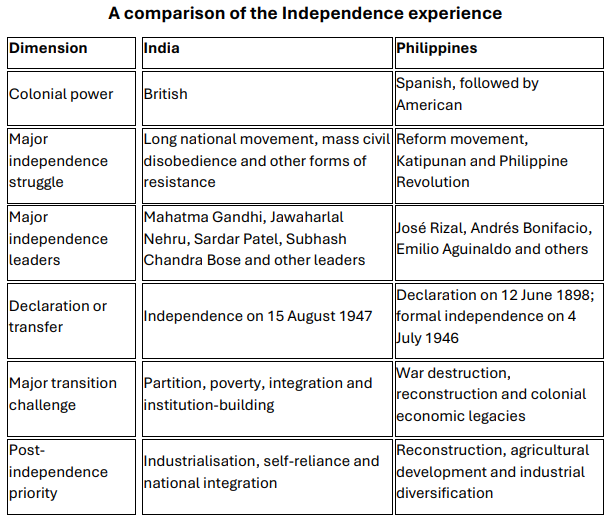
India and the Philippines experienced colonial rule under different powers and followed distinct paths to independence. India was ruled by the British, while the Philippines experienced Spanish and American colonial administration.
India’s independence movement developed over a much larger geographical area and involved a broad range of political, social, and ideological currents. The Indian National Congress, founded in 1885, became a central organization in the freedom movement. Mahatma Gandhi’s leadership gave mass mobilization, non-violent resistance, and civil disobedience a defining role, although revolutionary, socialist, and other political traditions also contributed.
The Philippines’ independence movement emerged through reformist intellectual activity and revolutionary resistance, culminating in the 1896 Revolution and the declaration of independence in 1898. Unlike India, however, the Philippines did not obtain internationally recognized independence at that time. It subsequently experienced American rule and achieved formal independence in 1946.
India became independent on 15 August 1947, accompanied by Partition and enormous human displacement. The Philippines became independent a year earlier, on 4 July 1946, following the devastation of the Second World War.
Both countries inherited institutions shaped by colonial administration. Both faced the challenge of transforming political sovereignty into economic self-reliance, social development, and stronger national institutions.
Their historical experiences also reveal the importance of education, political mobilization, institutional capacity, and the development of a shared national identity.
A comparison of the independence experience
15. Post-Independence Economic Development: A Comparative Perspective
India and the Philippines adopted different approaches to economic development after independence.
India initially followed a planned-development model, with substantial state participation in heavy industry, infrastructure, finance, and strategic sectors. Import substitution and public-sector investment were central features. Economic liberalization, from 1991, increased competition, encouraged private investment, and expanded integration with global markets. India subsequently developed strengths in information technology, pharmaceuticals, manufacturing, financial services, and a large domestic consumer market.
The Philippines followed a different path. Its close economic relationship with the United States, export-oriented agriculture, import-substitution policies, and later liberalisation shaped its development trajectory. Services, overseas remittances, and electronics exports became major sources of growth.
India’s much larger population and domestic market have provided scale, while the Philippines has benefited from English-language capabilities, overseas employment networks, and a strong position in selected services and electronics activities.
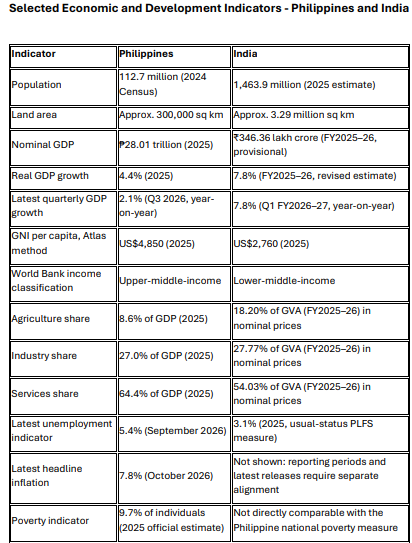
The Philippines has reached upper-middle-income status, while India remains in the lower-middle-income category under the World Bank’s classification. This does not mean that the Philippines has a larger economy or a higher level of industrial capacity. India’s total economic output and domestic market are considerably larger. The comparison instead highlights the different relationships between population, per capita income, economic structure, and development outcomes.
Both countries face the common challenge of generating sufficient productive employment, improving human capital, and reducing inequality. Their experience suggests that economic growth must be supported by productivity, institutional quality, and the capacity to create opportunities across regions and income groups.
16. India–Philippines Stratenetworks,Partnership: Moving Beyond Diplomatic Engagement
India and the Philippines have steadily expanded their bilateral relationship. The establishment of a strategic partnership during President Ferdinand Marcos Jr.’s state visit to India in August 2025 marked an important step. The Five-Year Plan of Action for 2025–2029 provides a framework for cooperation across political, economic, defense, technological and people-to-people areas.
Bilateral trade has expanded, with trade in goods reaching approximately US$3.9 billion in the financial year 2025–26. The two countries have identified opportunities in pharmaceuticals, information technology, digital public infrastructure, agriculture, infrastructure, defense, electronics, and services.
The 14th Joint Working Group on Trade and Investment, held in Manila on 5 June 2026, discussed ways to expand commercial engagement, including the review of trade arrangements and possibilities for further trade cooperation.
India’s strengths in pharmaceuticals, digital technologies, information technology services, engineering, and affordable healthcare solutions complement several Philippine development priorities. The Philippines, in turn, offers Indian businesses access to ASEAN markets, an English-speaking workforce, and opportunities in infrastructure, services, and manufacturing.
The relationship should increasingly be measured by commercial outcomes: investment flows, joint ventures, technology partnerships, market access, research collaboration, and employment creation.
17. Narendra Modi’s Manila Engagement and the Regional Opportunity
Prime Minister Narendra Modi’s first visit to Manila in November 2017, during the ASEAN and East Asia Summits, provided an important foundation for stronger India–Philippines engagement. The visit reflected India’s Act East policy and its interest in deepening ties with Southeast Asia.
The subsequent establishment of the Strategic Partnership in 2025 created a stronger institutional basis for bilateral cooperation. President Marcos’s expected engagement with India during the 2026 BRICS Summit and his invitation to Prime Minister Modi to visit Manila in connection with the November ASEAN meetings have added momentum to the relationship.
The anticipated high-level engagement in Manila in November 2026 offers an opportunity to translate diplomatic goodwill into practical cooperation. Defense and maritime security, trade and investment, pharmaceuticals, digital technologies, and infrastructure are among the areas where tangible progress would be valuable.
India’s engagement with the Philippines also has a wider regional dimension. As the Philippines serves as ASEAN Chair in 2026 and India continues its role as ASEAN–India Dialogue Coordinator through 2027, both countries can contribute to strengthening the ASEAN–India partnership.
18. The Future Outlook: From Growth to Productive and Inclusive Development
The Philippines has several important advantages. Its young population, English-language capabilities, overseas networks, strategic location, and established services industries provide a strong foundation for future growth. Its membership in ASEAN and RCEP creates opportunities to attract investment and participate more deeply in regional production networks.
However, these advantages will not automatically translate into higher productivity or better living standards. Several priorities deserve sustained attention.
First, manufacturing and industrial diversification. The country needs a stronger manufacturing base, particularly in electronics, machinery, food processing, pharmaceuticals, and other industries with potential for domestic value addition. This would help diversify exports and create more productive employment.
Second, agricultural modernization and food security. Investment in irrigation, storage, cold chains, logistics, research, and climate-resilient farming is essential. Greater productivity in agriculture can improve rural incomes, reduce food-price pressures, and strengthen domestic supply chains.
Third, infrastructure and energy. Reliable and affordable electricity, efficient ports, roads, railways, and inter-island transport are essential for competitiveness. Renewable energy, grid modernization, and regional energy cooperation can also improve resilience.
Fourth, education and skills. The education system must respond to changing labor-market requirements, including digital technologies, artificial intelligence, engineering, advanced manufacturing, and healthcare. Technical and vocational education should receive greater attention.
Fifth, employment and social inclusion. Economic growth must create secure and productive jobs for young people and women. Reducing informality, improving labor-market access, and strengthening social protection are essential to ensuring that growth benefits a wider section of society.
Sixth, institutional quality and fiscal sustainability. Transparent governance, predictable regulation, efficient public investment, and responsible fiscal management are necessary to build investor confidence and preserve resources for development.
Finally, climate and disaster resilience. The Philippines is highly exposed to typhoons, floods, earthquakes, and other natural hazards. Resilient infrastructure, disaster preparedness, insurance mechanisms, and climate-adaptive agriculture are therefore central to economic development, not peripheral environmental concerns.
19. The Philippines in a Changing Asian and Global Order
The global economic environment is changing rapidly. Supply chains are being reorganized, digital technologies are transforming production and services, and strategic competition among major powers is influencing trade, investment, and security arrangements.
For the Philippines, these changes create both opportunities and risks. Its strategic location and alliance relationships are important assets, but economic resilience requires diversified trade, investment, and technology partnerships.
ASEAN remains central to this approach. Its relevance depends on the ability of member states to preserve unity, strengthen economic integration, and maintain an open regional architecture. The Philippines’ 2026 Chairship offers an opportunity to advance these objectives.
Relations with the United States remain important for security and economic cooperation. Relations with China are essential because of geography, trade, and regional interdependence. Japan, South Korea, Australia, India, and the European Union also offer important opportunities for investment, technology, and market diversification.
India’s growing economic and strategic presence in the Indo-Pacific provides an additional avenue for cooperation. Stronger India–Philippines relations can support regional connectivity, maritime security, digital development, and diversified supply chains.
The Philippines can therefore pursue a constructive strategy that combines strong alliances, diversified economic partnerships and active participation in ASEAN-led institutions.
20. Conclusion: Converting Historical Progress into a New Development Phase
The Philippines’ journey from pre-colonial maritime communities to an independent upper-middle-income economy is a story of resilience, adaptation, and continuing transformation. Colonial rule shaped its institutions and economic structures, while the independence movement established the foundations of national sovereignty. Post-war reconstruction, democratic restoration, economic liberalization, and the expansion of services created new opportunities, but did not fully resolve the challenges of productivity, industrial diversification, and inclusive employment.
The country’s entry into the upper-middle-income category is a significant achievement, but it should be viewed as a platform for the next phase of development rather than an endpoint. The transition to a more productive, competitive, and inclusive economy will require stronger manufacturing, modern agriculture, reliable infrastructure, better education, sound institutions, and climate resilience.
The comparison with India illustrates that countries with different colonial histories, population sizes, and economic structures can follow distinct development paths while confronting similar questions about employment, productivity, and social inclusion.
As ASEAN Chair in 2026, the Philippines has an opportunity to connect its national development priorities with a wider regional agenda. Its relations with the United States, China, India, and other partners can be complementary if guided by economic pragmatism, national interest, and a commitment to regional stability.
Ultimately, the measure of the Philippines’ economic transformation will not be its income classification alone, nor the number of international summits it hosts. It will be the extent to which its people gain access to better jobs, higher incomes, quality public services, and greater economic security—and whether the country can convert its strategic location and human potential into lasting prosperity.
Appendix I: Selected Economic and Development Indicators — Philippines and India
The figures below provide a broad comparative snapshot. They do not all refer to the same reporting period, and some national accounting measures are not directly comparable.
Notes on interpretation
- GDP and GNI: GDP measures domestic production, whereas GNI includes net primary income from abroad. The World Bank income classification is based on GNI per capita using the Atlas method, not nominal GDP per capita.
- Income classification: The World Bank’s FY2027 upper-middle-income threshold begins at US$4,636 GNI per capita. The Philippines’ reported 2025 figure of US$4,850 is above that threshold; India’s reported US$2,760 remains within the lower-middle-income range.
- Sectoral shares: Philippine sectoral shares are expressed as percentages of GDP at current prices, while the Indian figures are shares of GVA at current prices. They are indicative of economic structure but should not be interpreted as perfectly comparable measures.
- Unemployment: The Philippine figure is a monthly Labour Force Survey estimate for September 2026. India’s 3.1% figure uses the annual Periodic Labour Force Survey usual-status measure. Differences in reference periods and methodology mean that the two rates should not be treated as directly comparable.
- Poverty: National poverty lines, survey methods and reference periods differ. The Philippine figure should not be compared directly with an Indian poverty estimate without harmonising definitions and methodology.
- Latest quarterly growth: The Philippine Q3 2026 figure is a year-on-year growth rate. India’s Q1 FY2026–27 figure is also year-on-year, but the quarters refer to different calendar and fiscal-year periods (April-June 2026).
Appendix II: Selected Historical and Institutional Milestones
| Year / Period | Philippines | India |
| Pre-colonial period | Maritime trade and barangay-based communities | Diverse regional kingdoms, trade networks and empires |
| 1565 | Establishment of permanent Spanish colonial administration | Mughal Empire at its height |
| 1757 | — | Battle of Plassey; beginning of East India Company political dominance in Bengal |
| 1857 | — | The First War of Independence (Sepoy Mutiny) |
| 1885 | — | Indian National Congress founded |
| 1892 | Katipunan founded | Nationalist and reform movements expanding |
| 1896 | Philippine Revolution begins | — |
| 1898 | Declaration of Philippine independence; subsequent transfer to US rule | — |
| 1899 | Philippine–American War begins | — |
| 1916 | Jones Act advances the promise of self-government | — |
| 1935 | Commonwealth government inaugurated | Government of India Act 1935 |
| 1942–45 | Japanese occupation and wartime devastation | Japanese advance in Asia; Indian independence movement intensifies |
| 1946 | Formal independence on 4 July | — |
| 1947 | — | Independence on 15 August; Partition of the Country |
| 1972 | Marcos declares martial law | — |
| 1986 | People Power Revolution restores democratic government | — |
| 1991 | Continuing economic liberalisation | Economic reforms begin |
| 2017 | ASEAN Chair; India–Philippines engagement deepens during Modi visit | Act East policy and ASEAN engagement |
| 2025 | Strategic Partnership with India established | Strategic Partnership with the Philippines |
| 2026 | ASEAN Chair; 49th ASEAN Summit in November | ASEAN–India Dialogue Coordinator through 2027 |