


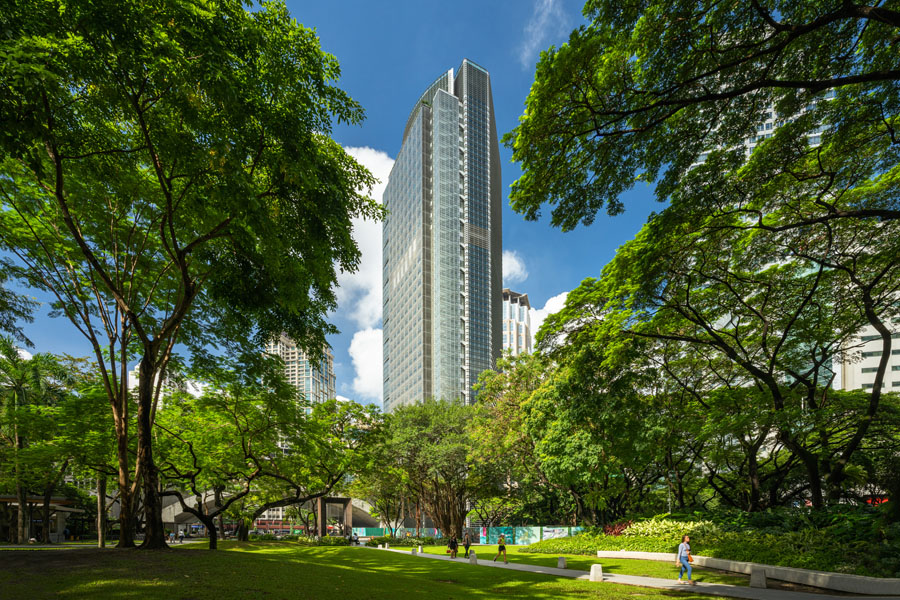
Makati City, Philippines – Ayala Land, Inc. (ALI) has achieved EDGE Zero Carbon certification for more than 1.5 million square meters of commercial office space, making it the largest EDGE Zero Carbon–certified office portfolio globally as of December 2025.
The milestone underscores ALI’s leadership in sustainable real estate development and reflects the company’s disciplined execution of its long-term climate and capital strategy.
On January 22, ALI formally received the EDGE Zero Carbon certifications during an awarding ceremony in Bonifacio Global City, attended by representatives from the International Finance Corporation (IFC), the Philippine Green Building Initiative (PGBI), Ayala Land executives, and property management teams. PGBI, one of the approved certifiers by IFC in the Philippines, conducted the third-party audits and awarded the certifications.
“This achievement demonstrates that sustainability at scale is both measurable and achievable,” said Robert S. Lao, Ayala Land Chief Sustainability Officer. “By securing the EDGE Zero Carbon Certifications for our office portfolio, we are able to verify the performance of our green buildings with measurable results that support operational efficiency, and long-term asset value.”
ALI’s certified portfolio spans 50 office properties across Metro Manila, Laguna, Cebu, Baguio, Iloilo, and Bacolod, covering a total of 1,529,179 square meters. The portfolio includes a mix of corporate headquarters and business process outsourcing (BPO) facilities.
EDGE Zero Carbon Certification
EDGE Zero Carbon is a global green building certification developed by IFC. To qualify, buildings must first achieve EDGE Advanced certification, demonstrating at least 40% reduction in energy plus at least 20% savings in water use and embodied carbon in materials. Projects must then operate using 100% renewable energy or verified carbon offsets, maintaining at least 75% occupancy for one year.
Sustainability-Linked Financing
The EDGE Zero Carbon milestone fulfills one of ALI’s key sustainability performance targets under its sustainability-linked financing program, which was established in adherence to international guidelines including the ASEAN Sustainability-Linked Bond Standards, the Sustainability Linked Bond Principles issued by the International Capital Market Association, and the Sustainability Linked Loan Principles issued by the Asia Pacific Loan Market Association.
Between 2024 and 2025, Ayala Land raised approximately USD 1 billion (₱56 billion) through sustainability-linked instruments. These include a ₱14.2 billion Sustainability-Linked Loan (SLL1) obtained in July 2024 and ₱12.87 billion SLL2 obtained in August 2025, both from IFC. A total of ₱29 billion in Sustainability-Linked Bonds (SLB) were also issued and listed on the Philippine Dealing & Exchange Corp. (PDEx) between July 2024 and October 2025.
These financial instruments are tied to clearly defined sustainability performance targets, including achieving EDGE Zero Carbon certification for 1.5 million square meters of commercial office properties by December 2025 and reducing greenhouse gas emissions by 42% across its malls, offices, and hotels by December 2030. The financing structures require a step-up in interest rates if targets are not met.
Advancing Green Building at Scale
In September 2023, Ayala Land and AREIT, Inc. signed a memorandum of understanding with IFC to pursue EDGE Zero Carbon certification for 1.5 million square meters of office space by 2025. This commitment involved retrofitting existing buildings, transitioning to renewable energy, and accelerating energy-efficiency initiatives.
Beyond offices, Ayala Land continues to pursue green building certifications across its portfolio, including malls, hotels, residential developments, logistics facilities, and mixed-use estates, reinforcing sustainability as a core operating principle across property types.
As ALI advances toward its Net Zero 2030 emissions -reduction targets, the company continues to integrate sustainability into development, operations, and capital allocation—aligning climate action with business performance and long-term value creation.
