



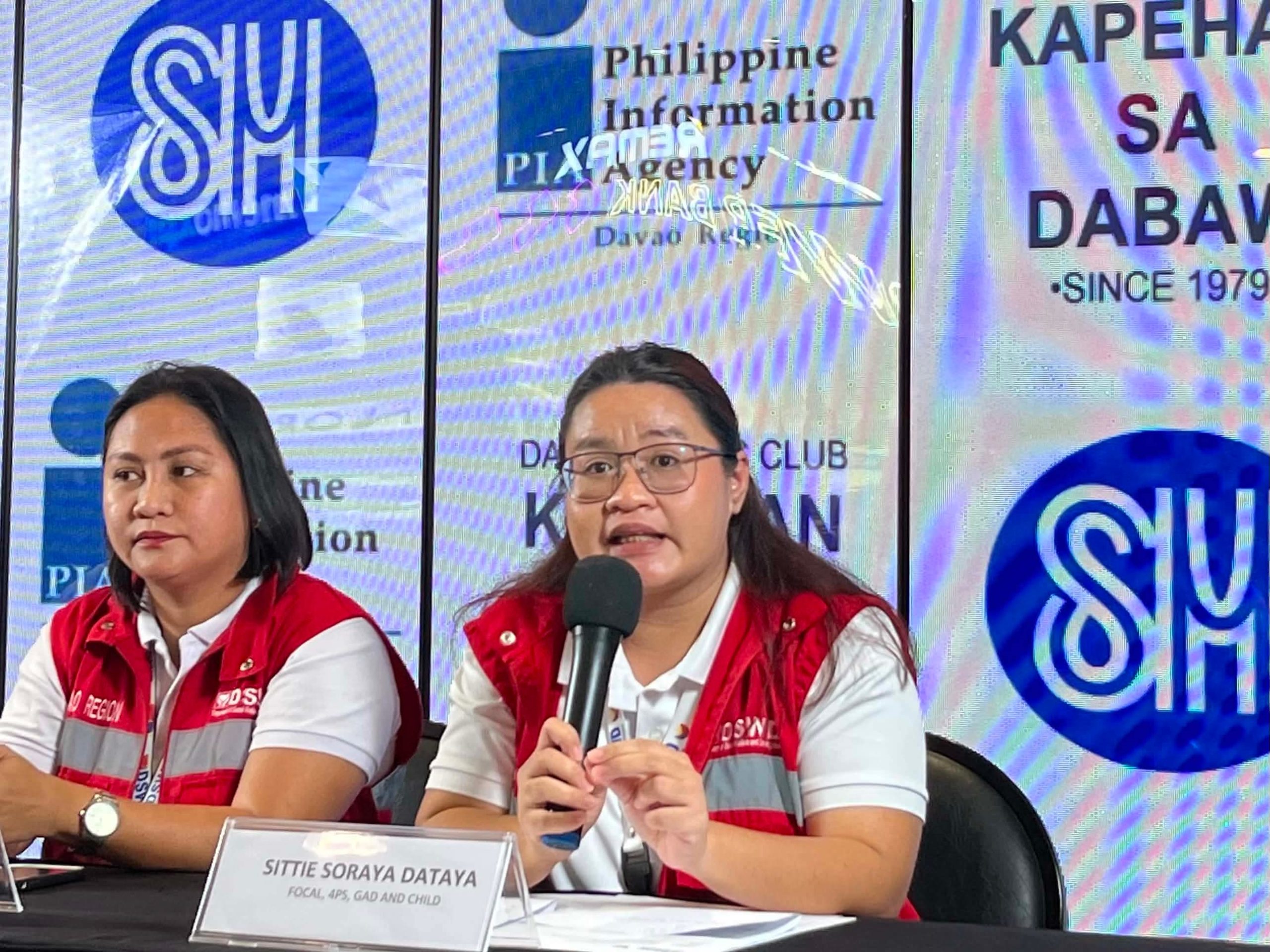
THE DEPARTMENT of Social Welfare and Development (DSWD) XI said households under the Pantawid Pamilyang Pilipino Program (4Ps) with children engaged in work are strictly monitored to prevent involvement in forced labor.
Sittie Soraya M. Dataya, the program’s GAD and children focal person, raised this during the Kapehan sa Dabaw on Monday, as concerns grow that rising inflation may push minors into labor in the Davao Region.
Dataya said the agency distinguishes between child work and child labor, and that reports of 4Ps beneficiary children engaged in work trigger interventions such as case management and referrals to partner agencies.
“It will always boil down to why the child is made to work. It is because the family does not have enough for daily needs,” the official said.
Case managers talk to the parents and make referrals to partner agencies, including but not limited to the Department of Labor and Employment (DOLE).
DSWD also monitors the children continuously, since school attendance is among the conditions families must meet to receive 4Ps cash grants.
She said child work that affects a child’s schooling is a concern under the program.
The official described what DSWD calls an “exhaustive intervention” when children are forced to work because a family cannot get by without their income, especially when a parent is sick.
Under this, beneficiaries are referred to possible partner agencies, and social workers conduct repeated home visits.
She added that teachers are also asked to talk with the children, and those who have fallen behind may be enrolled in alternative learning programs so they can return to school or advance a grade level.
DSWD 4Ps covers 355,945 children aged 0 to 18 in the Davao Region, as of June to July 2026 data.
By province, Davao del Norte has the most child beneficiaries at 72,869, followed by Davao de Oro (72,091), Davao City (69,255), Davao Oriental (67,814), Davao del Sur (41,574), and Davao Occidental (32,342).
Most of the children are of school age. The agency counted 217,565 aged 6 to 14 and 126,486 aged 15 to 18, while 8,278 are aged 3 to 5 and 3,616 are aged 0 to 2.
As of October 2026, DSWD XI reported disbursing ₱2,900,793,650 in education, health, and nutrition grants to 227,300 family beneficiaries across the region.

