



DAVAO Region has one developmental pediatrician for every 7,532 learners, worse than the national ratio of 1:4,808, according to data released by the Second Congressional Commission on Education (EDCOM 2).
The figure puts Davao Region (Region XI) among the regions that fall short of the national benchmark.
The ratio is about 57% higher than the national figure and roughly 12 times that of the National Capital Region, which recorded the best ratio at 1:627.
The data were drawn from the Philippine Society for Developmental and Behavioral Pediatrics (PSDBP) official directory as of July 27, 2026, and the Department of Education’s Learner Information System SNED database for School Year 2025–2026.
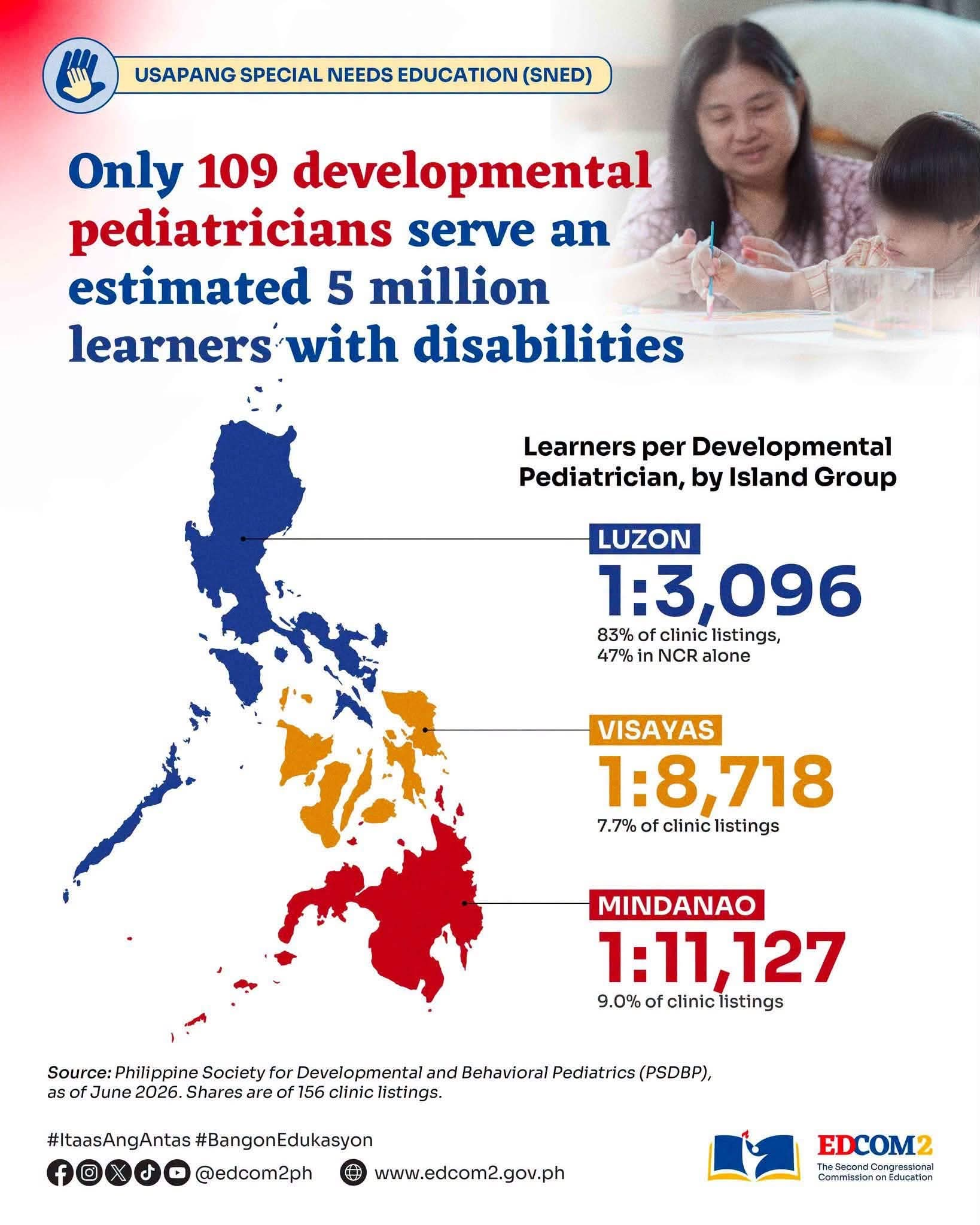
Nationwide, EDCOM 2 reported that only 109 certified developmental pediatricians serve an estimated five million learners with disabilities.
By island group, Mindanao has the weakest ratio at 1:11,127, compared with 1:8,718 in the Visayas and 1:3,096 in Luzon.
Mindanao also accounts for only 9% of the 156 clinic listings in the PSDBP directory as of June 2026, while Luzon has 83%, including 47% in the NCR alone.
However, within Mindanao, Davao Region has the second-best ratio, behind Northern Mindanao (Region X) with 1:4,744, the only Mindanao region better than the national figure.
Other regions were far worse: SOCCSKSARGEN stood at 1:24,728 and the Zamboanga Peninsula at 1:17,489.
Caraga (Region XIII) and the Bangsamoro Autonomous Region in Muslim Mindanao (BARMM) have no developmental pediatrician at all.
EDCOM 2 noted that doctors are counted in every region where they hold a clinic, and the national ratio uses the 109 certified doctors.
The commission noted that developmental pediatricians diagnose and manage conditions such as autism, ADHD, and developmental delays, which often determine whether a learner can access special education services.
The Commission also found that only five institutions nationwide offer fellowship training in developmental and behavioral pediatrics: UP-Philippine General Hospital, Philippine Children’s Medical Center, National Children’s Hospital, The Medical City, and De La Salle University Medical Center.
Of these, three are government hospitals, and two are private institutions; most are located in Metro Manila, with only De La Salle University Medical Center in Cavite.
An EDCOM 2 analysis of Department of Education (DepEd) Learner Information System (LIS) data for School Year 2025–2026 found that, among 492,902 public-school learners with disabilities, 312,383 (63.4%) were recorded with disability manifestations, while only 180,519 (36.6%) had formal diagnoses.
EDCOM analysis shows that Davao Region had the highest recorded number of enrolled learners with disabilities, at 60,257, but only 29% had formal diagnoses. CALABARZON followed with 58,272 learners, while NCR recorded 46,382.
Central Luzon had 35,616 learners, and Zamboanga Peninsula had 34,977.
NCR, CALABARZON, and Central Luzon were the only three regions that had more learners with formal diagnoses than learners identified through observed manifestations of disability.
Karol Mark Yee, EDCOM 2 executive director, said addressing these gaps requires closer coordination among DOH, CHED, DepEd, PhilHealth, and LGUs to expand access to developmental assessment and support services.
“We should also explore scholarships and training opportunities in regions where specialists are lacking and strengthen partnerships with local colleges and training institutions to develop more specialists who can serve these communities. Our goal is to ensure that children can access the assessment and support they need, regardless of where they live,” Yee stressed.

