



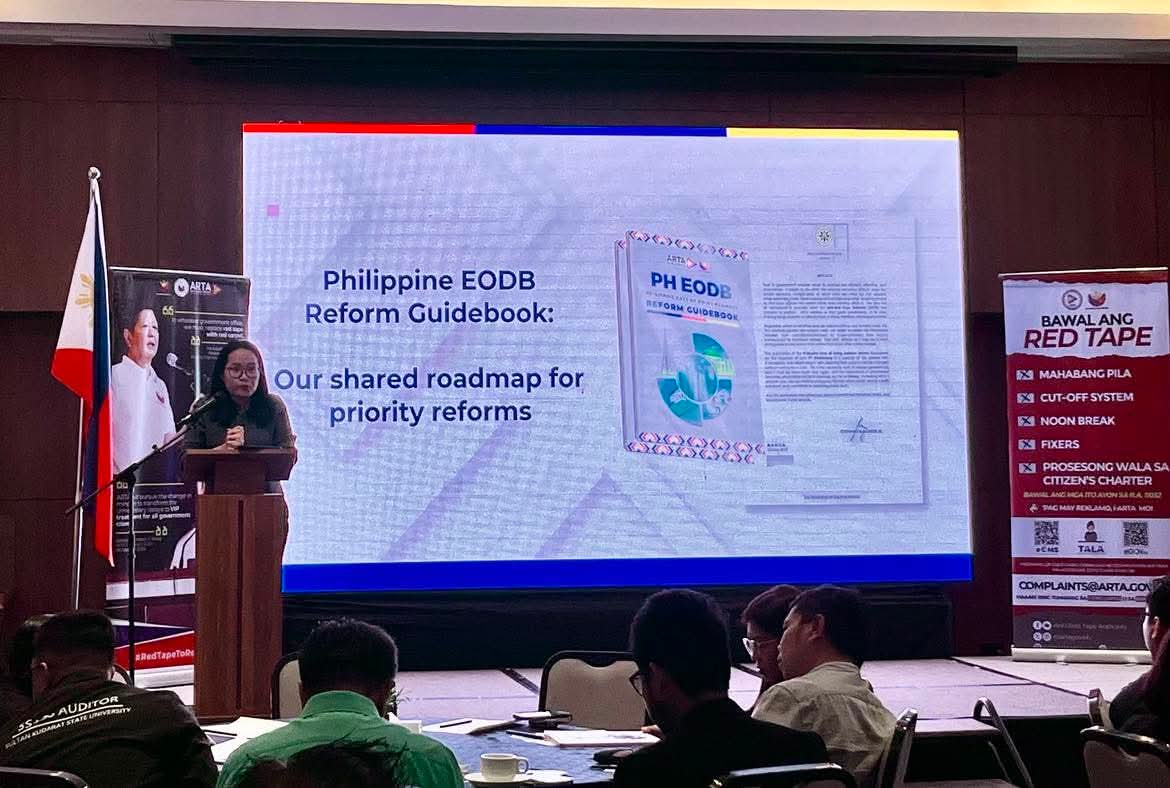
THE ANTI-RED Tape Authority (ARTA) on Thursday, Nov. 5, brought the Philippine Ease of Doing Business Reform Guidebook and the World Bank’s Business Ready (B-Ready) report to the regions for the first time.
ARTA Director IV Marbida L. Marbida emphasized the importance of strengthening local reforms to enhance the country’s business environment and global competitiveness.
She stressed that the involvement of regional offices, local government units, and the private sector is critical to achieve regulatory reform.
Marbida urged local governments and agencies to simplify permits and make processing times predictable.
“A globally competitive business environment relies heavily on predictable, transparent, and accessible public service delivery from the municipal level up to national agencies,” she said.
ARTA enforces Republic Act 11032, or the Ease of Doing Business and Efficient Government Services Delivery Act of 2018, and implements various ease of doing business and anti-red tape initiatives aimed at improving the competitiveness ranking of the Philippines.
Beyond individual complaints, ARTA’s Better Regulations Office works with agencies and local governments to remove unnecessary steps and redesign services, with a focus on regulatory management, digitalization, and capacity building.
To note, the World Bank Group launched the B-READY Report on Oct. 3, 2024, which benchmarks the business environment across economies worldwide.
After its release, ARTA assessed the Philippines’ performance across the report’s indicators to identify regulatory gaps and priority areas for reform.
The assessment served as one of the inputs in developing the PH EODB Reform Guidebook, which ARTA prepared with government agencies and private sector stakeholders and launched on May 22, 2025.
The guidebook lays out priority reforms and an implementation roadmap and serves as a reference for policymakers, agencies, and industry stakeholders.
The official urged local governments to streamline their processes before digitizing them.
“Maybe there’s a need to remove requirements if merong duplicate requirements; remove steps before we digitalize process. Kasi ang ayaw po nating mangyari eh ma-digitalize din po ‘yung red tape,” she said.
She said the B-Ready report, a competitiveness benchmark used by investors, found that Philippine regulations are well written but weakly implemented.
Marbida attributed this partly to a lack of personnel and overlooked provisions and said the report also points to overlaps among agencies’ rules and to regulations present in more developed economies but absent in the Philippines.
The Davao City Chamber of Commerce and Industry Inc. (DCCCII) has underscored the role of public-private partnerships in streamlining local governance.
Speaking on behalf of DCCCII president Dr. Mirasol Tiu, executive vice president Xavier Eric Manalastas emphasized that national administrative reforms must translate into tangible local outcomes.
The chamber highlighted that unnecessary bureaucratic hurdles carry hidden costs that affect business confidence, operational efficiency, and enterprise growth.
To mitigate these delays, he proposed leveraging Information and Communications Technology (ICT) and artificial intelligence to shift away from a reactive, complaint-driven model toward a more proactive system.
Under the proposed framework, digital tracking tools would automatically notify agencies and applicants regarding approaching transaction deadlines even before complaints arise.
Furthermore, he added end-to-end traceability features that would allow entrepreneurs to track permit applications across specific city departments in real time.
“Government and businesses are not opposing forces; we are partners in building a productive economy. The government creates the enabling environment, while businesses create economic opportunities, investments, jobs, and livelihoods,” Tiu stated in her official message.
The forum convened local government officials, national agency representatives, and business stakeholders to evaluate ease-of-doing-business initiatives, compliance frameworks, and digital integration strategies in Mindanao.
ARTA expects that implementing the reforms will improve the country’s standing in key competitiveness indices under the Philippine Global Competitiveness Report Card, including the B-Ready Report.

