
FOR OVER a decade, Maui’s horizon was hemmed in by the jagged ridges and dense, unforgiving canopies of Davao’s mountain ranges.
To the 27-year-old former combat medic, the world was cut strictly down the middle: there was “the movement,” and there was the government—the enemy.
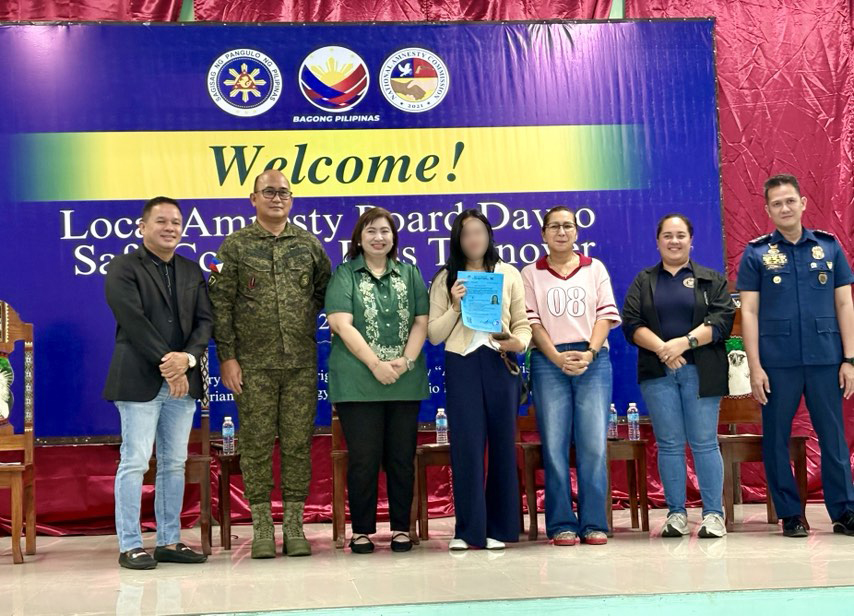
Today, that worldview has completely shattered. Sitting across from peace program officers in Davao City, Maui (real name withheld for security) holds a single, newly minted sheet of paper that has legally altered her trajectory: a Safe Conduct Pass (SCP).
“For me, it feels like we’ve been given a completely new life,” Maui said, her relief palpable. “We are free now. We don’t have to constantly worry about being arrested anymore. We finally have a document that proves we have returned to the folds of the law.”
Maui is just one of 87 former rebels who were formally awarded SCPs by the Local Amnesty Board (LAB) Davao during a ceremonial handover at the 1003rd Infantry Brigade.
For these returnees, the document is a critical legal shield, granting total immunity from arrest while their permanent, official amnesty applications are processed by the state.
The bait of education
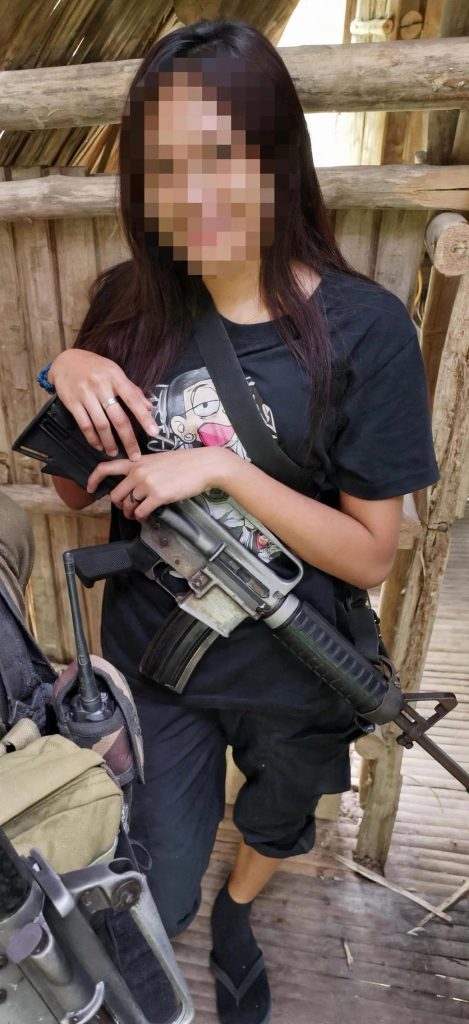
Maui’s descent into the underground armed struggle began in 2015. Like thousands of youth across far-flung, impoverished communities in Mindanao, she harbored a simple, urgent ambition: finish college and lift her family out of poverty.
When communist recruiters approached her, they didn’t just offer political ideology—they offered a way out. They promised to finance her education.
“They promised me that if I joined the movement, they would send me to school,” she recalled.
Instead, the promise turned out to be a tactical deception. Upon arriving in the mountains, she was never handed textbooks. Instead, she was handed a medical kit and a rifle. Thrust into the grueling, transient life of a combatant, she spent the next five years running from military operations while treating the casualties of conflict.
Motherhood under bombardment
The weight of the movement’s broken promises shifted from heavy to terrifying when Maui became a mother.
In 2019, seven months pregnant with her first child, she was forced to hike down the mountains to give birth in secret. Just two months later, she had to leave her newborn infant behind with relatives to report back to her unit in the field.
Her breaking point came during her second pregnancy. Six months pregnant and heavy with her child, her unit was caught in the crossfire of an intense military bombardment.
“Things change when you have a family already,” Maui said, recalling the sound of explosions ripping through the mountain silence. “You keep on thinking about going home. You start asking yourself: If I die today, who will raise my two kids?”
In December 2020, Maui was captured by government troops. Prepared for harsh treatment or retaliation, she was instead met with immediate medical care and safety. It was the turning point that permanently de-radicalized her. The soldiers she had been trained to hate became the very people who guaranteed her survival.
A new legacy
Because she possessed a clean legal record prior to her capture, Maui’s application was fast-tracked by the Office of the Presidential Adviser on Peace, Reconciliation and Unity (OPAPRU) and LAB-Davao.
While her transition has been smooth, her household remains in a delicate limbo; her husband’s SCP remains pending due to ongoing legal cases tied to his time in the underground.
Nevertheless, Maui says the immediate protection she holds has allowed them to step out of the shadows.
Now safely integrated into the civilian community of Asuncion, Davao del Norte, Maui is focused entirely on securing the one thing stolen from her 11 years ago: a proper education—not for herself, but for her children.
In a stark twist of irony, when asked what they want to be when they grow up, both of her young children eagerly state they want to enlist as soldiers.
“We do not discourage them because that is their prerogative,” Maui smiled. “We just want their perspective of the world to be different from what ours used to be.”
A warning to urban youth
Now working alongside peace advocacy groups, Maui is using her story to issue a stark warning to students in urban “white areas” who are actively targeted by legal fronts and underground recruiters.
While she emphasizes that expressing grievances through democratic means is a fundamental right, she urges the youth to recognize the line between activism and armed manipulation.
“It is okay to stand up for your rights and express your grievances through rallies; that is your right,” Maui stated firmly. “But please, do not let it reach the point where you take up arms against the government. Do not reach the point where we, as Filipinos, are killing one another. Life on the inside is incredibly bitter, and there is absolutely no future for you there.”