

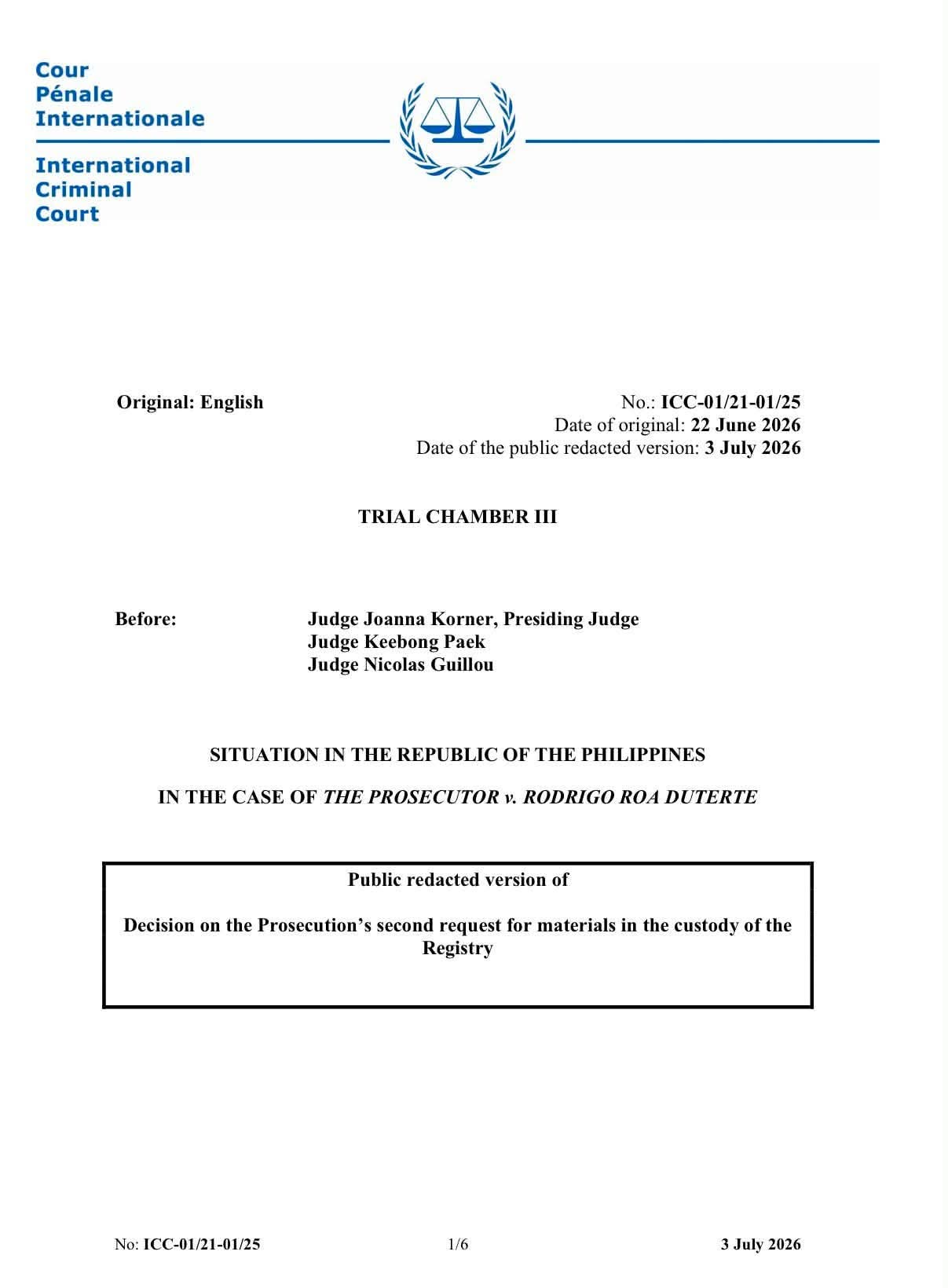
THE INTERNATIONAL Criminal Court (ICC) has partially checked the investigative powers of its own prosecution team, denying them access to personal keys seized from former President Rodrigo Roa Duterte during his arrest.
In a heavily redacted decision made public by Trial Chamber III, the panel of judges ruled that giving investigators blanket access to the keys was “neither necessary nor proportionate.”While the court permitted prosecutors to inspect other specified items seized during Duterte’s March 2025 arrest, it drew a firm boundary against what the defense team has criticized as a late-stage “fishing expedition.”
The legal clash intensified after the Prosecution filed its second request seeking an array of materials held by the ICC Registry, including “all keys” taken from the former president.
ICC Trial Chamber III—composed of Presiding Judge Joanna Korner, Judge Keebong Paek, and Judge Nicolas Guillou—reaffirmed that any evidentiary request must strictly satisfy the legal requirements of necessity and proportionality under the Rome Statute.
The judges blocked the sweep for the keys based on two major vulnerabilities in the prosecution’s motion:
- Failure of Substance: The Prosecution failed to identify exactly what the keys unlock or explain how those hidden materials could provide concrete evidence relevant to the crimes against humanity charges.
- Third-Party Privacy Threats: The Chamber validated arguments raised by lead defense counsel Peter Haynes, who noted that Duterte was traveling with family members at the time of his arrest.
The judges agreed that without a proper factual basis, turning over the keys could unjustifiably intrude upon the privacy rights of innocent third parties and relatives who are not accused in the case.
However, the ruling was not an entire loss for the prosecution. The court did approve access to two specific, redacted categories of materials held in the Registry’s inventory, finding “reasonable grounds to believe” those items could produce evidence necessary to the core investigation.
Signaling that it will not tolerate open-ended delays as the high-profile case marches toward its November 30, 2026, trial date, the Chamber slapped a strict retroactive deadline on the prosecution.
Acknowledging the defense’s structural concerns—and noting the prosecution’s own admissions of administrative delay—the judges ordered that any and all further requests for access to Registry-held materials must have been filed no later than June 30, 2026. The move signals to both teams that repeated, open-ended requests will not be entertained indefinitely.
Duterte remains detained at the ICC Detention Center in Scheveningen, The Hague, where he faces charges of crimes against humanity stemming from his administration’s controversial anti-drug campaign.
The court has scheduled a pivotal, mandatory-attendance status conference for September 7, 2026, which the former president is expected to attend personally ahead of the winter trial.