

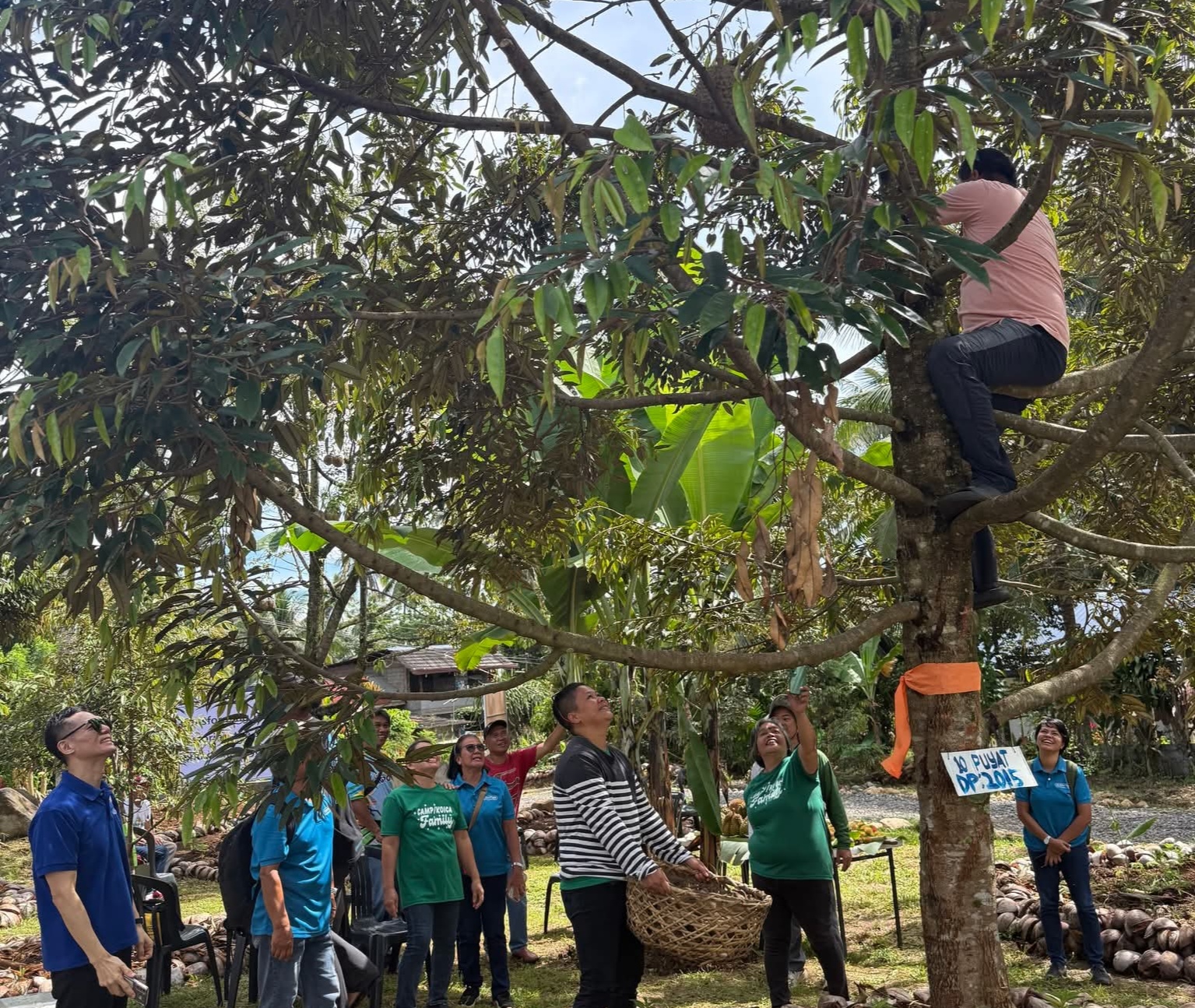
THE KOREAN non-government organization, Center for Asian Mission for the Poor (CAMP) Asia, partnered with Korea International Cooperation Agency (KOICA) to launch Phase 2 of the project that will boost the income of small-scale farmers from Davao City.
Titled “Income Enhancement of Farmers through Strengthening a Sustainable Agricultural Environment in Mindanao,” KOICA launched the project in 2023 with a total funding of approximately USD 740,000, supporting durian farmers in Tugbok and Calinan Districts of Davao City.
Roni Buenaventura, project director, said that the success of the first phase triggered the second stage, launched on Wednesday, May 6, in time for the observance of Farmers Month.
The project has led to the establishment of the Davao Mt. Apo Farmers Agriculture Cooperative (DAMAFACO), where beneficiaries now have access to facilities, including a consolidation center with cold storage, a transport vehicle, and marketing support for frozen durian products.
“DAMAFACO is the first cooperative for durian in Davao city, and they are into eco-friendly farming ngayon, and ang goal nila is mag produce ng organically grown na durian,” Buenaventura told TIMES.
Farmers were also trained in eco-friendly farming skills, pest and disease management, infrastructure support, and other capacity-building activities such as recording of production.
For the second phase of the project, KOICA has doubled its allocation to USD 1.5 million to scale organic production.
Buenaventura said phase 2 seeks to expand the cooperative’s footprint to over 300 farmers, covering at least 300 hectares across seven barangays.
Phase 1 covered 74 members and 100 hectares, focused exclusively on organic durian farming, distributed from barangays Wangan, Sirib, Tamayong, and Manuel Guianga.
While yield volume remained stable during the transition to organic farming, she noted a significant rise in farmer profitability due to reduced reliance on expensive chemical inputs.
“The yield didn’t necessarily increase dramatically yet because we were still in Phase 1, but what we saw in our survey was that the income increased,” she explained, noting the production costs of farmers went down.
Buenaventura said the farmers adopted their recommendation to move away from chemical fertilizers and instead apply organic fertilizer plus limestone.
The cooperative is also enforcing strict quality control by prioritizing local varieties like Puyat and D101 over foreign cultivars that have failed to adapt to the local climate.
Buenaventura said these efforts are part of a long-term strategy to meet the rigorous standards of international trade, which is targeting the South Korean market. At present, the market for the produced durian is limited in Davao City.
Beyond durian, the cooperative plans to diversify to include cacao, banana, coffee, and coconut, expanding its operations into the barangays of Kawayan and Subasta of Calinan district and Tagakpan of Tugbok.
Photo: KOICA