

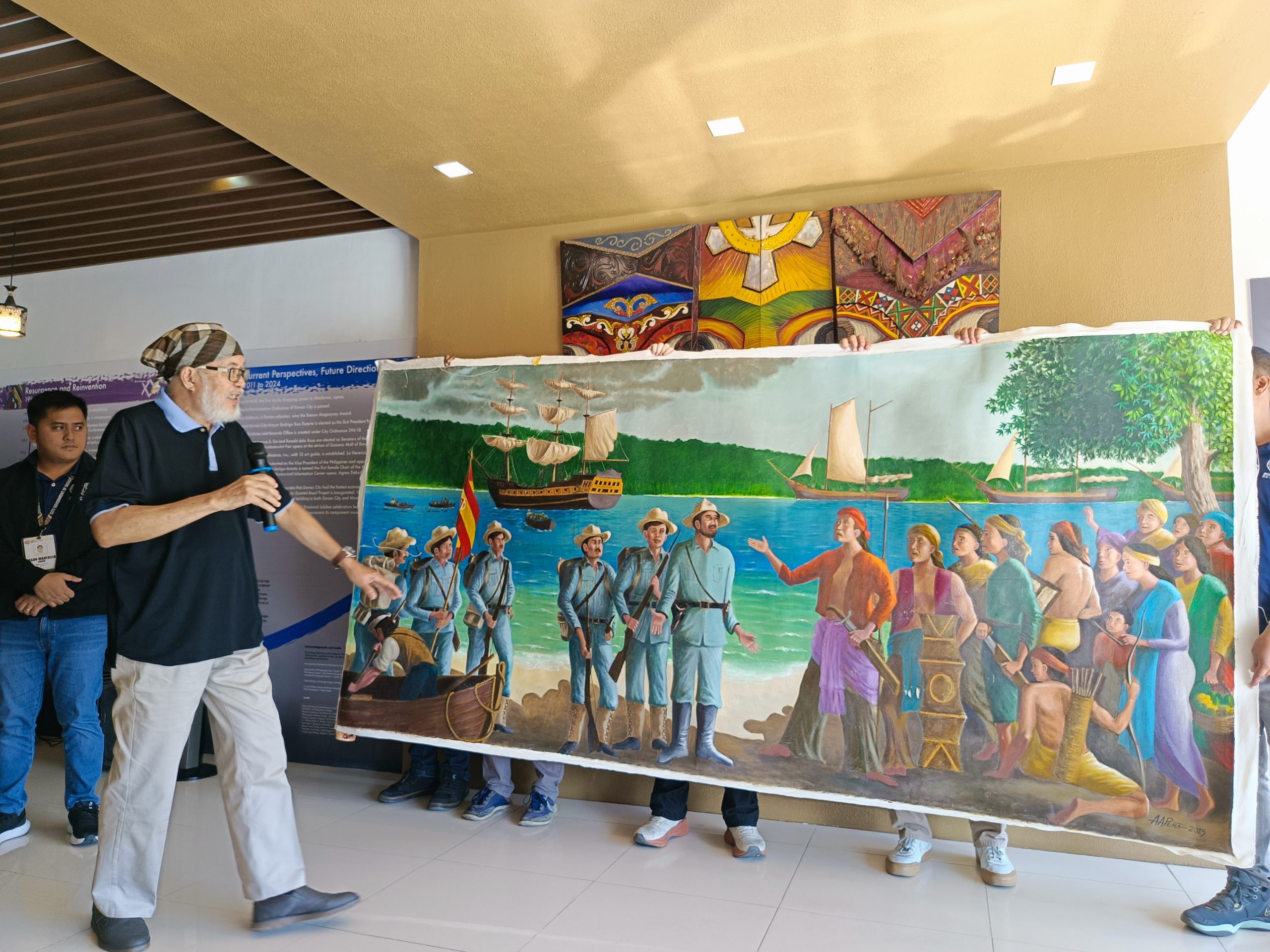
ARTIST and author Aurelio “Boy” Peña formally turned over two paintings to the Museo Dabawenyo on Tuesday, March 31, 2026.
The two oil-on-canvas works–”1848 Battle for Davao” and “Oyanguren Landing at Malipano Island”–immortalize significant moments in the early history of Davao.
The paintings were formally handed over by Pilar C. Braga, chairperson of the Datu Bago Awardees Organization Inc. (DBAOI), together with Peña, and received by Jason Arceo, Museo Dabawenyo OIC.
Peña said the “1848 Battle for Davao” painting illustrates the historic battle in Bucana, at the mouth of the river, which is in present-day Bankerohan, where the forces of Datu Bago defended the area against Spanish forces led by Don José Oyanguren.
Meanwhile, the “Oyanguren Landing at Malipano Island” portrays Don Jose Oyanguren’s landing at Malipano Island in Island Garden City of Samal, where he sought support from Datu Daupan, the tribal leader of Samales, to fight against Moro warriors led by Datu Bago.
Karina Lazarraga, one of the founders of 1848 Group, said this was the product of the advocacy of the group.
“We are a collective of advocates, and we really want to promote the history, the rich culture and heritage of Davao City, and how do we do that, is through storytelling, revisiting our landmarks and really also questioning the narratives that we see,” she said in her message in the ceremony.
Lazarraga said some of the markers for landmarks in the city are not visible or are placed somewhere else.
She cited, for example, the corner of San Pedro Extension and Piapi marked as “Oyangoren landing,” which is “actually wrong.”
“Who are we really as Dabawenyos? We have to really go back and honor the sacrifices made by Datu Bago and the pioneer settler families, and many more,” she stressed.
The paintings were originally gifted by Peña to Braga, but the latter deemed it most fitting to donate the artworks to the Museo Dabawenyo, where they can be appreciated by a wider audience.
Braga told TIMES the next project is the ocular inspection of Malipano Island and review of the historical landmarks of the city.
“We will check, mga minor lang na mali para maayos, and to make sure they are properly situated, kasi natabunan na, walang alaga. Siguro that’s one of the things the city government can do, especially the Office of the Culture and Arts,” Braga said.
She noted the importance of a collective effort of different groups, such as Datu Bago and the Davao Historical Society, to work together “not for personal agendas.”
Arceo said the inclusion of the paintings in the Museo Dabawenyo ensures that these visual accounts of history will be preserved and made accessible to the public. The paintings will be put up for exhibition once approved by the Museo Advisory Board.
The office is looking into placing them on the 5th floor of the National Museum of the Philippines- Davao, inside People’s Park, or in the changing gallery in the Museo Dabawenyo Events Center along Mabini Street.