
BY ALEX ALAGON

BY ALEX ALAGON

AN up-the-ladder level politician who is a harsh critic of the national administration is intriguingly silent in regards to the current issue of corruption in the implementation of infrastructure projects, especially those for flood control.
In the current controversial issue several congressmen are literally dragged into the vortex because they are believed to be the true owners of construction companies. Only, their ownership is hidden through deception with other people’s name listed as owners.
Also, the congressmen are the ones proposing the project, with most of these provided bloated budgets, and are only given the go-signal to implement if the implementation is given to their favored contractors. More so if the contractors concerned are close relatives, their dummies, or big contributors to their campaign kitty.
But this politician, despite being a known critic of President Ferdinand R. Marcos, Jr., seems evasive in manifesting a take on the corruption-laden anti-flood control projects. What could possibly be the reason for keeping such a demeanor?
From where we are perched, we can see some smoke emitting somewhere, providing us with what could be the answer to our query.
Yes, we believe that the politician is simply showing the shrewdness that will help in ensuring the insulation of the said politician’s family business, which is construction, and its having cornered most of the infrastructure projects in the area where the politician comes from.
Indeed this politician appears to have mastered the art of politics. That is, some brakes must be applied when getting involved in certain issues could possibly jeopardize one’s interests. In the case of this politician, joining in the fray may unnecessarily put the family construction business on the line.
So this politician wisely prefers to be silent and stay away from any possible risk to the family enterprise.
After all, it is common knowledge that the politician’s family’s construction firm had been devouring contracts from both the national and local governments, more abundantly years back.
But there is one thing good about this politician’s family-owned construction firm. What we heard from sources known familiar with the ways of the politician’s family, it is giving out to the congressman or local official project sponsors a total of 30 percent of the won bid price.
Of the 30 percent, 15 percent goes to the congressman or the top local government project sponsor, and the remaining 15% is apportioned accordingly, depending on one official’s role in the facilitation of processing the papers needed for easy collection of payments.
Indeed, this politician’s decision to keep himself silent in the hotly discussed issue of unfinished, substandard, and even ghost anti-flood control projects is one move that the politician could have learned from the “master” that the politician had been serving with dog-like loyalty.
Surely, that is one wise move that others need to emulate if they are intending to remain in the public service for long while keeping a distance from being discovered for certain weaknesses.
*********************************
So, it is not true that there are illegal Philippine offshore Gaming Operations (POGO) hubs in Davao City? This is what Davao City Acting Mayor Sebastian “Baste” Duterte would want Davaoeños – and possibly all the Filipinos – to believe.
Of course, we can understand the acting mayor. After all, the issue of POGOs cannot escape being connected to the administration of his father, former President Rodrigo Duterte, who was President when POGOs were dominating the landscape of gambling operations in the country, with aficionados doing their wagering from other countries, specifically China. The Chinese, though, are known to have initiated the POGOs in the country with approval by the Philippine government done through the Philippine Amusement and Gaming Corp. (PAGCOR).
When some of the POGOs diversifying their operation into scamming, cybersex, and other criminal activities, the effects on the Philippine society started getting intolerable. And that was when the clamor to ban the POGOs in the country started rolling.
Despite the ban made official during the President’s 3rd State of the Nation Address, and compliance by the concerned establishments set by the end of December 2024, some splinters of POGOs started relocating and operating clandestinely.
There were those apprehended in Cebu; then in Panabo, Davao del Norte; and lately in a residential building inside a posh subdivision in Buhangin, Davao City.
Acting Mayor Baste, though, appears unconvinced that it was a POGO thing that was busted in the city. Rather, he believes, that it could be another scheme, but the buster law agents prefer to call the operation of the arrested individuals, which includes Chinese nationals as another relocated illegally operating POGO.
And it is all because of the obsession of certain political groups identified with the national administration as one convenient way of discrediting his former President father, Baste suspects.
But of course, the raiding lawmen from the National Bureau of Investigation (NBI) are fixated on their claim that all attributes set up and confiscated from the house that was raided, with information provided by residents, point to the operation as that of a POGO hub.
So, who is going to settle the issue on whether or not there was or is a POGO hub relocating in Davao City?

I must have heard it spoken by grownups during the whole length of my childhood. Sometimes uttered in regret, sometimes in jest (as though they were witnessing a completely unique attribute by us) and lastly said in exasperation and surrender. In the varying degrees of separation, family members and closer relatives might articulate it in a more direct manner and passionately too, while strangers and acquaintances tend to be more civil and empathetic. Whether out loud or in whispers, spanning generations of countless elders which include our parents, these collective grownups ask the same thing. What’s wrong with the kids of today?
In an earlier recollection, a college teacher and friend of mine once confided, what was she to do with her niece who was apparently undergoing the confusing emotions tied with adolescence, all the while forgetting I too was only several years ahead of her ward.
“The jury is still not out on what’s behind the whys of what’s wrong with those younger than we.
One thing is sure though, as Mike & The Mechanics succinctly put it: every generation blames the one before….”
Though I must admit, being privy to such grownup chat may have been a bit flattering at the time, I was already aware that wasn’t the first time I heard it. Even during our college days, our mother sometimes conferred with us regarding our younger siblings. Much later, t’was as if there was a seamless transition, the employee years saw the same thing happening. Same question, different sets of people, involving different generations.
At the present time, nothing much has changed. It’s still being asked today, except the reality is, I have become one of those who are doing the asking. At this, I’m already wondering, does it even need to be answered? Is it just part of our nature to ask it, the way our parents and those before them have repeated the process, as though repeating this age-old query was a part of some odd tradition? Is there some secret context involved that I still have to discover?
I recall when my younger son was in high-school. The father of his class mate had asked me, how come my son and his peers so sensitive, unlike us and others from our generation? They’re so quick to sulk but fast at being critical of old ways, I remember him saying. Last night, a friend again posed a similar observation. And I thought, just another circle game, as Joni might have put it.
While already some may have placed an official tag on it as being a generational issue, I, like a few still maintain, the jury is still not out on what’s behind the whys of what’s wrong with those younger than we. One thing is sure though, as Mike & The Mechanics succinctly put it: every generation blames the one before….

Phoenix Petroleum Philippines, Inc. and V-Green Charging Station Development Philippines, Inc. recently signed a strategic partnership to install electric vehicle (EV) chargers at strategic Phoenix stations nationwide, making Phoenix the first fuel company in the Philippines to collaborate with V-Green in expanding the country’s EV infrastructure.
Under the agreement, Phoenix will lease designated station spaces to V-Green for EV charger deployment. Three Phoenix station sites in Luzon are already under construction, with site visits for Cebu and Davao scheduled as part of the next phase.
The collaboration aims to accelerate the adoption of clean and sustainable transportation in the Philippines, enabling more VinFast customers to access convenient charging points and supporting Green GSM’s rapidly growing EV taxi fleet.
“This is more than just a contract signing—it’s the beginning of a meaningful partnership,” said Kim Ira Cabaccang, General Manager for One Retail of Phoenix Petroleum. “We are proud to work with V-Green to enable more sustainable transport solutions. This move reflects our dual-energy approach, combining traditional fuels with emerging clean technologies to meet the evolving needs of Filipino commuters.”
“Our mission has always been to make green mobility accessible, scalable, and impactful,” said Luu Viet Hung, CEO of V-Green Philippines. “Partnering with Phoenix allows us to reach even more communities and build a nationwide charging network that supports our growing EV fleet.”
The partnership reflects Phoenix’s commitment to sustainability and its role in shaping the energy transition in the Philippines. Together, Phoenix and V-Green aim to create a future where mobility is both efficient and environmentally responsible.
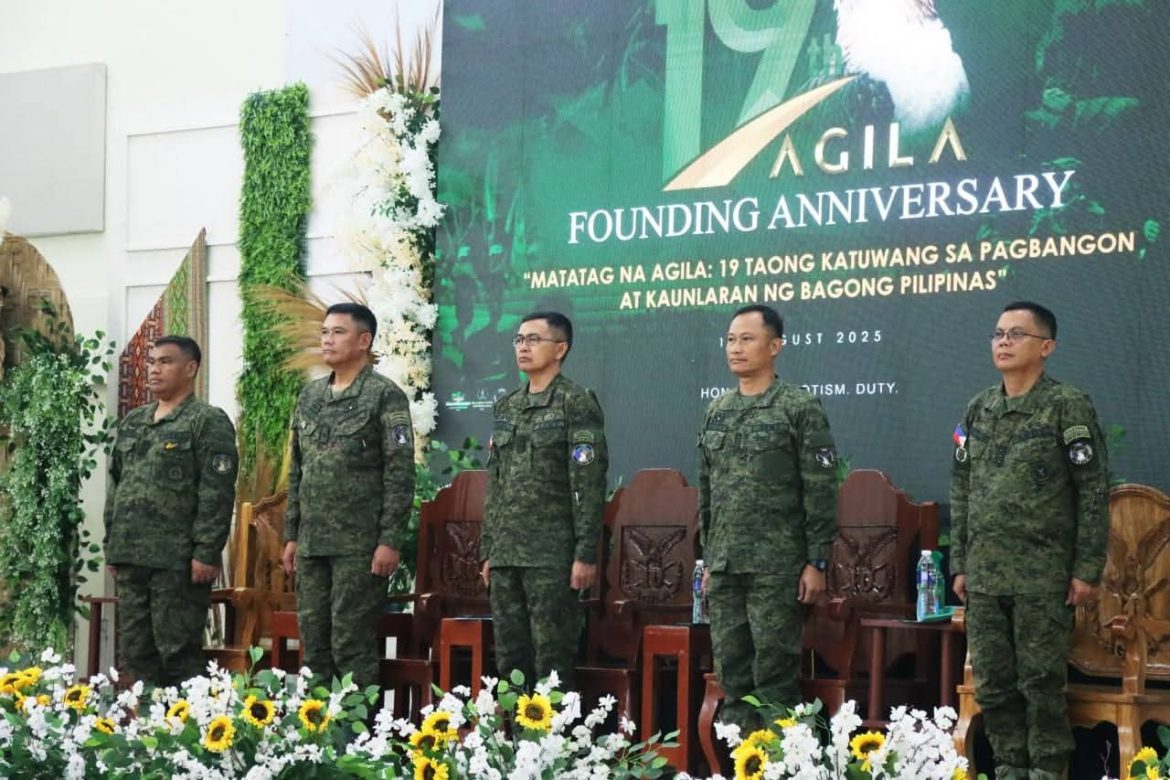
10TH INFANTRY Division commander Major General Allan Hambala highlighted the successful military operations and the declaration of several insurgency-free areas during the division’s 19th Founding Anniversary on Aug. 16, 2025, with a ceremony at Camp General Manuel T. Yan Sr.
The event honored the division’s achievements and paid tribute to its personnel and fallen soldiers.
The commemoration began with a mass, followed by a wreath-laying ceremony led by Major General Allan Hambala, Commander of the Agila Division.
The highlight of the celebration was an awarding ceremony that recognized the exceptional performance of both individual soldiers and military units for their dedication in combat and administrative duties.
In his address, Maj. Gen. Hambala stated that 2025 stands as a “testament to 10ID’s greatness and excellence,” citing the successful operations against the remnants of the Southern Mindanao Regional Committee (SMRC).
He announced that there are no remaining NPA units within the 10ID’s joint operational area, a victory attributed to the Whole-of-Nation Approach under the National Task Force to End Local Communist Armed Conflict (NTF-ELCAC).
The division’s success has led to the declaration of several insurgency-free areas, including the entire Davao Region, the province of Cotabato, and eight municipalities in Bukidnon.
Since 2023, the Agila Division has neutralized 1,304 Communist Terrorist Group (CTG) members and recovered 543 firearms.
Maj. Gen. Hambala also noted the crucial role of collaboration with other security sectors, which led to the apprehension of key NPA leaders, including Porferio Tuna Jr., Ruel Villanueva Cabales, Catherine Apares Guinoo, and Charisse Bernadine Bañez.
These arrests, he said, effectively crippled the leadership structure of the SMRC.”
Behind these visible victories are the contributions of every Agila Trooper,” Maj. Gen. Hambala stated, commending his troops for their “dedication, expertise, and unrelenting support.”
Photo courtesy of 10th ID
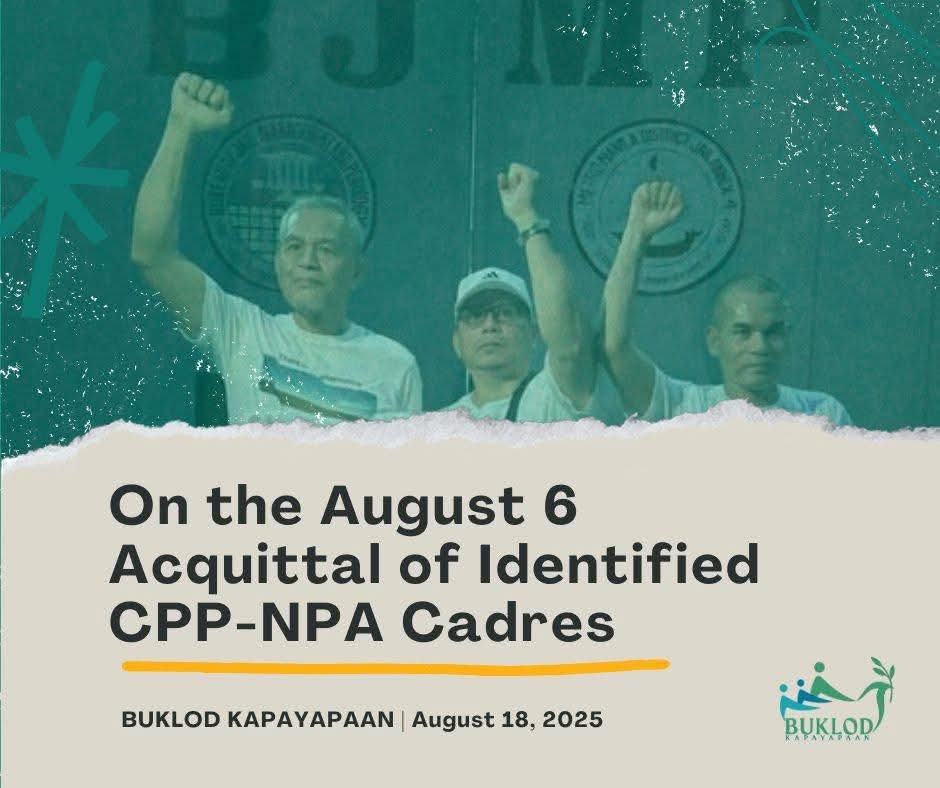
BUKLOD Kapayapaan, a national federation of former members of the Communist Party of the Philippines-New People’s Army (CPP-NPA), was dismayed by the recent acquittal and release of several individuals they identify as leaders and cadres of the armed movement.
In a Facebook post on Aug. 18 by Arian Jane Ramos, national spokesperson, the group highlighted the potential impact of the court’s decision on peacebuilding efforts and public trust in the justice system.
The statement specifically addressed the acquittal of Central Committee members Tirso Alcantara and Renante Gamara, along with Dionisio Almonte, Diony Borre, and Raul Razo.
While acknowledging the independence of the judiciary, Buklod Kapayapaan asserted that these individuals are known to them through their “firsthand experience with the structure, operations, and strategies of the CPP-NPA.”
Gamara, Borre, and Razo were released on Aug. 14, 2025, while Almonte remains in custody and Alcantara is at large.
The five individuals, along with 32 others, were charged in connection with a 2007 case that included the abduction and killing of a soldier in Mauban, Quezon.
Buklod Kapayapaan claimed that Alcantara and Gamara should be held responsible for numerous crimes under the doctrine of command responsibility, citing documented cases of children involved in armed conflict and the willful killings of civilians.
The organization warned that the court’s decision “undermines the message we bring to communities that choosing the path of peace, truth, and accountability remains the right and just course.”
The group noted the painful reality that many former rebels who have surrendered still face legal cases, while their “unrepentant former leaders are the ones who are walking free.”
Buklod Kapayapaan concluded its statement by urging the government and the judiciary to ensure that legal outcomes are aligned with the goals of reconciliation, public trust, and national security, stating that “peace without justice and accountability is fragile and will, ultimately, be unsustainable.”
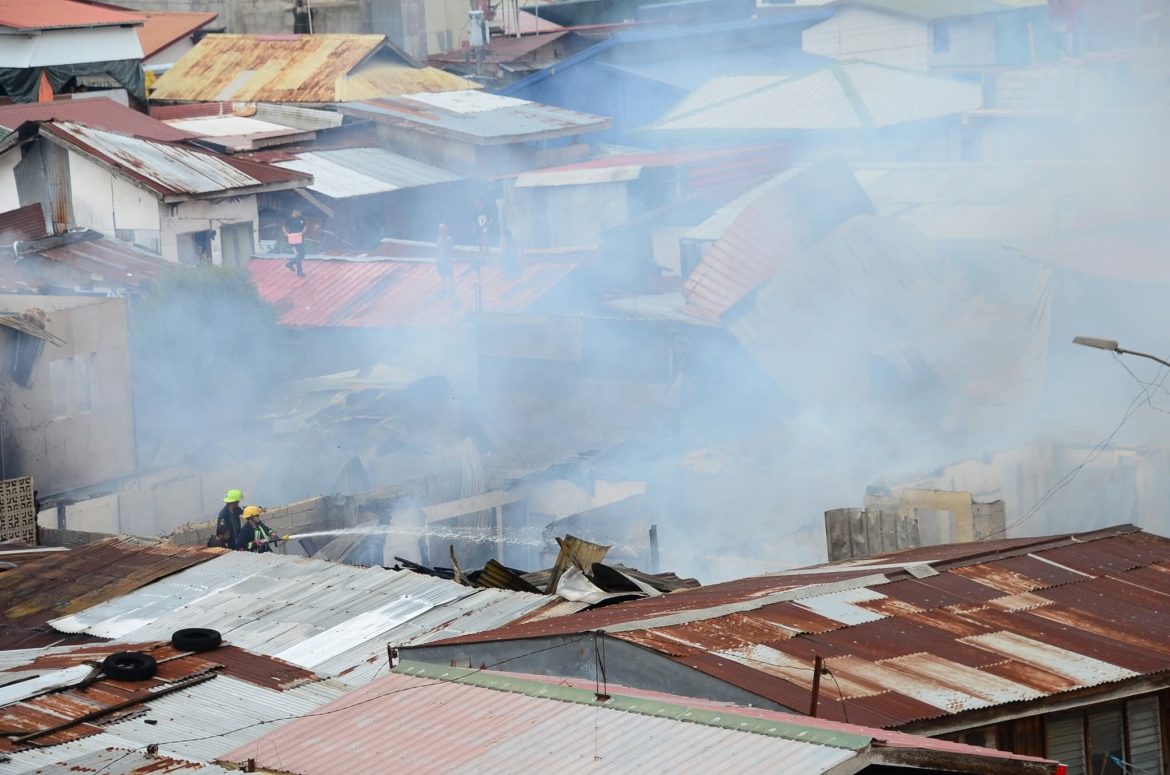
A RESIDENTIAL fire in Purok San Isidro, Barangay Agdao Proper, displaced 70 families on the afternoon of Aug. 18, 2025.
According to the Bureau of Fire and Protection XI’s report, the fire was reported at 1:06 p.m. and quickly escalated, reaching a second alarm at 1:40 p.m.
The Bureau of Fire Protection (BFP) responded with three fire trucks from the Charlie, Lanang, and SPMC fire stations.
They were supported by more than eight auxiliary units from groups including Davao Raven, Davao Volunteer Fire Brigade, and Central 911. Firefighters were able to control the blaze at 2:31 p.m. before declaring a “fire out” at 3:39 p.m.
The affected area is estimated to be around 1,000 square meters, the report said.
Rescue and medical teams, including two ambulances from Luigi and the Philippine Red Cross, were also on site. Despite the extensive damage, authorities confirmed that there were no reported casualties, injuries, fatalities, or missing persons.
The estimated damage to property is more or less ₱1,500,000.

DAVAO City Police Office chief Pcol. Mannan Muarip pushed to add imprisonment as a penalty for liquor ban violations to deter non-compliance.
Muarip paid a visit to the 21st City Council on Tuesday, Aug. 19, to report on the accomplishments of the DCPO after assuming office on July 16 until the present.
The move to amend the liquor ban was motivated by the data, which revealed that 34 liquor-related violent cases were recorded from January to August this year, equivalent to the total liquor-related incidents for the entire 2024.
Muarip hoped that imprisonment would put fear into the hearts of violators.
“Kasi kung fine lang, sa una siguro sumusunod sila sa fine. But along the way, hindi na sila magbabayad kasi alam nilang wala namang mangyayari,” Muarip said.
“Without the imprisonment penalty, kahit ano ang gagawin ng kapulisan, ang mga tao hindi magtatanda,” he added.
According to police data, liquor-related crimes occur mostly inside residences (17), on the street (10 incidents), and in business establishments (7). Most cases involved mauling/punching (14), stabbing (9), hacking (5), hitting with a hard object (3), and shooting (3).
Meanwhile, for January to August this year, most of the incidents occurred inside private homes (20), on the street (12), and in business establishments (2). Stabbing and hacking comprised 20 incidents, mauling and punching with seven incidents, and two incidents each of shooting and hitting with a hard object.
Asked about the proposed duration of imprisonment, he proposed a minimum of six months for first-time offenders. Once caught, the offender will be brought to the police station for an inquest.
Muarip added that he will also push for imprisonment for urination in public places and for being half-naked in public areas. The police chief is set to meet with Councilor Luna Acosta, the committee chair on peace and public safety, to discuss his recommendations.
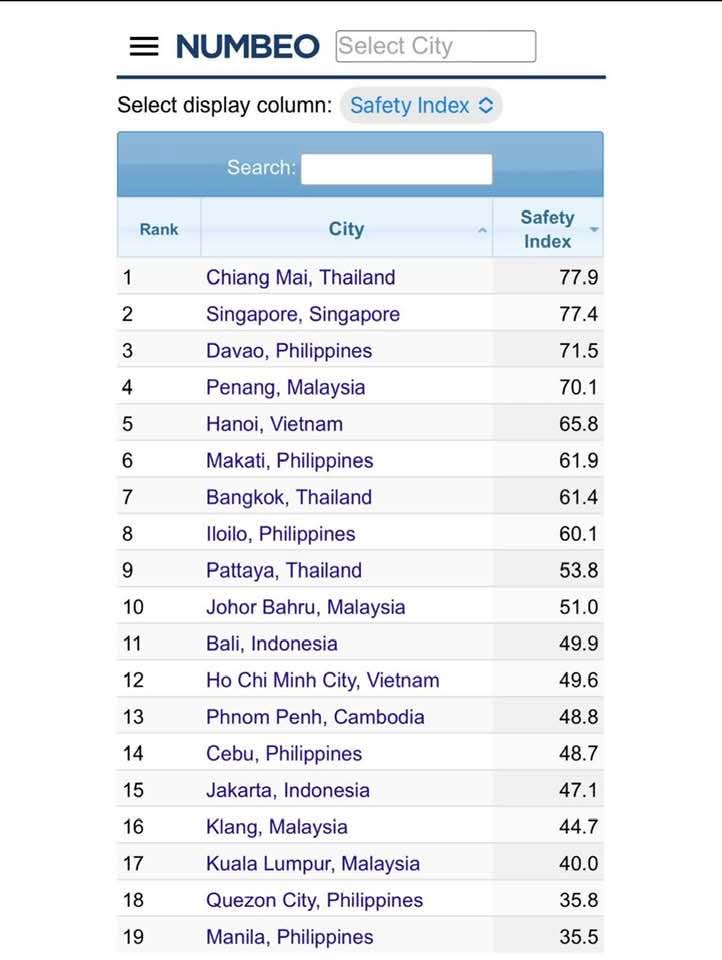
THE CITY police director expressed pride over the recent recognition of Davao City as the third safest in Southeast Asia. with a notable score of 71.5, according to the Numbeo Safety Index 2025.
Col Mannan Muarip said the recognition highlighted Davao City’s long-standing reputation as a safe and secure community—an outcome of the united efforts of law enforcement and the active participation of its citizens.
The Safety Index considers reported crime rates, police efficiency, and residents’ sense of security in daily life as metrics to tabulate the overall score.
The data, which reflects the city’s safety index score of 71.5, places it behind only Chiang Mai, Thailand, and Singapore, Singapore.
A higher index score indicates a safer city.
According to the same data, other major Philippine cities also appeared on the list but ranked lower, with Iloilo City at 8th and Manila at 19th.
Numbeo only includes cities with a sufficient number of contributors, making Davao City’s placement both a reflection of public perception and a confirmation of its peace and order situation.
He attributed this recognition to a holistic and proactive approach—including community involvement, extensive surveillance systems, and sustained monitoring programs—implemented in line with Philippine National Police (PNP) directives.
Muarip emphasized that the recognition is not solely a victory for the police force but a shared success of every resident.

SAMSUNG Philippines held its first exclusive unveiling in Mindanao on Aug. 19 for a line-up of AI-driven home living products featuring smart technology, personalized home experience, and seamless assistance.
Smart appliances ranging from refrigerators, washing machines, microwaves, to air conditioners are all integrated with AI technology, offering users optimizations for each product, and efficient energy.
The launch introduced Samsung’s ‘SmartThings’ app to connect and monitor smart devices more easily via mobile phone or tablet.


One of the company’s featured products ‘360 Cassette’, a circular and bladeless ceiling air conditioner, provides 360-degree cooling with 25% more airflow and wider reach and consumes 55% less energy by its ‘WindFree’ efficient chill.

In an interview, Ramon Antonio Medina, Samsung’s head of division for home appliances, said their smart home appliances market penetration rate in Mindanao is quite low for now.
“We need to be able to educate consumers. Actually, the AI functionality of our appliances, we started to introduce it about two years ago. And then every year, we’re trying to introduce more and more products,” he said.
He added that the company’s vision is for AI to be present in most appliances since it offers a wide range of products from high to mid-range. Samsung will also lead in terms of AI innovations in smart home integration.