

MANILA – Southeast Asia is moving further into technology-enabled living, but a new regional study finds that consumer trust is becoming more conditional: the technology categories that carry the highest stakes earn the strongest trust but also face the sharpest consequences when that trust is broken.
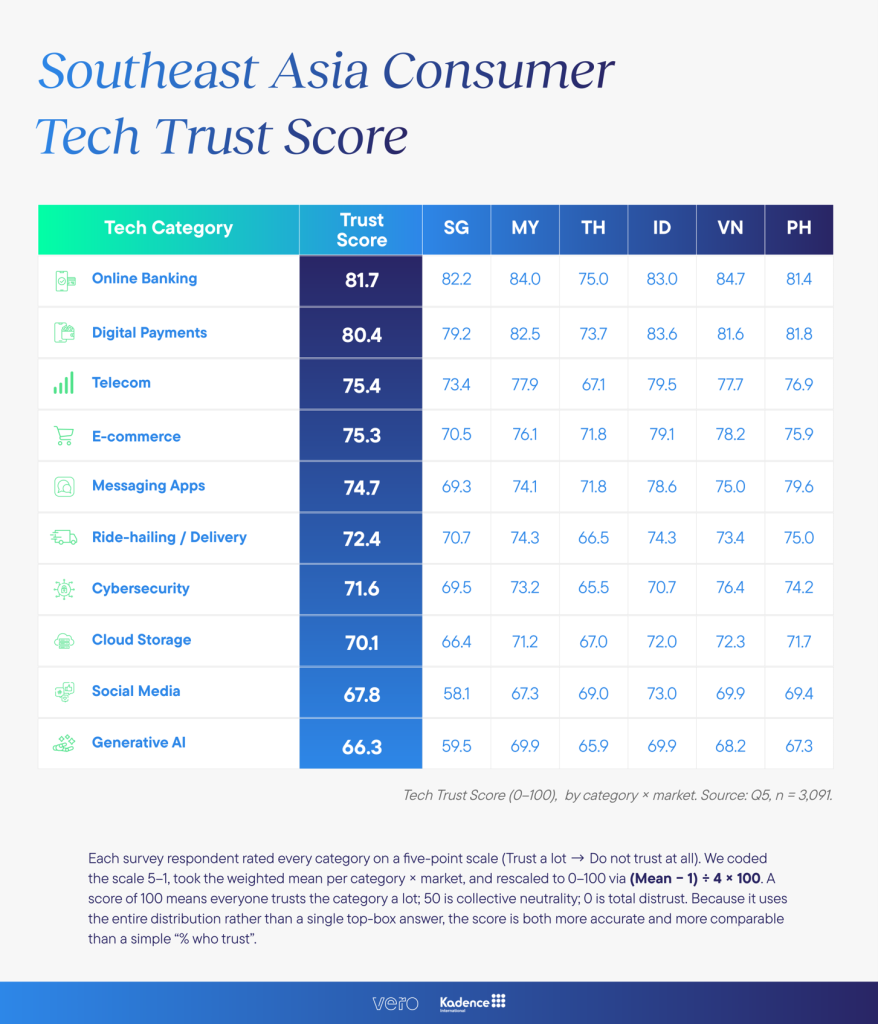
Online banking and digital payments are the most trusted categories in the region, with trust scores averaging 81.7 and 80.4, respectively. Yet more than half of consumers say they would be quickest to abandon these tech services after a serious incident.
This pattern cuts across markets, gender, and age, providing a clear signal of a shared consumer expectation that when technology handles money and personal data, trust must be protected continuously.
The Southeast Asia Consumer Tech Trust Score, a collaborative study by Vero and Kadence International, examines the levels of trust consumers place in ten tech categories: cloud storage, cybersecurity, e-commerce, digital payments, generative AI, messaging apps, online banking, ride-hailing / delivery, social media, telecom. The insights are drawn from an online survey conducted among more than 3,000 consumers across Indonesia, Malaysia, the Philippines, Singapore, Thailand, and Vietnam.
At the heart of the study are category Trust Scores that offer a comparative view of Southeast Asia’s digital ecosystem. Financial technology services, supported by clearer regulation and visible security expectations, emerge as some of the most trusted categories. Telecom, e-commerce, messaging apps, ride-hailing, and cybersecurity form a broad, stable middle– habitual services where trust is solid but not reverential. Social media, despite being among the most frequently used, sits lower in consumer trust. Meanwhile, generative AI has the lowest or second-lowest Trust Score across all markets surveyed, indicating that the newest technology carries the lowest earned trust.
“Trust is probably the single most important indicator of success and the key ingredient for sustainable growth in any sector, but more so in technology,” said Konwika Fikaew, vice president for tech comms at Vero. “This Tech Trust Score comes at a critical time for both tech brands and consumers, when adoption is accelerating at an exciting pace and confidence is tested at a deeper level. This offers a very clear view of where trust is strongest and where it trails, which brands, governments, and consumers can use to make better decisions about how technology is built, regulated, and used.”
Serious data breach poses a reputation risk
As technology becomes more deeply embedded into daily life, brands, tools, and platforms are no longer expected to offer mere convenience, but also security and protection. The survey results reveal that 49.5% of respondents rank personal data misuse as their top concern. However, online scams and fraud are the most widely shared concern across all markets, appearing in the top three for 79% of total respondents.
Consumers show near-zero tolerance to these serious incidents, with 42% saying they would stop using the tech brand or platform immediately. This cautious approach is particularly strong among consumers in the Philippines (56%), Malaysia (50%), and Singapore (48%). Meanwhile, a majority of Indonesian (54%) and Vietnamese (49%) respondents are willing to give companies a second chance, only pausing their use until the issue has been resolved. Thailand is the least reactive market in the study, with only 30% of respondents quitting the platform immediately. Across all markets surveyed, only 3% say they would continue as normal.
“One of the patterns we’ve observed in the Philippines is that consumers are becoming more discerning about the technology they choose to engage with,” said Lisa San Buenaventura, PR senior account manager at Vero. “While adoption remains high, people are paying closer attention to the signals that build confidence: from transparency and accountability to how organizations safeguard the interests of their users. As technology becomes more embedded in everyday life, consumers expect the same level of trustworthiness they would from the institutions and services they rely on daily. Ultimately, trust is becoming a key factor in how lasting relationships between brands and consumers are built.”
These reactions are especially critical for online banking and digital payment brands. Respondents in Indonesia (42% online banking, 25% digital payments) and Malaysia (40% online banking, 20% digital payments) consistently show the strongest pullback against financial apps during scam, leak, or service failure. Social media platforms are also vulnerable, especially in Vietnam (25%) and Thailand (19%), where consumers show a stronger likelihood of stopping use after a serious incident. By contrast, telecom services show the slowest withdrawal response at just 2% in total, likely because the category is harder to abandon and remains essential for communication, work, and access to other services.
While consumers regionwide demand the greatest accountability from the company’s CEO/founder during moments of failure (33%), they are the least trusted voices to explain what went wrong. This does not mean that company communication is unimportant – only that it is not enough to move the needle on trust once it is lost. Independent cybersecurity experts are the most-trusted post-incident voice in four markets, overwhelmingly so in Indonesia (51%) and Vietnam (44%). Singapore is the only market where government is the most trusted post-incident source at 43%.
Trust hinges on data protection, regulation, and accountability
When asked for the strongest proof that a tech company can be trusted, respondents split across three pillars: regulatory compliance, track record, and transparency.
Government approval and compliance are considered the strongest proof of trust among respondents in Singapore (36%), Malaysia (28%), and the Philippines (23%). Established laws, formal approvals, and compliance rules are designed to protect consumers and are therefore seen as standards for deeper trust by these markets. Indonesia is the outlier, with a majority (43%) of respondents there seeing a proven track record as a signal of a trustworthy tech brand. For consumers in Thailand and Vietnam, nothing outweighs clear, plain-language data-use explanations, selected by 26% of respondents in both markets.
“This study reveals how critical government approval and regulatory compliance have become to building trust between consumers and tech brands,” said Pongsiri Poorintanachote, managing partner at Vero Advocacy. “Regulatory obligations are often seen as an operational burden, but this data suggests they can do more: they make a company’s sense of accountability visible to consumers. In markets where people are actively looking for proof points of trust, that visibility is what earns credibility and reduces friction.”
High tech usage does not equal high trust
The study also finds a pronounced pattern among consumers in the region: high usage does not mean high trust. In an increasingly digitized world, people may continue using certain tools, platforms, and systems because they are convenient, habitual, or difficult to avoid.
This gap is particularly visible in social media, which is used by 79% of consumers – well above the ~38% regional category average – but ranks lowest or second-lowest in the Trust Scores across all markets, averaging at 67.8. In contrast, telecom, e-commerce, ride-hailing, cybersecurity, and cloud storage are categories where trust outruns usage. Meanwhile, online banking and digital payments see above-average usage, while also ranking highest on trust.
“Usage is an important signal, but it is not a complete measure of trust,” noted Ashutosh Awasthi, director at Kadence International. “The trust-usage gap reveals a more complex consumer relationship with technology. This gives brands a more demanding brief: they need to understand not only how often consumers use a product, but what level of confidence sits behind that behavior. To ensure sustained growth, brands need to make consumers feel confident enough to keep relying on the product when expectations, risks, or alternatives change.”
The insights in this study point to the growing importance of moving beyond awareness and usage in technology. For brands, the challenge is to build the signals that make consumers feel protected, informed, and confident. For regulators, the task is to make safeguards visible and enforceable to give consumers confidence that tech companies are being held to the highest standards of responsibility.
To learn more, access the full report for free on the Vero website.