



BY ALEX ALAGON

BY ALEX ALAGON

A 31-YEAR-OLD construction worker is facing a prison sentence after he allegedly molested a six-year-old girl in Barangay 23-C, Isla Verde, on Wednesday afternoon, Jan. 14.
The suspect, identified by police only as Russel, a resident of the same barangay, was apprehended by responding officers from Mobile 15 and turned over to the local police station for inquest proceedings.
The incident occurred at approximately 1:30 p.m. in Purok 3-D Barangay 23-C. The incident caused trauma to the Kinder 2 student, according to the mother who immediately sought police assistance.
Upon his turnover to the police, investigators noted that the suspect had visible injuries, which was reportedly caused by a bystander who struck him before the authorities arrived.
The suspect has been charged with acts of lasciviousness in relation to Republic Act 7610 (Special Protection of Children Against Abuse, Exploitation, and Discrimination Act). The case has been filed through inquest proceedings (IS No. XI-02-INQ-26-A-0172).
Meanwhile, the young victim was brought to the Southern Philippines Medical Center for a mandatory psychological evaluation and intervention.
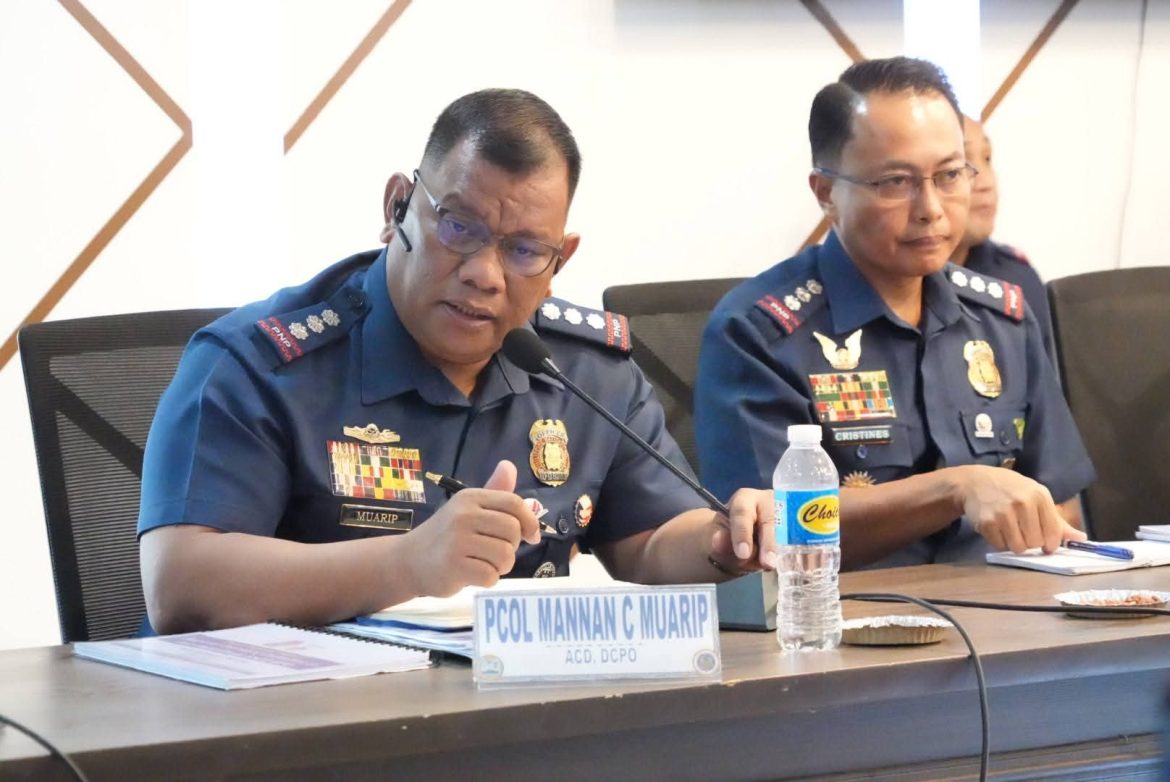
THE DAVAO City Police Office (DCPO) intensified its crackdown on crime over the past week, resulting in the arrest of 107 individuals across various operations from Jan. 11 to 17.
Acting city director Col. Mannan C. Muarip said police arrested 51 suspects in 46 anti-drug operations in the same period. They seized 102.7 grams of shabu and 5.62 grams of marijuana, with a combined street value of approximately ₱699,000.
In the campaign to bring in fugitives, DCPO apprehended 44 individuals, with 30 of them classified as most wanted persons.
For illegal gambling, six operations led to the arrest of 10 individuals and the filing of five formal cases. Finally, police recovered seven guns through “Oplan Katok” and active law enforcement against loose firearms.
Two suspects were arrested in connection with illegal possession, while others were surrendered or turned in for safekeeping.
“These achievements reflect not only the dedication of our personnel but also the active support of the community,” he said.

THE NAVAL Forces Eastern Mindanao (NFEM) intercepted a motorboat carrying ₱44 million worth of undocumented cigarettes off the coast of Pantukan, Davao de Oro, around 7:40 p.m. on Thursday, Jan. 15.
The operation was carried out by BA491 of the 3rd Boat Attack Division, which is under the operational control of Naval Task Force 71. Operatives used a Mini-Typhoon MGS camera system to spot a suspicious vessel, later identified as M/B QAISAR , moving three nautical miles northwest of Pantukan.
The camera footage revealed a large cargo covered in canvas, prompting an immediate interception.
Upon boarding the vessel, the Navy discovered 1,118 boxes of undocumented cigarettes. The 13 Filipino crew members onboard were detained.
During the initial investigation, the vessel’s master admitted that the shipment originated from Jolo, Sulu. The plan was to offload the contraband onto smaller motor bancas at sea to be smuggled into various municipalities in Davao de Oro and surrounding areas.
This “mother ship” to “small craft” transfer is a common tactic used by smuggling syndicates to evade detection at major ports, the Navy said.
Following the seizure, the Navy’s Special Operations Unit 7 (NAVSOU7) placed a “prize crew” on the M/B QAISAR to escort it to the Captain Feranil Pier at Naval Station Felix Apolinario in Panacan, Davao City.
All 13 crew members were brought to Camp Panacan Station Hospital for mandatory medical evaluation before facing a charge for violations of Republic Act No. 10863 (Customs Modernization and Tariff Act) and Executive Order No. 245. Meanwhile, the contraband was turned over to the Bureau of Internal Revenue.
Commodore Ireneo D. Battung, commander of NFEM, said the successful operation underscores the Navy’s commitment to securing the maritime domain and disrupting illegal trade routes that rob the government of needed revenues.

THE NATIONAL Commission of Senior Citizens (NCSC) XI targets 13,844 grantees who will receive cash incentives totalling P149 million this year as part of the ongoing Expanded Centenarians Act.
Filbert Bryan Sollesta, NSCC XI program development officer, urged qualified senior citizens to submit their requirements, which include an application form, proof of identity and age, and other documents to avail of the cash gift.
The commission will continue to accept applicants who were not able to submit their requirements in 2024 and 2025 until Mar 31, 2026.
Under RA 11982, “qualified senior citizens are entitled to P10,000 cash gifts upon reaching their milestone ages of 80, 85, 90, or 95 years old. Qualified centenarians (100 years old) shall receive P100,000 Cash Gift, along with a Letter of Felicitation from the President of the Philippines.”
In the region, Davao City has the most awardees with 3,624, followed by Davao del Norte with 2,802, and Davao de Oro with 2,243.

THE CITY Traffic and Transport Management Office will purchase clamps and tire locks to implement the Wheel Clamping Ordinance by the second quarter of the year.
In an interview with city-owned Davao City Disaster Radio, Atty. Eduardo Perez IV, CTTMO admin officer said they will start enforcing the ordinance after it was approved in October last year.
Along with the procurement of equipment, CTTMO personnel will also be trained for efficient execution.
“On our end, we are now processing the procurement of clamps. The training however is targeted to be scheduled hopefully in the first week of February,” Perez said.
For the first quarter of the year, CTTMO will focus on information dissemination of the provisions of the ordinance.
The installation of overhead traffic signs indicating “Clamping Zone” to inform motorists.
The 21st City Council approved “Wheel Clamping of Illegally Parked Vehicles Ordinance of Davao City,” which is a separate provision in Article 10 of Ordinance No. 0334-12, or the Comprehensive Transport and Traffic Code of Davao City.
The ordinance authorized the CTTMO to declare streets within the territorial jurisdiction of Davao City as “Clamping Zone.”
The initially identified streets include Daang Maharlika Highway from corner R. Castillo up to Lasang Boundary; Sandawa or GE Torres Street from corner Quimpo to corner MacArthur Highway; and Ecoland Drive from corner Quimpo to corner Sandawa.
Designated clamping zones may be increased or decreased depending on the study and proposals of CTTMO, and to be approved by the City Transport and Traffic Management Board.
Owners of the illegally parked clamped vehicles will face penalties of P2,000 for light vehicles and P5,000 for trucks and other heavy vehicles.
Whenever a vehicle is found parked at a Clamping Zone, the CTTMO or DCPO-TEU will call the attention of the registered owner, driver, or operator of the vehicle, when available.
If the driver is present, the CTTMO will require the driver to remove his illegally parked vehicle and issue a ticket for illegal parking If the owner is absent, the enforcer will clamp the vehicle and leave a ticket in the windshield.
Those who will be found tampering with the seal of the city government, removing the clamp, or causing damage to the clamp will face a fine of P1,000- P3,000.

OUR FAULT, our grievous fault.
We mean an item we wrote in our column for the last Saturday and Sunday issue of this newspaper’s online edition. Yes, we mentioned the exoneration by a Regional Trial Court (RTC) in Manila of ousted Negros Oriental Congressman Arnulfo Teves from a murder case.
We immediately wrote about it without first waiting for details, as these were not included in the initial social media post we read last Friday, early afternoon.
We assumed it was the murder charges file against Teves in connection with the massacre that happened where the late Negros Oriental Governor Roel Degamo was killed with several others. Teves was the immediate suspect as mastermind.
His flight or escape to another country led to his subsequent ouster from the Lower House. Formal murder charges were filed against him when he was finally extradited back to the Philippines.
With Teves widely known as the accused in the Degamo murder case, we were quick to assume – and quite wrongly – that his acquittal was that of the murder case of the slain Governor Degamo. The acquittal was for an earlier murder rap that was filed against Teves for the death of a bodyguard of one of the former Congressman’s political opponent
When we learned through a subsequent post on social media on Friday evening, our column was already processed in the online edition. It was too late for us to make the necessary revision or even have the same excluded from the issue.
So, with this major omission on our part, we would ask for the indulgence of our readers for the misleading item. Indeed, we are very sorry for our mistake.
*********************************
So, one of the country’s multi-millionaires and gambling lor,d Charlie “Atong” An,g is now also one among the country’s leading fugitives?
Yes, Ang has been issued a warrant of arrest in connection with the disappearances of over thirty “sabungeros” or cockfight aficionados. The millionaire’s firearms licenses are also reported to have been revoked by the police.
According to reports posted on social media as well as those that came out in the mainstream media, the law enforcers are still clueless as to the whereabouts of Atong.
Maybe so. What with Ang’s many houses with which to hide from the pursuing law enforcers? And what about the multi-million pesos at his disposal? With his money easily he can make those knowledgeable of his whereabouts close their eyes or shut their mouths. The same resources can also make law enforcers shift to another direction instead of going straight to where Ang is hiding.
It is not even remotely possible that Ang’s money can make witnesses against him change their testimony. And remember, even with the licenses of Ang’s possessed firearms are revoked, the firearms are still with him and his henchmen. These are not surrendered and therefore ready for their use when the situation demands.
Moreover, with Atong’s multi-million, the country’s top and shrewdest lawyers will not hesitate to invent their own interpretation of existing criminal laws, all for the sake of their moneyed clients. Ang is definitely one of them.
**************************
Public transportation operators and private vehicle owners are grateful to the Department of Public Works and Highways (DPWH) for its unceasing restoration of the stretch of the Davao-Bukidnon Highway that was destroyed after a landslide occurred somewhere in sitio Capulot, barangay Palacapao.
The DPWH XI announced the stretch was already passable to vehicular traffic last Wednesday, January 14. The reopening was preceded by an inspection visit of the restored stretch by no less than DPWH Secretary Vince Dizon and Bukidnon-son Sen. Migz Zubiri.
But did the destruction and damage of the highway really resulted to a P40 million loss in the economy daily? Senator Zubiri said that the loss was due to the disruption in agricultural trade and tourism.
It was a good thing that the DPWH was able to have the restoration of the landslide section completed in just a period of two months instead of the estimated one-year work duration.
Imagine how big the economic loss would have been at P40 million daily!
We just hope “walang cut dito.”

I was one of those kids who were absolutely scared of loud noises and fire. Now in my mid-fifties, I am still not a fan. So you can imagine my relationship with firecrackers growing up and where I stand — banning them where I live is totally fine with me.
From time to time in the last 25 years — since Davao City banned the manufacture, sale, distribution, possession, and use of all firecrackers, pyrotechnic devices, including improvised items that have the same effect, within city limits — there have been proposals to amend it.
I remember one instance during Davao City’s hosting of the ASEAN Tourism Forum (ATF) in 2006 when no less than the Department of Tourism (DOT) requested then Mayor Rodrigo R. Duterte to make an exception for the next host country, Singapore. The Singapore government wanted to have a fireworks display during the closing ceremony when it would accept the hosting of the next ATF.
Without needing to pause to consider the significance of the request, Mayor Rody stood firm: “No, if I make an exception for the national government or a foreign government, then I have to grant the same to anyone who makes the same request. The ban remains, it will not be lifted just because we are hosting an international tourism event.”
As the city mayor’s chief-of-staff then, it fell upon me to communicate this, delicately and diplomatically, to the DOT and the government of Singapore. They outlined very persuasive arguments and did everything to beg the mayor to change his mind. But the mayor was not willing to ask the city council to amend an ordinance that he believed was good for the city to please and appease the Singaporean government.
Yes, that could have been Mayor Rody’s chance to restore good relations with Singapore after burning a Singaporean flag to protest the hanging of Flor Contemplacion in 1995. He was banned from entering Singapore because of that (I cannot confirm or deny that this may have been included in the negotiations to allow them fireworks in Davao City). The ban was lifted during his first state visit to Singapore as Philippine President in December 2016.
As Plan B, the ATF 2006 closing ceremony was held at Waterfront Insular Hotel so the fireworks that Singapore wanted can be viewed from the Island Garden City of Samal (just across the hotel), which is part of Davao del Norte province, outside the coverage of Davao City’s ordinance.
However, I had to remind DOT and the government of Singapore that the fireworks cannot be transported to and within Davao City because mere possession of any pyrotechnic devices is still a violation of the ordinance. So the fireworks were flown to Butuan and traveled by land to Panabo and then by boat to Samal to avoid Davao City.
That’s how serious the firecracker ban in Davao City is.
I still remember how this idea of banning firecrackers started. I served as Mayor Rody’s chief-of-staff first from 1997-1998 and from 2004-2010 for the second time. He served as Representative of the city’s first congressional district from 1998-2001 (I was supposed to join him in Congress but I ended up serving as chief-of-staff to Executive Secretary Ronaldo B. Zamora in Malacañang instead, which is a long and complicated story for another time). He made a comeback as city mayor in 2001, when he issued the executive order to ban firecrackers but this idea was already on his mind in late 1997.
He was in his office at city hall and many people were in line to see him for various concerns. Most of the people’s problems brought to him then were health-related. They could not afford to pay for medicines, hospitalization, cancer or dialysis treatments.
I vividly remember this one incident with an old lady who was recently widowed and was asking for help for her own cancer treatment. Mayor Rody asked her how her husband died and she said, “He died of cancer, mayor.” And the mayor replied, “No, your husband did not die because of cancer; he died because of poverty.” Or “kapobrehon” as the mayor would call it.
That stuck with me. Cause of death: cannot afford the treatment needed. Sadly, that is usually the case in the Philippines with our broken health care system. Many more people could have survived and healed from their illnesses if the system worked as it should.
So when the mayor’s budget officer said there was not enough money left to help subsidize the health care needs of his poor constituents, he demanded to see a hard copy of the budget.
I was by his side when he went through the budget line by line and saw a significant amount allocated at the end of the year. “What’s this for?” The budget officer replied, “Para sa mga nadisgrasya sa pabuto, mayor.” (That’s for the firecracker-related accidents, mayor.)
I will leave it to you to imagine the colorful cuss words that came out of the mayor’s mouth. And then he said: “Financial support should be given only to those who are really sick and in need of help, not to stupid people who hurt themselves because of firecrackers.”
He instructed the budget officer to use that budget to augment the “Lingap para sa Mahirap” (Care for the Poor) program and ordered the person in charge of public safety to find ways how to lessen firecracker-related accidents in the city.
By January of 1998, the mayor found out that firecracker-related accidents were getting worse. At first, he wanted to ban only the most dangerous ones but then a selective ban would be difficult to regulate and enforce. He was also advised that it would need an ordinance for proper implementation of a ban of that kind. But his term as mayor was about to end so an ordinance could not be passed at that time.
His economic advisers said it should be studied more to know the economic impact of the ban. But the mayor was resolute. “Clearly, the economic benefits of the business of firecrackers do not outweigh the public health and safety of our people,” he argued. Same argument for the smoking ban.
When he came back as city mayor in 2001, one of his priority executive orders was banning firecrackers. The city ordinance followed a year later on October 15, 2002. Since then, there was no need for another line item budget for firecracker-related accidents in the city.
So for those who want to amend the firecracker ban ordinance to have a controlled, community-based fireworks display, I suggest you do what the government of Singapore did in 2006. Go somewhere else where it is not banned. ###

Last week, we received a message from our dear friend and writer, Nikki Rivera Gomez, offering a rare glimpse into the storied past of our City Hall as it celebrates its centennial this year. His anecdote provides a more intimate appreciation of the landmark—moving beyond the concrete and stone to the personal lineages that built it.
Nikki shared these reflections:
“I recently came across an intriguing post regarding our City Hall and its architect, Juan Arellano. Juan was the father of my Tito Oscar, who was married to my father’s sister, Pomona. It was the elder Juan who designed the now-vanished post-colonial Arellano mansion in San Juan, Metro Manila, where we spent childhood days visiting our cousins. While Juan shaped our skylines, Oscar Arellano went on to pioneer the OB Montessori school system in the Philippines. It is a small but meaningful slice of personal history.”
We are grateful to Nikki for this gem of information, which lends greater depth to the City Hall narrative. Beyond the blueprint, the true allure of history lies in the people behind the craftsmanship and the cultural circumstance of their era.
For a century, City Hall has stood as a resilient sentinel, witnessing the evolving dramas and triumphs of Davao. It remains unyielding; no earthquake or typhoon has yet compromised its foundations. While the building has seen minor structural refinements over the decades, its original silhouette remains untouched, standing firm and unexpanded even as the city around it surged into a metropolis.
Completed in 1926 as a Municipal Building, the structure predates Davao’s formal transition to cityhood. Although President Manuel L. Quezon signed Commonwealth Act No. 51 on October 16, 1936, the charter was not inaugurated until March 1, 1937. This latter date is now immortalized as the city’s foundation day.
The building was conceived during the American colonial period, an era that birthed a unique architectural dialect in the Philippines—one that harmonized Western classical grandeur with the necessities of a tropical climate. The identity of the hall is inextricably linked to Juan M. Arellano, a titan of 20th-century Filipino architecture. A pensionado who honed his craft at the Pennsylvania Academy of the Fine Arts and Drexel University, Arellano was a virtuoso of Neoclassical and Art Deco forms. While he is celebrated for masterpieces like Manila’s Metropolitan Theater, his genius reached Mindanao through the Davao City Hall. The structure exemplifies the American Neoclassical tradition, defined by its symmetrical facade and a sense of civic permanence designed to command respect and dignity.
The 1920s construction marked Davao’s metamorphosis from a rugged frontier into a burgeoning economic powerhouse. Though the hall suffered significant damage during the liberation in 1945, the city recognized its peerless value and restored it in 1947, meticulously adhering to Arellano’s original vision.
In 2012, the City Hall was officially designated a National Historical Site by the National Historical Commission of the Philippines (NHCP). As we approach the centennial, the City’s Office of Arts, Culture, and Heritage is currently finalizing the commemorative festivities. We eagerly anticipate the official briefing on how Davao will honor this monumental milestone in our collective history.

BY ALEX ALAGON
