


IN THE latest Philippines Economic Update (PEU) for December 2025, the World Bank underscored that urbanization and connectivity are crucial in poverty reduction.
The report, titled “Closing the Gaps: The Role of Urbanization and Local Service Delivery for Integrated Development in the Philippines,” identifies urbanization and enhanced connectivity as the primary drivers.
During the PEU Development Dialogues on Feb. 26 in Davao City, World Bank economist Irene Azardon emphasized that the country achieved “robust” economic convergence in terms of Gross Domestic Product and household income.
“The poorer part of the country is growing more than the richer part, so in a way we are converging in terms of level, we are eventually having that lesser gap in terms of income levels,” she said.
Azardon said that while there is a convergence, significant disparities remain across the regions.
In the report, the GDP per capita of the National Capital Region was double those of the middle income region and much higher compared to the low income region.
The low-income regions in Mindanao include BARMM, SOCCSKSARGEN, Zamboanga Peninsula, and Caraga; while Davao Region is part of the middle-income regions.
In terms of poverty rate, Azardon said as of the latest data in 2023, the poverty rate in provinces and highly urbanized cities ranges from 0% up to 55%.
Concentrations of high poverty are most visible in parts of Visayas and Mindanao, contrasting sharply with the low poverty rates in and around the NCR.
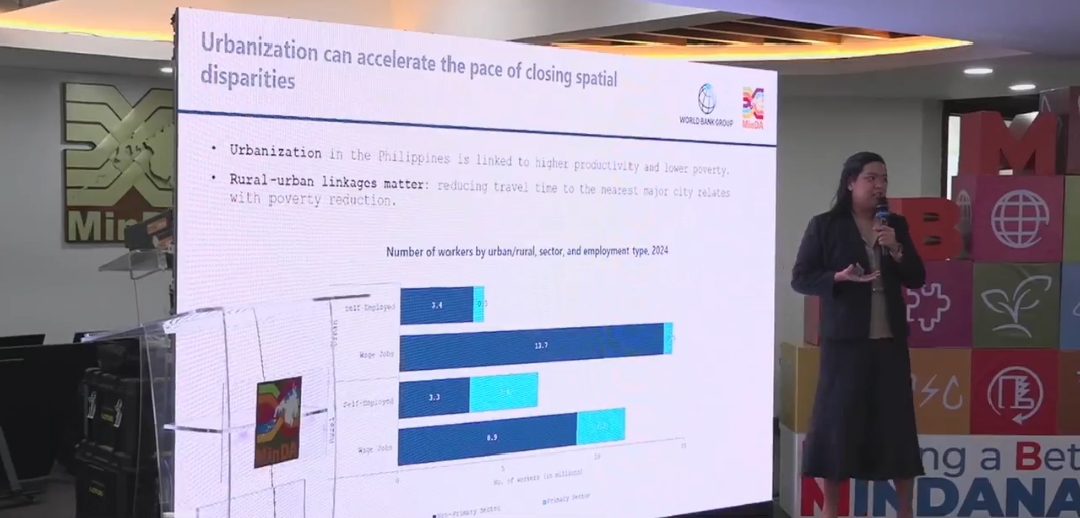
Arzadon stressed that while there is a disparity in poverty rates across regions, urbanization, coupled with connectivity, has led to higher productivity and lower poverty.
She added that in rural areas that have more connections to these urbanized areas, they tend to have more poverty reduction.
In the report, she noted there are more wage jobs in urban areas compared to rural areas, as urban areas are higher in job quality, presence of social protection, and security.
Arzadon also emphasized taking advantage of the economic potential of every city or at the municipal level for long-term growth.
The World Bank’s analysis showed that high-potential urban clusters are scattered across regions defined by three location-specific advantages: Natural Endowments for arable land and tourism attractions; Infrastructure and Service Access (roads, internet speed, and healthcare reach); and agglomeration advantages (industry diversity and a pool of skilled workers).
For Mindanao, the “high-potential” urban clusters as defined by location-specific advantages, include: Northern Mindanao Cluster (Cagayan de Oro City, Butuan, and Ozami; z)Central Mindanao Cluster centered around Malaybalay; Southern Mindanao Cluster (major growth area encompassing Davao, General Santos City, and Cotabato) and Western Mindanao Cluster: (Zamboanga Peninsula, including Zamboanga and Dipolog City).
“When we consider these urban centers, they tend to spill over outside other LGUs,” Arzadon said, citing, for example, Davao City’s progress is also linked to other LGUs that are nearby Davao City.
“Enhanced connectivity can provide potential through transport links, not just land transportation, but water transportation. It is a good way to boost integration and create jobs,” she added.
