



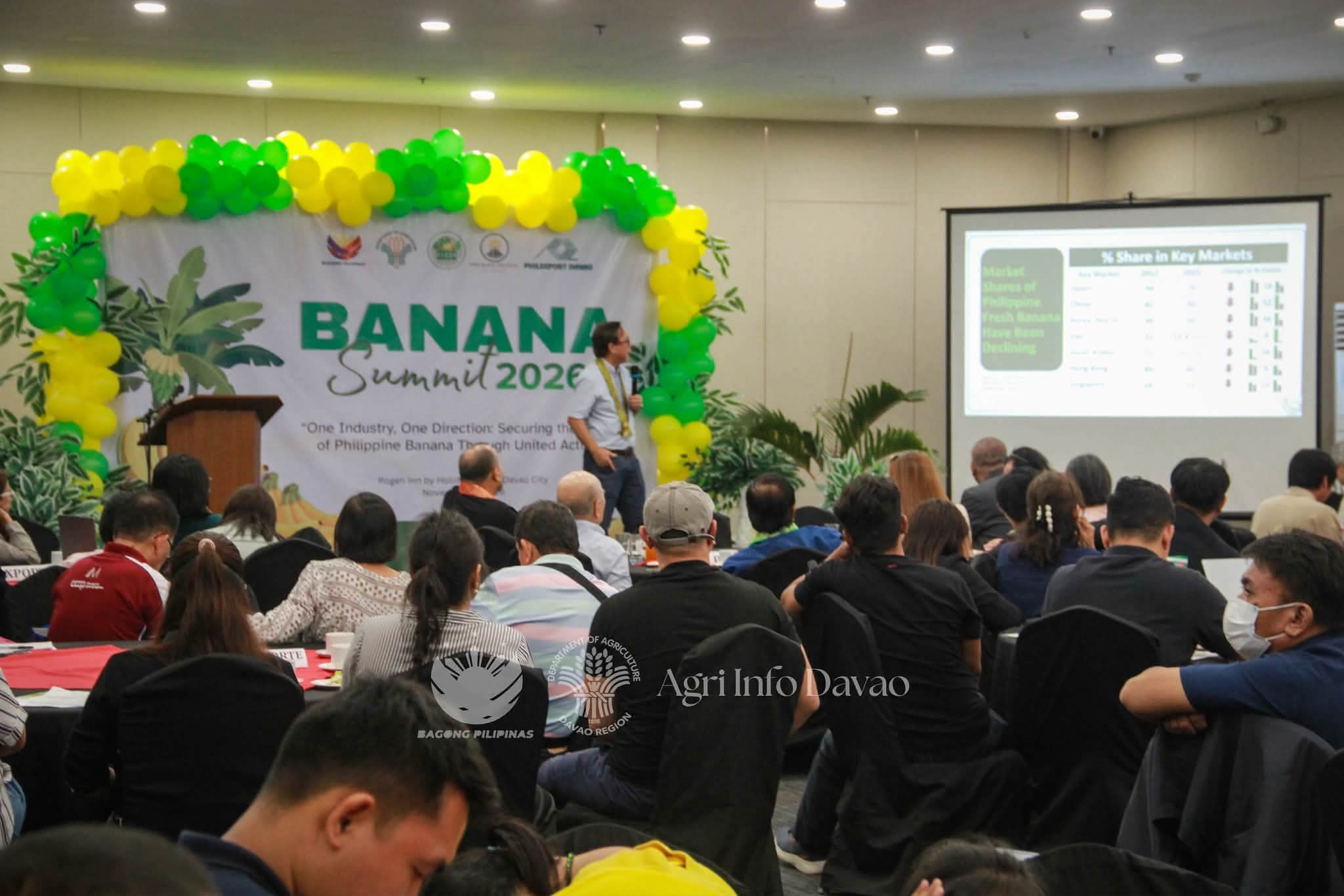
THE BANANA Summit 2026, held in Davao City on Thursday, Nov. 19, raised compliance with international export requirements, particularly maximum residue limits (MRL), traceability, and the proper use of agricultural inputs.
Government agencies, industry associations, growers, exporters, processors, and other stakeholders gathered during the Banana Summit 2026.
Department of Agriculture (DA) XI organized the summit through its High Value Crops Development Program, in partnership with the Philippine Banana Council (PHILBANA Council) and PHILEXPORT Davao.
The agency summit aims to assess the state of the industry and map out strategies to keep Philippine bananas competitive in the global market.
Marie Ann M. Constantino, DA XI regional technical director for operations, stressed the need for synchronized action between government and the private sector.
“Farmers and other stakeholders are essential partners in sustaining the country’s presence in the global banana market,” Constantino said.
Stephen A. Antig, PHILBANA council chairperson and PHILEXPORT Davao trustee, hoped the summit would address the industry’s continuing challenges on production efficiency, access to financing, full technical support, and government intervention.
Among the critical issues discussed was compliance with international market requirements, especially MRL.
An MRL is the highest legal concentration of a pesticide or veterinary drug residue permitted in or on food commodities and animal feeds, ensuring food safety while reflecting good agricultural practices.
The DA sets and regulates the MRL for pesticides and veterinary drugs in food through the Bureau of Agriculture and Fisheries Standards, in coordination with the Fertilizer and Pesticide Authority (DA-FPA) and the Bureau of Plant Industry (DA-BPI).
The summit also discussed traceability systems to track agricultural and fishery products from farm-to-table, ensuring food safety. Meanwhile, the role of the Fertilizer and Pesticide Authority in safeguarding banana exports was deemed critical.
The summit also served as a venue for growers to raise concerns, share technical insights, and identify ways to strengthen production and improve compliance with export requirements.
Industry stakeholders called for legislative measures supporting the banana sector and securing the industry’s long-term growth, alongside preparations for the Banana Congress 2027.
In the first quarter of 2026, Davao Region produced 700,768.55 metric tons of fruit crops, reflecting a 0.5 percent increase from the 697,393.62 MT production during the same quarter in 2025.

