


BY DATU MUSSOLINI SINSUAT LIDASAN
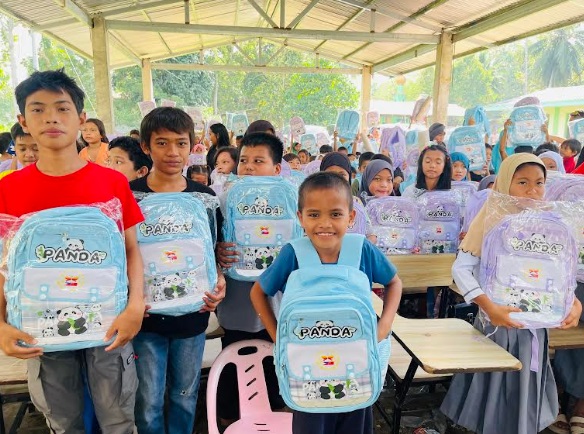
IN THE quiet, resilient municipality of Matanog, Maguindanao del Norte, lies the village of Cabugao, Barangay Sapad—a place where the lush green of the landscape is often mirrored by the quiet strength of its people. It was here that the Al Qalam Institute, supported by the Consulate General of the People’s Republic of China in Davao City, brought its mission of hope through a bags and school supplies distribution project.
Amidst the echoes of the region’s complex history, this initiative sought to provide more than just material aid; it sought to fuel the intellectual journey of a generation. We did not carry boxes. We carried futures, tender and unformed, wrapped in nylon and fastened with a hopeful zipper.
Into the villages of the Bangsamoro, where most of the roads surrender to footpaths, we brought bags. Simple, durable bags. Inside, the humble alchemy of potential: pencils not yet sharpened, notebooks with blank pages, a ruler to measure more than lines, and a box of crayons to color worlds yet unseen.
These were not handouts; they were invitations. To a child whose horizon has been the next ridge or the aftermath of conflict, these tools whispered a new question: not what is, but what could be?
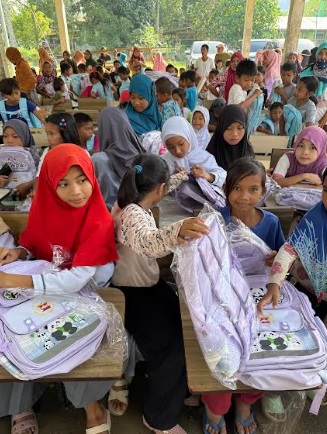
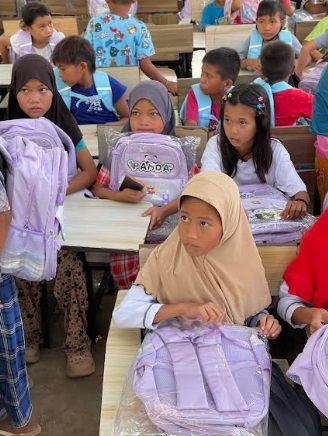
The magic was not in the objects, but in the ceremony of their giving. We did not simply pass them out; we called each child forward, meeting their bright, uncertain eyes. We said their names aloud—Fatima, Samir, Kalil—and with each name, we named a possibility. “This is for your discoveries, little scientist,” we’d say, placing a bag in small, eager hands.
“These are for the stories you will heal, future doctor,” to another. The bag became a covenant—a pact between their community and their own nascent dreams. It was a tangible sign that someone, somewhere, believed their mind was a territory worth cultivating.
I saw a boy, perhaps ten, immediately open his notebook. He did not draw a house or a car; with a steady pencil, he began mapping the constellations of his imagination—a complex web of lines he called his “village bridge.” A girl cradled her crayons like sacred gems, telling me the green was for the peace-filled fields she would grow as a farmer-scientist.
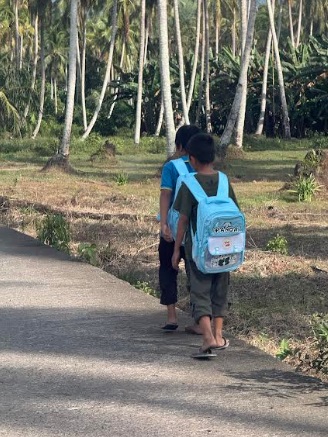
The bag, slung over a tiny shoulder, became a banner of a new identity. No longer just a child of a forgotten barangay, but a student. A person with a mission, armed with the instruments of learning. The weight of the bag was the dignified weight of becoming.
This was a small project. The budgets of “empires” would not notice their cost. But impact is not measured in scale; it is measured in the quiet revolutions behind a child’s eyes.
We did not distribute school supplies. We distributed mirrors in which children saw their own brilliance reflected. We distributed keys—not to classrooms, but to the locked rooms of their own vast potential. In the resilient heart of Bangsamoro, where history is heavy, we offered a light backpack for a long journey.
And now, a generation walks forward, backs straight under their new burden of hope, ready to draft their future not in the dust, but on the clean, waiting pages we placed in their hands.
