

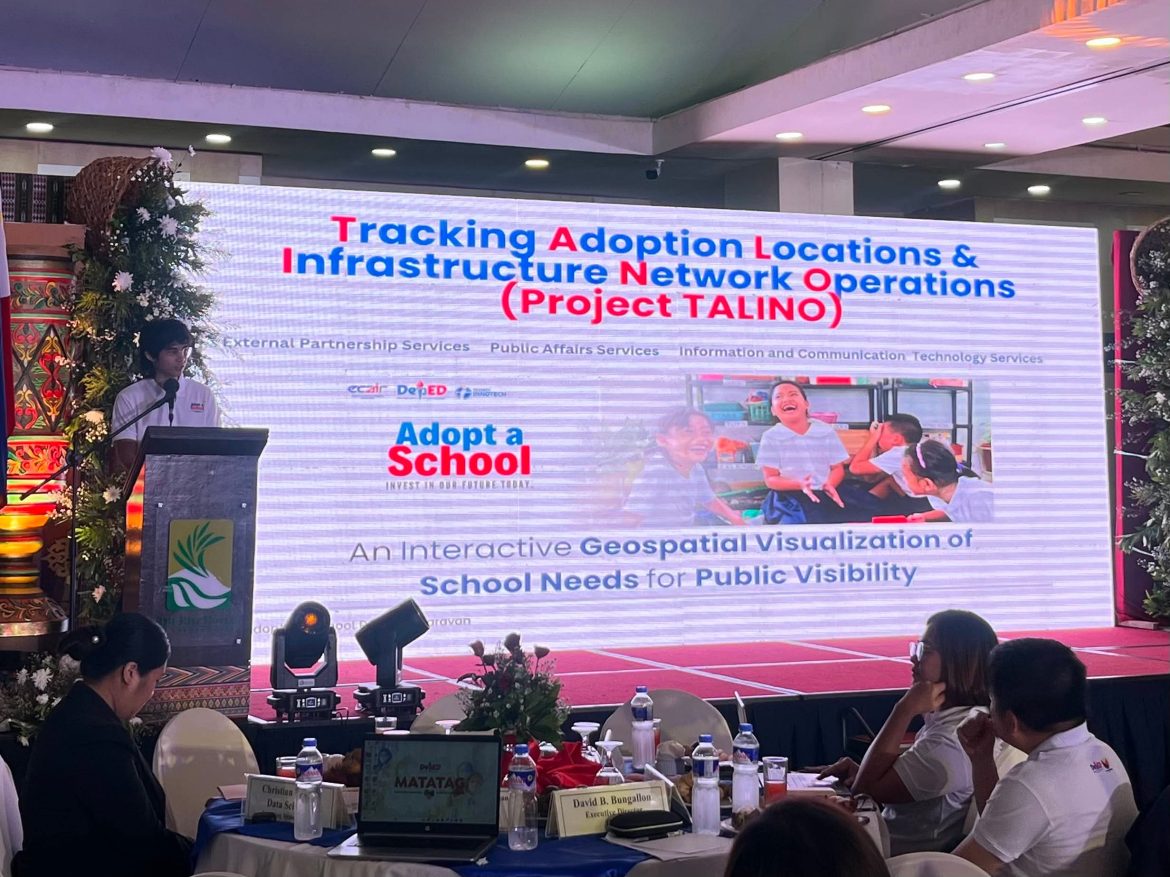
THE DEPARTMENT of Education (DepEd) rolled out the Mindanao leg of its Adopt-A-School Program (ASP) caravan on Tuesday, Aug. 11, at Ritz Hotel, Davao City.
The ASP Caravan officially launched a new digital platform and an expanded menu of investments to address critical resource gaps in basic education through public-private sector partnerships.
Janir Datukan, DepEd assistant secretary for learning systems, said the persistent challenges in the education sector, ranging from classroom shortages to digital access, cannot be addressed by the government alone.
“Adopt-a-School is all about partnering the public sector with the Department of Education specifically to support educational initiatives such as infrastructure, technology, teaching and learning processes, and, of course, support to our teachers,” Datukan told reporters.
He added that DepEd is making it more organized for the partners to choose a menu of items for them to provide targeted assistance to the schools.
The expanded ASP Menu of Investments directly aligns with DepEd’s 5-Point Reform Agenda, detailing targeted areas where private sector interventions are most needed: infrastructure & learning spaces; digital & learning tools; STEM & skills training; health & basic needs.
DepEd currently maintains 192 active nationwide partners, with active contributors including Hope, Metrobank, and SM, which have supported the construction of classrooms and school buildings; Khan Academy for digital learning tools; and the Aboitiz Foundation, which supports the strengthening of Science, Technology, Engineering, and Mathematics or STEM education.
Christian Villarin, data scientist under the Education Center for AI and Research, said the new ASP platform serves as an online portal designed to simplify project matching and facilitate real-time donation tracking.
In his report, Villarin said while DepEd has an existing platform, tedious user navigation often dissuades potential donors from completing the process, and donors lack a direct way to identify the school needs and which schools they can prioritize.
Project TALINO, which stands for Tracking Adoption Locations and Infrastructure Network Operations, features a map containing all available schools; search and filter options to narrow down preferences; and individual school information when you click a point on the map.
The map also uses color-coded points to indicate priority levels, where red points represent schools with a high number of needs, while orange and yellow indicate those with a lower priority.
The search and filter are straightforward and use school name, location, and needs as a basis for filtering, while individual school profiles provide the school needs in terms of packages, along with the address and contact details.
The app also incorporated a pledge school implementation, which allows donors to formalize their support, tailored each form to the specific needs of each school, and an “other” option for contributions outside the standard packages.
It added a chat agent, which is similar to ChatGPT or Gemini, specifically designed for information related to the Adopt-a-School Program to answer the frequently asked questions (or FAQs), filter the map based on the prompt, and recommend which schools and packages to pledge based on the preferred amount and location.
“Project TALINO is built, is designed to drive innovation and make data accessible, ensuring the Adopt-a-School Program achieves its purpose in empowering the private sector to bridge gaps for the schools that need it the most,” Vilarrin said.
The caravan convened national and regional offices of the DepEd in Mindanao, the Technical Education and Skills Development Authority, the Commission on Higher Education, and potential partners from the private sector.