

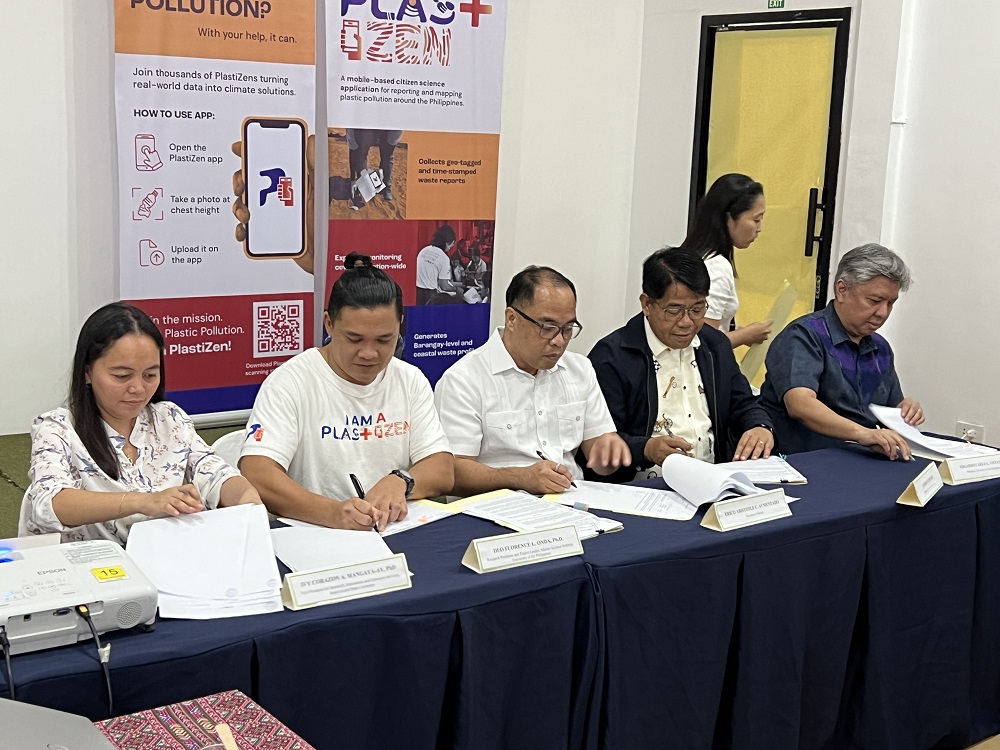
TAGBILARAN CITY, Philippines –– The University of the Philippines Marine Science Institute (UP MSI), through its PlastiZen Project, signed a memorandum of agreement (MOA) with the Provincial Government of Bohol and Bohol Island State University (BISU) on July 31, at the Reyna and Havens and Gardens, Calceta Street, Tagbilaran City.
Governor Erico Aristotle “Aris” Aumentado of Bohol, Dr. Deo Florence L. Onda, project leader of the PlastiZen Project; Edgardo Carlo L. Vistan II, chancellor of the University of the Philippines Diliman; and Dr. Anthony M. Penaso, president of Bohol Island State University, were present during the signing.
Earlier in July, their citizen science application, PlastiZen Basura Patroller, was launched on Google Play, co-implemented by the Department of Mathematics and Computer Science, University of the Philippines Baguio. Funded by the Department of Science and Technology–Philippine Council for Industry, Energy and Emerging Technology Research and Development (DOST-PCIEERD), PlastiZen Basura Patroller is an app through which plastic pollution can be reported via anonymous photo submissions, allowing for the geotagging of plastic waste.
The PGB, through the Bohol Provincial Environment Management Office (BPEMO), recognizes the urgent need to strengthen environmental monitoring systems and institutionalize data-driven strategies to mitigate plastic pollution while enhancing sustainable coastal and marine resource management in the province. The partnership reflects Bohol’s commitment to integrating scientific research, digital innovation, and citizen participation into environmental governance, enabling more responsive and evidence-based decision-making for the province’s ecosystems.
Under the agreement, BPEMO will adopt the institutional use of the PlastiZen application as an environmental monitoring tool across the Province of Bohol. Through the institutional adoption of PlastiZen, Bohol aims to strengthen science-based environmental management by generating community-driven data to inform local policies and conservation initiatives.
The province is officially recognized as a UNESCO Global Geopark for its globally significant geological heritage, underscoring the importance of integrated conservation, education, and sustainable development, including the protection and restoration of terrestrial, coastal, and marine ecosystems. The BPEMO will coordinate with provincial and local stakeholders to support its implementation, collaborate with state universities and colleges and national government agencies in developing communication materials for the application’s promotion and use, and adopt policy recommendations and briefs derived from data collected through the PlastiZen application.
Through this MOA, UPD will lead the technology transfer of the project’s citizen science PlastiZen application by designing and implementing capacity-building programs and adoption frameworks. UPD will also provide technical expertise and guidance on the application and monitoring framework, support data storage and retrieval for information collected through the PlastiZen and PlastiCount applications, and prepare consolidated technical and monitoring reports.
By mapping the location and concentration of plastic pollution, geotagging provides local governments, researchers, and environmental organizations with real-time data that can guide targeted interventions, optimize resource allocation, and support evidence-based waste management policies. PlastiZen also enables long-term monitoring of pollution trends and informing strategies to prevent further waste leakage into waterways and marine ecosystems.
PlastiZen Basura Patroller
vAll data collected through the app are integrated into a central public database called the PlastiCount Pilipinas portal, creating an end-to-end data pipeline that transforms citizen-generated reports into an artificial intelligence (AI)-assisted analytical repository for monitoring and analyzing plastic pollution trends. The PlastiCount Pilipinas portal was first launched in 2022, and is the first open-source marine plastic pollution (MPP) tracker in the Philippines and Southeast Asia, covering both microplastics and macroplastics.
PlastiZen also supports the Philippines’ National Plan of Action for the Prevention, Reduction, and Management of Marine Litter (NPoA-ML), adopted by the Department of Environment and Natural Resources (DENR), which has the overarching goal of achieving Zero Waste to Philippine Waters by 2040. A key component of the NPoA-ML is the establishment of science- and evidence-based baseline information on marine litter.
By empowering citizens and encouraging greater awareness of the sources and continuing challenges of plastic pollution, as well as what it takes to solve them, PlastiZen represents one step toward more efficient and data-driven local waste management workflows.
The ceremonial signing of the MOA builds upon the previous capacity-building efforts by formalizing long-term collaboration among UPD, BISU, and the Provincial Government of Bohol in advancing environmental monitoring and management in the province.
HOW TO USE THE APP:
- Open the app
- Snap a photo of the litter
- Submit anonymously
For further information on the project’s updates, follow the Microbial Oceanography Laboratory on Facebook, or email microocelab@msi.upd.edu.ph. If you have questions or concerns about the application, you may contact the PlastiZen team directly through plastizen@msi.upd.edu.ph.