



THE ANTI-RED Tape Authority (ARTA) emphasized strong rules and improving services must translate into faster, simpler, and more predictable business transactions to improve local business environments.
Karizza Mae P. Paredes, assistant division chief, ARTA BRO-Doing Business Division, presented the Philippines’ standing in the World Bank Group’s 2025 Business Ready (B-Ready) report during its first regional rollout, on Thursday, Nov. 5, in Davao City.
The B-Ready Report serves as the World Bank Group’s flagship assessment tool, evaluating the business environment across ten topic areas covering the full lifecycle of a firm from business entry and location to daily operations, utility connections, and business insolvency.
The Philippines placed 53rd out of 101 (countries) economies in the 2025 B-Ready report, with an overall score of 61.04 out of 100, according to ARTA.
“ARTA assessed where we are. Since we have 61 as score, we are a bit improved, beyond the middle, mostly from improvement of the regulatory framework pero mababa sa operational efficiency,” Paredes said.
Rules are there, but practice is weak
B-Ready assesses the business environment across three pillars: regulatory framework, public services, and operational efficiency.
The Philippines scored highest in the regulatory framework at 73.86, up about three points from the first report in 2024, placing 26th out of 101 and landing in the second quintile.
ARTA credited new laws, including the National Government Procurement Act and the e-Governance Act, along with its implementing rules.
The agency said the World Bank noted that local business permit processing for foreign firms fell from 103 days in 2024 to 75 days in 2025.
The country scored 57.82 in public services, a slight increase attributed to improvements in digital systems and the publication of gender-sensitive data, placing 51st and landing in the third quintile.
However, the score declined in operational efficiency, which reflects the time, effort, and cost businesses experience, placing 80th out of 101 and landing in the fourth quintile.
“This is due to reported delays and processing bottlenecks experienced by private sector firms,” Paredes said.
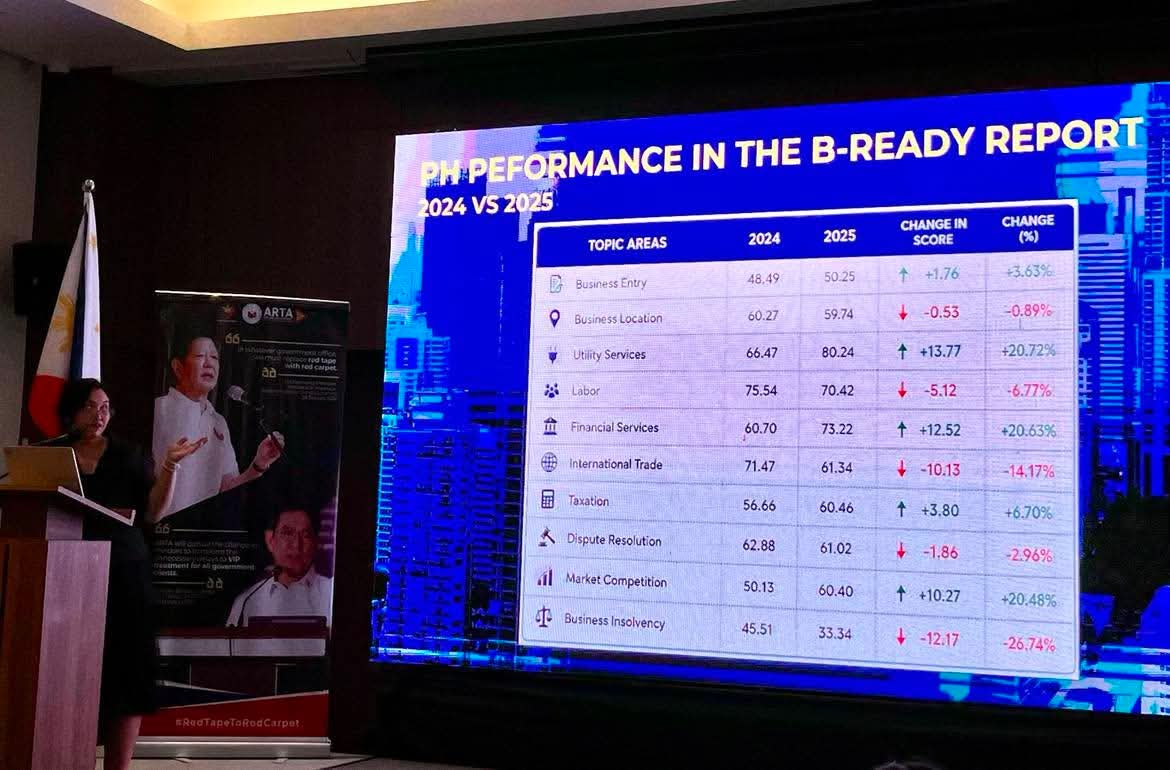
Paredes presented the breakdown by topic area compared between 2024 and 2025, where utility services posted the biggest gain, rising from 66.47 to 80.24. Financial services followed, up 12.52 points from 60.70 to 73.22.
Market competition also rose by 10.27 points from 50.13 to 60.40, while taxation improved by 3.80 points from 56.66 to 60.46, and business entry by 1.76 points from 48.49 to 50.25 percent.
Meanwhile, five areas have declined, including business insolvency, which fell the most, dropping from 45.51 to 33.34 percent. International trade fell from 71.47 to 61.34 percent, and labor fell from 75.54 to 70.42.
Dispute resolution also slipped from 62.88 to 61.02 percent, and business location dipped from 60.27 to 59.74 percent.
Role of LGUs
Paredes noted that local government units play the main role in business entry, business location, utility services, and taxation, as these are the areas where permits and clearances are issued locally.
She cited three key challenges: implementation gaps and low operational efficiency, limited digitalization and interoperability of government systems, and limited publication of sex-disaggregated and performance data.
“Some of our LGUs may kanya kanyang system, but the digital system being assessed by the World Bank is how interoperable our systems are, not just at the local level but also at the national level,” Paredes said.
ARTA noted that the World Bank assesses end-to-end processes, so delays at any agency, including the Bureau of Internal Revenue or social security offices, affect the result even if a local government issues permits quickly.
She added that many agencies already hold such data but have not made it public and need to be improved.
Paredes stressed that the way forward is to maintain clear, transparent, and proportionate requirements to ensure regulatory quality; make guidance, systems, and services accessible to firms; and reduce unnecessary steps to prevent delays and repeat submissions.
“A good regulation must also work well at the service counter and online,” Paredes said.
