

FOR A long time, the conversation about Philippine mining has revolved around a familiar question: How much mineral wealth does the country have, and how much revenue can be generated from it?
That question is important. But it is no longer enough.
The more important question today is: How much economic value can the Philippines create from what it mines in a sustainable way?
This distinction matters because critical minerals are no longer just commodities. Nickel, copper, cobalt, and other minerals are increasingly part of the supply chains behind electric vehicles, batteries, renewable energy, electronics, power systems, and advanced manufacturing.
The Philippines therefore has an opportunity that goes well beyond the mine site.
But there is another question that must accompany it: Can this opportunity be pursued without damaging the environmental and natural-resource base on which communities depend?
That is what makes the present moment different.
A new policy direction is taking shape
The recent policy direction is significant. President Ferdinand Marcos Jr. has approved Executive Order No. 122, establishing a national policy framework for the responsible development of the Philippines’ mining and critical-minerals sector and reorganizing the Mining Industry Coordinating Council.
The order goes beyond extraction. It promotes value-added processing and downstream industries, including refining, advanced materials processing, batteries, electronic components, and renewable-energy technologies. It also identifies supporting industries such as energy, water supply, transport, logistics, recovery and recycling. At the same time, it calls for responsible and sustainable development of critical-mineral resources.
That changes the conversation.
The policy question is no longer only how to extract mineral resources. It is how to build an industrial ecosystem around them—while ensuring that the environmental costs do not simply get pushed onto communities and future generations.
The direction is therefore becoming clearer: move from extraction toward value creation, but do so responsibly.
The nickel paradox
The Philippines already has a strong starting point.
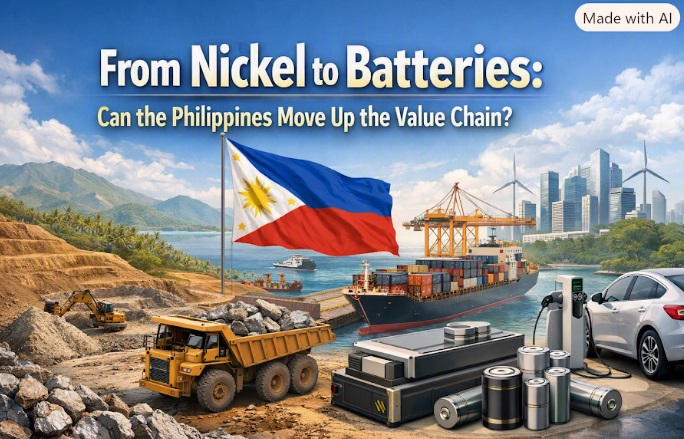
In 2024, the country was the world’s second-largest nickel producer, accounting for about 9.5 percent of global production. It was also the world’s seventh-largest cobalt producer, although with a much smaller global share.
These are substantial positions in minerals that are becoming increasingly important to the global energy and technology transition.
Yet being a major producer of a mineral does not automatically make a country a major participant in the higher-value parts of the supply chain.
That is where the paradox lies.
If the Philippines exports ore, it earns from the ore. If it processes that ore, it can capture additional value. If it moves further into refined materials, components, or manufacturing, the potential value created inside the country becomes much larger.
The objective should not be to force every stage of production into the Philippines. That would neither be realistic nor necessarily efficient.
The objective should be more practical: identify the stages of the value chain in which the Philippines can become competitive—and then build the infrastructure, skills, technology and institutions needed to succeed in those stages.
From ore to industry
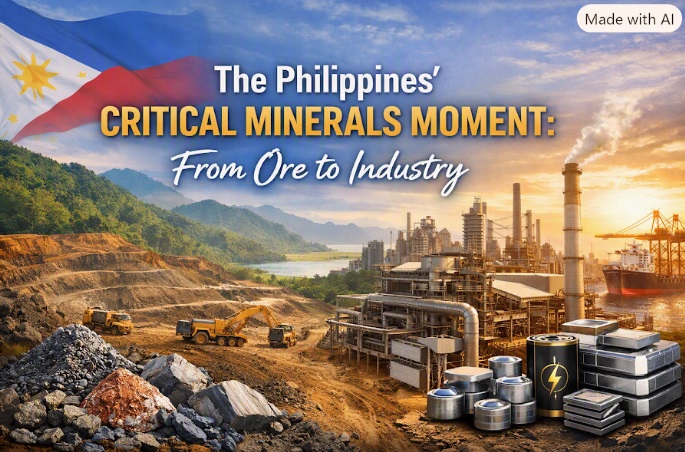
This is where the idea of “downstreaming” becomes much more than an industrial policy slogan.
A processing plant does not operate in isolation. It needs reliable electricity, water, ports, roads, logistics, engineers, technicians, maintenance services, financial services, laboratories, and suppliers.
Over time, it can create demand for universities, technical institutes, and research centers. It can encourage Filipino companies to become suppliers. It can create opportunities for technology partnerships and new enterprises.
That is how a mine can become the starting point of an industrial cluster rather than simply the source of an export commodity.
The Philippines should therefore ask a simple question about every major critical-minerals project:
What remains in the country after the mineral leaves the ground?
If the answer is mainly ore and export earnings, the economic opportunity is limited.
If the answer includes processing capacity, skilled workers, Filipino suppliers, technology, research, manufacturing capability, and new enterprises, the development impact is much greater.
And there should be another question:
What remains of the environment after the project is completed?
A genuinely successful mineral strategy must be able to answer both questions.
Copper tells another part of the story
Nickel is understandably at the center of the discussion, but copper deserves equal attention.
The Philippines produced about 256,800 dry metric tons of copper concentrate in 2024, equivalent to about 53,200 metric tons of copper metal. Copper concentrate production was valued at roughly ₱27.2 billion.
Copper is fundamental to electrification. It is used in power transmission, renewable-energy systems, electric vehicles, electronics, and infrastructure.
For the Philippines, this creates another possibility: linking mineral resources with the country’s broader industrial ambitions.
Mining policy, energy policy, manufacturing policy, infrastructure policy, and investment policy should not operate as separate compartments.
A copper project, for example, becomes much more valuable to the economy if it is connected to processing, engineering services, equipment supply, industrial parks, ports, renewable energy and manufacturing.
The real competition is not underground
This may be the most important point.
The Philippines is not competing simply on the basis of what lies beneath its soil. It is competing for investment, technology, processing capacity and a place in global supply chains.
And in that competition, geology is only the beginning.
Investors will look at the cost and reliability of electricity. They will look at ports, roads, water, logistics, and digital infrastructure. They will look at the availability of skilled workers. They will look at permitting, environmental rules, taxation, policy consistency, and the speed with which decisions are made.
A country can have excellent mineral deposits and still lose the industrial opportunity if the surrounding ecosystem is not competitive.
But competitiveness cannot mean lowering environmental standards to attract investment.
The Philippines needs a system in which responsible environmental performance becomes part of industrial competitiveness, not something treated as an afterthought.
This is why critical-minerals policy should ultimately become industrial policy—with environmental responsibility built into it from the beginning.
Mindanao must be part of the industrial story
The geographical dimension is equally important.
Mindanao is already central to the country’s mineral economy. In 2024, the Caraga region accounted for about 30.9 percent of the Philippines’ total metallic-mineral production value, the largest regional share.
That creates an opportunity to make mineral development part of a broader strategy for regional industrialization.
Mindanao should not simply supply raw materials to industrial centers elsewhere—or to industries outside the country. Where economically and environmentally feasible, processing, services, logistics, technical training and related industries should also be developed closer to the resource base.
That could mean jobs, skills and investment outside the traditional economic centers.
But this will require something more than mineral deposits. It will require reliable power, transport, water, ports, digital connectivity and a predictable regulatory environment.
And it will require careful environmental planning because many resource-rich areas are also environmentally sensitive and closely connected to the livelihoods of local and indigenous communities.
Processing is not automatically development
There is, however, a danger in becoming too enthusiastic about downstreaming.
A processing plant by itself does not guarantee inclusive development.
A project can bring large foreign investment but create relatively few high-quality local jobs. It can generate exports without creating much Filipino technological capability. It can increase government revenues while leaving communities to bear substantial environmental and social costs.
The real test, therefore, is not simply whether a processing plant is built.
The test is what kind of industrial capability is built around it—and what kind of environmental legacy is left behind.
How much technology is transferred? How many Filipino engineers, technicians, and managers acquire advanced skills? How many domestic firms become suppliers? How much research and development takes place locally? How much value is retained in the Philippine economy?
And equally important: How are water, forests, biodiversity, and community livelihoods protected?
These questions should be built into the investment conversation from the beginning.
Mining, industry and the environment: Development without compromising the future
This is the part of the critical-minerals debate that cannot be treated as a footnote.
Mineral deposits are located in real communities, watersheds, forests and agricultural areas. Indigenous peoples and local communities may have a direct stake in decisions about land and natural resources.
Faster permitting is important if the Philippines wants to attract investment. But faster should not mean weaker.
The goal should be clearer, more predictable, and more efficient regulation, while maintaining credible environmental and social safeguards.
There is also a broader principle at stake.
The world needs critical minerals for clean energy, electrification, and modern technology. But the transition to a cleaner economy should not create new environmental damage in the places where those minerals are extracted.
The Philippines therefore has an opportunity to demonstrate that mineral development and environmental stewardship do not have to be opposing ideas.
Responsible mining should mean protecting watersheds, reducing pollution, managing waste and tailings properly, rehabilitating mined areas, respecting biodiversity, and ensuring that affected communities have a meaningful voice.
Mining takes place somewhere.
That somewhere is somebody’s community.
That simple fact should remain at the center of the country’s critical-minerals strategy.
The Philippines should aim not merely for more mining, but for better mining—more responsible, more transparent, more environmentally conscious, and more closely connected to long-term industrial development.
Responsible development is not an obstacle to industrialization. It is part of the foundation on which durable industrialization must be built.
ASEAN could make the opportunity much bigger
The Philippines does not need to build an entire critical-minerals supply chain alone.
ASEAN offers an obvious platform for regional value chains.
Indonesia has moved aggressively into nickel processing. The Philippines has major nickel and copper resources, along with strengths in electronics and a growing manufacturing base. Other ASEAN economies bring capabilities in manufacturing, logistics, technology, finance, and downstream industries.
The opportunity is to identify where the Philippines can be genuinely competitive and connect those capabilities to a wider regional production network.
The objective should not be self-sufficiency at any cost.
It should be strategic participation.
And if the Philippines can combine competitive processing with credible environmental and social standards, that could become an advantage rather than a constraint.
The government now has to connect the dots
The new critical-minerals framework is an important beginning. But the difficult work starts now.
The Philippines needs to identify which minerals matter most, which stages of their value chains are commercially realistic, where processing facilities make economic sense, what infrastructure they require, and how Filipino workers and enterprises can participate.
At the same time, environmental safeguards cannot be left to a separate policy track.
Mining, industry, energy, infrastructure, education, investment, trade, environment, and regional development need to work together.
The 2026 Strategic Investment Priority Plan provides an important investment-policy foundation by identifying strategic and critical minerals and higher-value processing among priority areas.
But the next step is to turn that policy direction into a coherent industrial strategy—with clear priorities, measurable targets, strong domestic capability, and equally clear environmental standards.
The Philippines should know not only what it wants to produce, but also what kind of country it wants that production to help build.
From mineral wealth to industrial wealth—and environmental stewardship
The Philippines may be sitting on considerable mineral wealth. But mineral wealth by itself does not create lasting prosperity.
The real question is what happens after extraction.
Does the country simply export more ore? Or does it use its mineral endowment to build processing capacity, develop Filipino skills, create domestic enterprises, attract technology, deepen manufacturing, and strengthen regional supply chains?
And can it do all this while protecting the natural resources and communities that must live with the consequences?
That is the choice now emerging.
The Philippines does not need to become a mining superpower merely for the sake of producing more minerals.
It needs to become better at converting its natural resources into productive capabilities—while ensuring that economic progress does not come at the expense of the country’s environmental future.
That is a much more ambitious goal—and, ultimately, a much more meaningful one.
From mineral wealth to industrial wealth. From resource extraction to responsible value creation.
That should be the ambition.
Because the real opportunity is not simply to dig more.
It is to build more—and to build responsibly.