

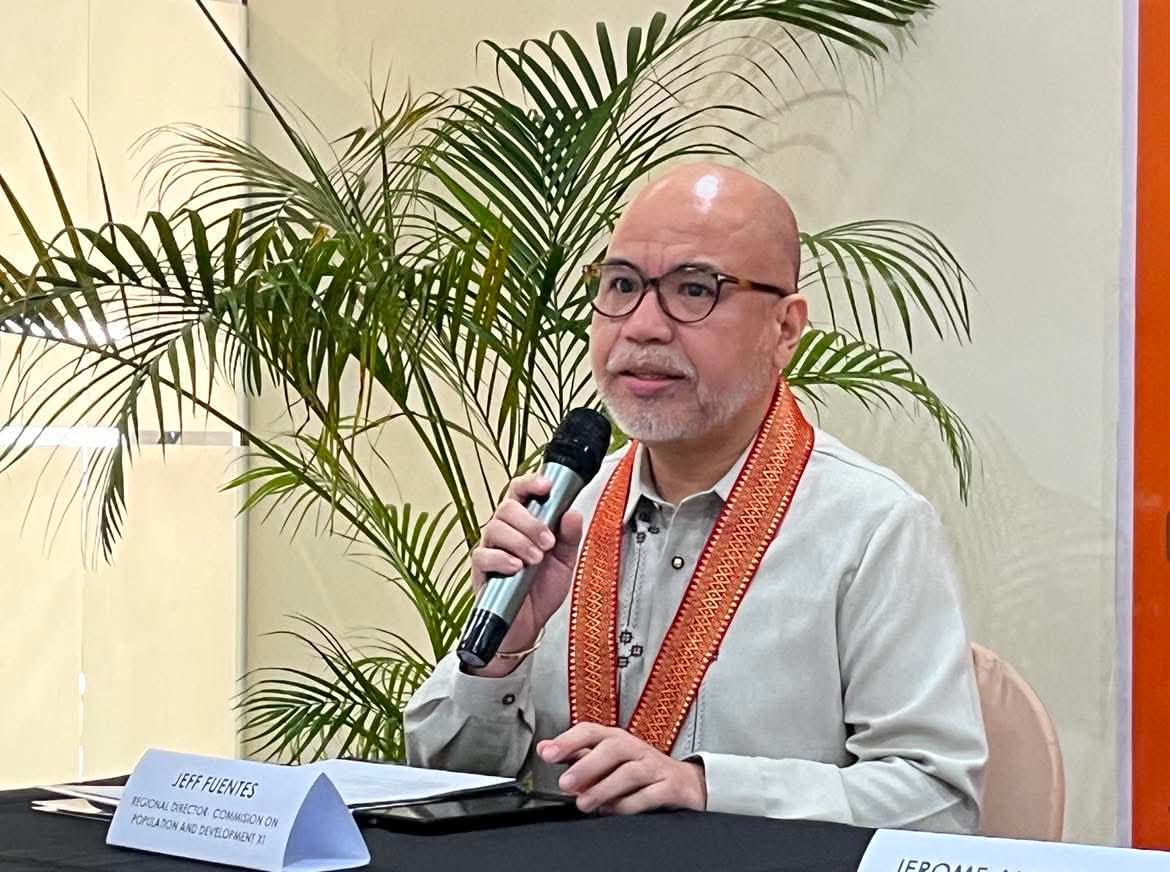
ACCELERATING rural development and creating local economic opportunities are critical to curbing internal migration toward major urban hubs, an official from the Commission on Population and Development (CPD) XI said.
CPD XI regional director Jeff Fuentes called on local government units (LGUs) to step up local job generation and public services.
Fuentes said internal movement within the region is largely driven by residents seeking better living conditions, education, and employment.
With around 53 percent of the Davao Region’s economy concentrated in Davao City, he warned that provincial LGUs must proactively develop their local economies to retain their populations.
“Movement is really motivated by hope, yang merong kang pag-asa. That’s the most important thing for our local government units: we have to give hope to our people so that we can retain them in our localities,” Fuentes said at a press conference during the 2nd Mindanao Summit on Migration, Environment, Peace and Development on July 28.
Fuentes highlighted that addressing internal migration requires understanding the demographics of migrating populations, including age groups and socioeconomic profiles.
He said that providing competitive local opportunities, such as establishing state colleges and expanding local industries, can effectively encourage residents to stay in their home municipalities rather than moving to urban centers.
He cited the municipality of Sulop, which recorded an increasing population growth rate despite an overall declining growth trend across the region.
Fuentes attributed this growth to local programs that enhanced residents’ overall quality of life, and that strong municipal services reflect the stability of local populations.
The CPD is advocating for the integration of internal migration tracking into local data systems, such as the Community-Based Monitoring System (CBMS) and the Registry of Barangay Inhabitants and Migrants (RBIM), to help LGUs design targeted interventions.
“Internal migration is a very big development issue in the Philippines, but it is currently invisible because we lack ground-level data,” the official noted.
“In order to truly move forward in terms of development where no one is left behind, we need to know who is coming in, who is leaving, and why,” Fuentes stressed.
Fuentes reported that the municipality of Kiblawan has implemented a full RBIM system and is currently processing local migration data.
Meanwhile, Panabo City is planning to adopt the system, while Asuncion and Santo Tomas are likewise incorporating migration components into their local data collection frameworks.