




AS THE Philippines hosts the ASEAN Summit and related business meetings in November, the country has an opportunity to shape a regional agenda that puts employment, economic inclusion, and the future of ordinary workers at the center of the artificial intelligence revolution.
Artificial intelligence is rapidly changing the way businesses operate, decisions are made, and services are delivered. For the Philippines, this transformation brings both an important opportunity and a serious development challenge. AI can strengthen the country’s competitiveness, improve public services, modernize agriculture, support small businesses, and raise productivity. But it could also unsettle employment patterns on which millions of Filipino households depend.
The Philippines has a particular stake in this debate. Its information technology and business process management (IT-BPM) industry has become an important source of employment, foreign exchange earnings, and economic opportunity. Its large services workforce, young population, and overseas employment connections also make the country particularly sensitive to changes in the global demand for labor.
As the Philippines hosts the ASEAN Summit and related meetings in November 2026, the issue deserves attention beyond the technology sector. The country has an opportunity to help ASEAN move from a discussion about digital transformation towards a more ambitious agenda of people-centered economic transformation.
The real challenge is not simply whether artificial intelligence will replace workers. It is whether the Philippines can create enough productive and decent jobs, preserve pathways into employment for its young people, expand women’s economic opportunities, and ensure that low-income households and less-developed regions share in the gains. ASEAN’s digital integration must ultimately improve the economic prospects of its people.
The first-job challenge: Who will employ the next generation?
The immediate employment concern may not be mass unemployment. It could be the gradual weakening of the traditional route into work.
Businesses have long recruited young people for entry-level positions in customer support, administration, data processing, accounting assistance, documentation, and routine research. These jobs provide more than an income. They offer workplace experience, professional discipline, and an opportunity to progress towards better-paid positions.
AI can increasingly perform parts of these tasks. Companies may consequently require fewer junior employees even as they retain experienced professionals who can supervise systems, interpret results, and exercise judgment.
This raises a difficult question for young Filipinos: if the first rung of the employment ladder becomes harder to reach, where will they acquire the experience needed to progress?
The International Labour Organization’s February 2026 research brief, Generative AI and Jobs in the Philippines: Labour Market Exposure and Policy Implications, provides an important indication of the scale of the challenge. It estimates that more than one-quarter of Philippine employment, or approximately 12.7 million jobs, is exposed to generative AI. However, only 3.6% of jobs fall into the highest exposure category associated with elevated displacement risk. Exposure should therefore not be confused with inevitable job losses. Much of the impact is likely to involve changes in tasks, responsibilities, and working conditions.
The ILO also identifies young workers in clerical, service, and sales occupations as groups requiring particular attention. The potential disruption is greater for young women than for young men.
A related regional warning comes from the ILO’s July 2026 brief, Generative AI and Labour Markets in ASEAN: Significant Exposure, Limited Disruption, Uneven Preparedness. It finds little evidence of widespread labor-market disruption so far but identifies emerging signs of weaker outcomes for young workers in some entry-level occupations. Its central message is that future outcomes will depend heavily on policy choices, skills, infrastructure, and responsible adoption.
The Philippines should not wait for large-scale displacement before strengthening the transition from education to employment.
The BPO industry: From vulnerability to a higher-value future
The IT-BPM industry deserves particular attention because it is one of the Philippines’ most important connections to the global digital economy.
Customer service, back-office operations, financial processing, documentation, and other digitally delivered services contain tasks that generative AI can increasingly perform. The concern is not that the entire industry will disappear. Rather, its employment model may change as clients demand faster services, lower costs, and more sophisticated solutions.
The World Bank’s November 2025 Digital Progress and Trends Report 2025, in its Philippine-focused case study, Co-worker, Coach, or Competitor? How AI Is Transforming the Future of Digitally Delivered Services examines this transition. It finds that many workers and businesses surveyed view AI as a coworker or coach that can improve efficiency, quality, and learning, rather than simply as a competitor that will eliminate their jobs. But the study also recognizes that AI may take over many routine tasks.
This offers a more constructive way to approach the future of BPO. The Philippines should seek to move beyond dependence on routine outsourced services towards higher-value activities involving complex customer relationships, financial and professional services, specialized technical support, cybersecurity, health-related services, and AI-assisted business solutions.
The Asian Development Bank’s January 2021 report, Reaping the Benefits of Industry 4.0 through Skills Development in the Philippines, had already examined the implications of technological change for IT-BPM and electronics manufacturing. Its emphasis on industry transformation and investment in skills remains relevant, but the arrival of generative AI makes the need for action more urgent.
The objective should be to strengthen the industry’s competitiveness while ensuring that workers are not left behind as its business model evolves.
The people’s divide: Who will share the gains?
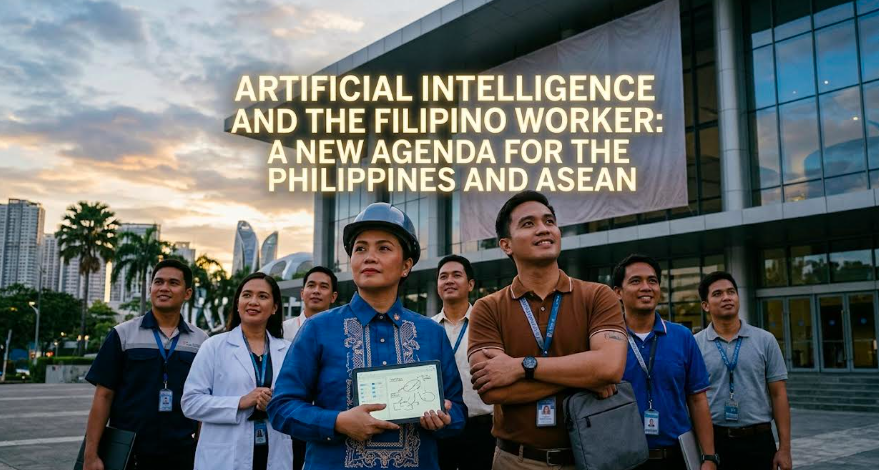
The AI debate is often presented as a digital divide between those with access to technology and those without it. But the deeper concern is the divide between people who can convert AI into higher earnings and economic opportunity and those who may experience it mainly as a threat to their livelihoods.
A highly educated professional with reliable internet, advanced training, and financial security may use AI to improve productivity and earn more. A large corporation can invest in sophisticated systems and capture substantial efficiency gains.
A low-income worker, an informal employee, or a small entrepreneur may have far fewer resources to adapt. Access to a smartphone alone does not provide the education, finance, reliable connectivity, or business opportunities needed to benefit from AI.
This is also an income and ownership divide. The gains may accrue disproportionately to those who control technology, capital, and data, while workers with weaker bargaining power face greater insecurity.
The World Bank’s Philippines Country Growth and Jobs Report 2025 provides an important background to this concern. It records that the country added more than 11.7 million jobs between 2010 and 2023, but three out of four jobs created were in non-tradable sectors. More than 90% of economic growth during the period came from capital accumulation, while productivity gains remained limited.
The report also notes that incomes of the poorest 40% grew faster than those of the richest 20% over the period, demonstrating that more inclusive growth is possible. But it argues that the Philippines must now move towards productivity-driven, job-rich, and resilient growth.
AI should support this transition, not reinforce a pattern in which economic gains are concentrated among a relatively small section of society.
The geographical and gender divides
The geographical distribution of AI-related opportunities also matters. The ILO’s February 2026 Philippine research brief estimates that around two in five jobs in the National Capital Region are exposed to generative AI, reflecting the concentration of IT-BPM, finance, and professional services. Exposure exceeds 30% in Central Luzon and CALABARZON as well.
But the geographical challenge is not simply exposure to automation. It is whether workers in other regions can access the education, connectivity, investment, and new employment opportunities that AI may create.
The Philippines must ensure that provincial cities and less-developed regions are not excluded from the next phase of economic transformation. Better digital infrastructure, stronger local educational institutions, and support for regional enterprises can help distribute opportunity more widely.
Women’s employment requires equally serious attention. The ILO’s February 2026 study finds that women face twice the rate of generative AI exposure as men, largely because of their concentration in occupations involving administrative, clerical, and service-related tasks. This does not mean that women’s jobs will automatically disappear. But it does mean that women may face a disproportionate adjustment burden.
The challenge is compounded by unpaid domestic and care responsibilities, unequal access to training and finance, and barriers to secure employment. Affordable childcare and eldercare, safer transport, reliable healthcare, and flexible but secure work arrangements are not merely social policies. They are economic investments that can enable more women to participate productively.
The country must also avoid treating blue-collar employment as a fallback for people displaced from office jobs. Modern agriculture, food processing, construction, renewable energy, logistics, healthcare support, tourism, and skilled technical services can all provide productive employment. These occupations require practical judgment and human interaction, even when AI can assist the work.
What ADB and the World Bank are telling us
Recent research by the Asian Development Bank and the World Bank provides a useful framework for the Philippines.
The Asian Development Bank Institute’s October 2026 policy brief, Managing the AI Transition: Upskilling and Reskilling Asia’s Workforce in the Age of Automation, warns that AI could disrupt the traditional Asian growth model based on low-cost labor in manufacturing and business process outsourcing. It argues that countries must move beyond competing on labor costs and develop stronger human–AI collaboration, modern technical and vocational education, continuous reskilling, and social protection for workers affected by technological change.
The Asian Development Bank’s June 2026 working paper, Skills That Pay: Digital Skills Demand and Wage Premia in Asia and the Pacific, examines millions of online job postings across six economies during 2019–2024. It finds that demand for digital skills is spreading beyond conventional technology occupations and that intermediate and advanced digital skills can command significant wage premiums. This suggests that digital capabilities should become part of the training of workers across manufacturing, finance, tourism, logistics, and other sectors—not just the technology industry.
The World Bank’s October 2026 East Asia and Pacific Economic Update: Riding the AI Wave offers another important insight. It argues that, for many developing economies, adopting and adapting existing AI technologies—particularly smaller, practical applications—may offer a more immediate route to productivity gains than trying to become major producers of advanced AI systems. It also identifies tourism and agribusiness as sectors with potential for large-scale job creation because they are relatively labor-intensive.
For the Philippines, this is particularly relevant. AI-enabled farm advisory services, better supply chain management, digital marketing for small tourism enterprises, and improved access to markets could help smaller producers and businesses become more productive without requiring enormous investments.
The lesson from these publications is clear: preparing workers for AI is necessary, but creating an economy in which businesses can use technology to expand productive employment is equally important.
ASEAN connectivity must become connectivity for people
The Philippines’ ASEAN chairmanship offers an opportunity to take this discussion beyond national borders.
A major development is the conclusion of negotiations on the ASEAN Digital Economy Framework Agreement (DEFA). In its June 1, 2026, statement, the ASEAN Senior Economic Officials confirmed that outstanding negotiating issues had been resolved at their meeting in Manila on May 27–29. This is an important step towards a more digitally integrated, secure, interoperable and inclusive regional economy.
But digital integration should not be measured only by the growth of online trade, cross-border transactions, and digital business. It should also be judged by whether it expands employment opportunities and economic mobility for ordinary people.
The Philippines could encourage ASEAN members to develop practical cooperation in several areas: regional recognition of technical and professional qualifications, common digital and AI skills standards, accessible training and certification, stronger support for small and medium-sized enterprises, and better protection for workers affected by technological change.
ASEAN can also promote cooperation among educational institutions, employers, and training providers so that young people can acquire skills relevant to emerging regional industries. Women, rural communities, and workers in less-developed areas should be central to these initiatives.
The ASEAN Business and Investment Summit, scheduled for November 14–15, 2026, under the theme ASEAN: Creating Our Shared Future in the Age of Intelligence, provides a timely platform for this discussion. Its second day is devoted to AI and the digital economy. The challenge is to ensure that the regional conversation connects investment and innovation with jobs, skills, and shared prosperity.
From technological change to human opportunity
The Philippines has a genuine opportunity to benefit from artificial intelligence. But it cannot assume that investment in technology will automatically produce better employment or more inclusive growth.
The country needs to strengthen the first-job pathway for young people, help the IT-BPM industry move towards higher-value services, support employment-intensive sectors, improve women’s access to productive work, and ensure that low-income households and less-developed regions share in the gains.
It must also make training more closely connected to actual business demand. Skills programs cannot substitute for investment, enterprise expansion, and the creation of new jobs. The economy must generate demand for the people it is preparing.
As ASEAN deepens its digital integration, the Philippines can help advance a broader vision: a regional economy in which technology makes businesses more competitive, workers more productive, and public services more effective, while creating opportunities for people across countries and communities.
The true measure of the AI revolution will not be how many tasks machines can perform or how much investment technology attracts. It will be whether more Filipinos can find their first jobs, earn decent incomes, improve their skills, support their families, and participate meaningfully in economic progress.
The Philippines and ASEAN must ensure that the age of intelligence also becomes an age of opportunity—one in which technological progress serves people, rather than leaving people to adjust to progress on their own.
