


THE ISLAND Garden City of Samal (IGACOS) has gained headway in its goal of transitioning to a circular economy.
In a bid to lessen piles of used clothes, the PWD-led group Sinagtalang Hardin Adi sa Pu ng Samal transforms it into reusable rags which can be used for cleaning and polishing homes.
The group sees textile waste as one of the emerging problems with fast fashion becoming a trend.
Leonel Candido, the group president said repurposing worn-out clothes into the rags emphasize reuse, repair and resource efficiency.
“Rags are eco-friendly as repurposing keeps materials in use and extends the life cycle of the textile,” Candido said.
Rather than being tagged as garbage, the circular model treats used clothing as a resource which is a practical step to avoid waste.
Candido said in a way this helps the group members, who are currently 46, all differently-abled to have a livelihood at the comfort of their homes.
The group provides the raw materials to its members who will create the rags and they sell it back to the group for larger distribution to various establishments.
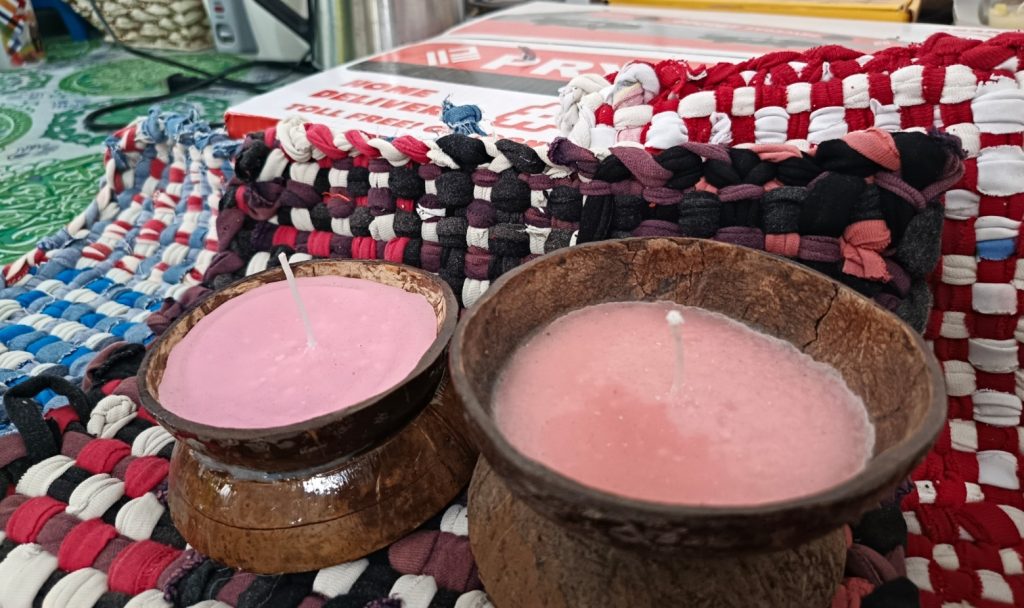
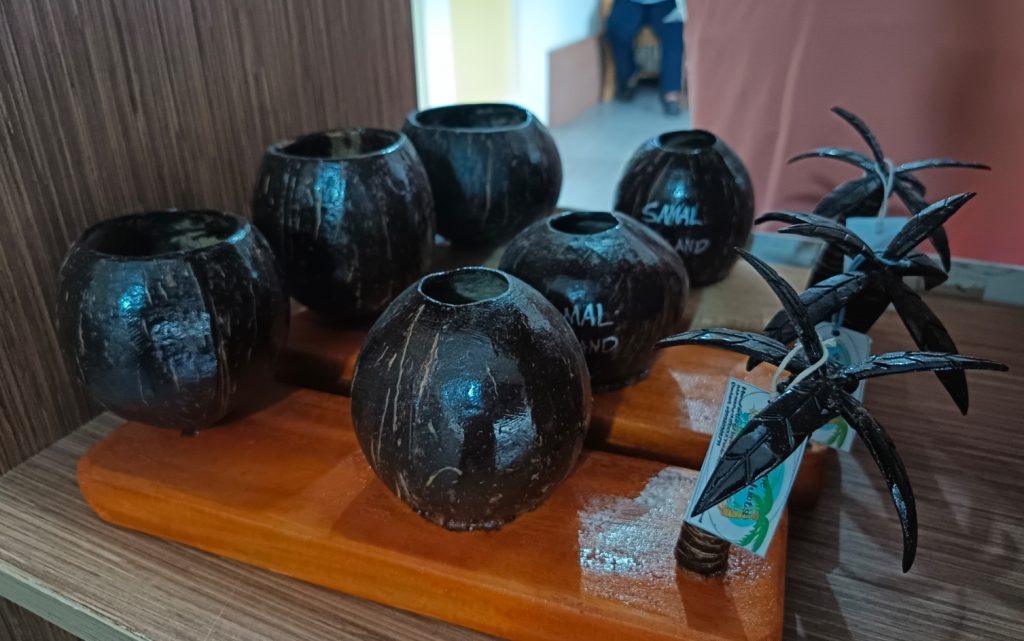
On the other hand, the group also repurpose coconut shells as vessels for eco-friendly candles.
“The city is surrounded by coconut trees and it’s a missed opportunity if it will just go to waste,” Candido said.
Beyond traditional use of coconut shells which is burned for charcoal, the group turns these discarded coconut waste into beachy aesthetic candles.
The group is targeting to promote the use of these rags and display candles in tourism establishments as a souvenir in the resort city.
Sustainable use of resources
Circular economy as defined by the United Nations Development Programme (UNDP) aims to minimize waste and promote a sustainable use of natural resources, through smarter product design, longer use, recycling and more, as well as regenerate nature.
UNDP in the Philippines under the EU–PH Green Economy Partnership (Specific Objective 2: Green LGUs) through Global Gateway launched the Innovation Challenge in 2025.
The Innovation Challenge aims to identify and pilot innovative solutions to address local circular economy priorities in 10 partner local government units (LGUs): Pasig, Quezon, Caloocan, Baguio, Puerto Princesa, Iloilo, Ormoc, Davao City, IGACOS and Municipality of Del Carmen.
The challenge focuses on three priority areas: plastic circularity, organic and food circularity and green tourism.
Two groups Sinagtala Hardin Adi sa Pu ng Samal and Hugpong Manggagama sa Isla advances circular economy, transform waste and scraps into reusable items.
From trash to craft
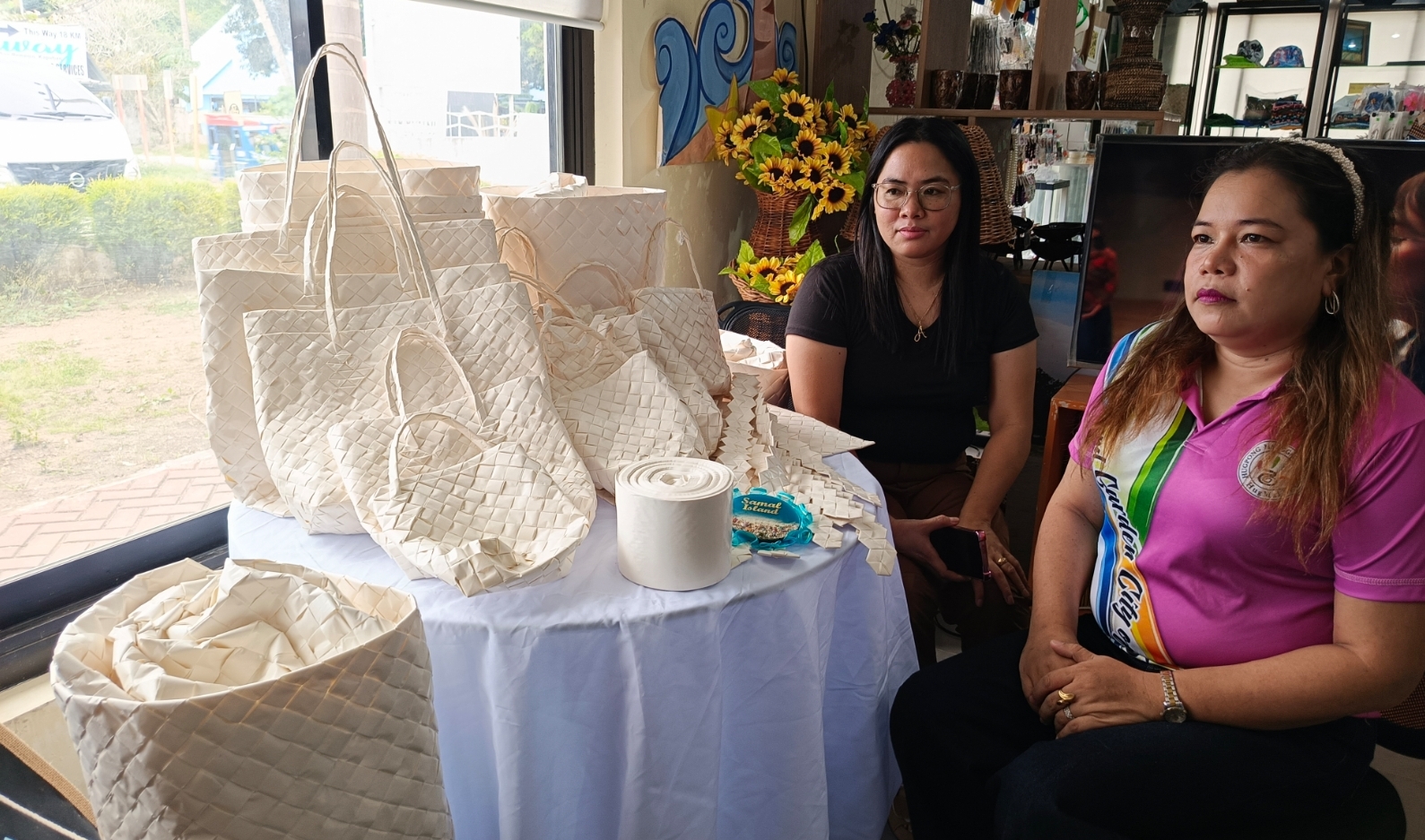
Transforming trash to crafts, the women-led association Hugpong Manggagama sa Isla (HUGMAI) Association champions circular economy through turning discarded sticker papers into fashionable bags.
The group is in partnership with International Pharmaceuticals, Inc. (IPI) who provides them with the discarded sticker papers, since 2013.
As a major manufacturer and distributor of health, wellness, and consumer products known for its flagship brands like Efficascent Oil, Bioderm, and Casino Alcohol, IPI has a lot of discarded sticker papers from their product labels.
Sticker papers usually come stuck with another sheet of paper which is easy to peel off. HUGMAI president Louell Cinto said rather than throwing away the peel off sticker papers, they thought of reusing it to weave bags.
“Instead of throwing it away, these peel off stickers can be used to make bags, garlands, and mats,” Cinto said, noting this product counters the take-make-dispose of the linear economy principle.
Apart from fashionable bags that can be used as tokens for visitors in the city, these bags can also be used for everyday use such as for groceries, an eco-friendly alternative to plastic bags.
Cinto said the innovative product became a source of livelihood for the members, as the finished product can be sold from P50-P200 depending on the size.
LGU support
Mercel Fernin, senior environmental management specialist of the city’s environmental and natural resources office, said while the waste of the city is being managed through the comprehensive waste management system of the city, it continues to increase due to its increasing population.
Fermin said although the segregation and regulation is strict, the population increases as the tourism of the island garden city continues to boom.
“The circular economy intervention is a huge help so that any type of waste will not go directly to final disposal, and be repurposed,” Fernin said.
On the ground, the LGU eyed to integrate the circular economy in the barangay government for education and awareness so as to contribute to the city’s goal to lessen waste that is brought to the sanitary landfills.
CENRO also proposed to resort owners to contribute to the circular economy by using plastic bottles as floaters as it is more durable than wood.
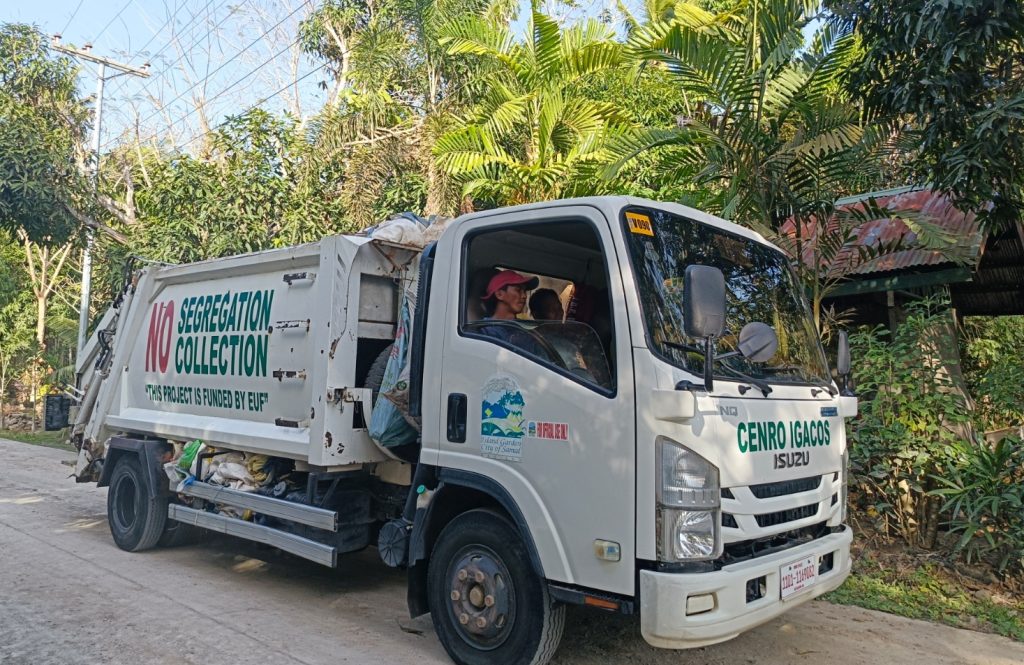
CENRO recorded a daily waste collection of nine tons for recyclables including PET bottles, and broken glasses 10 tons per day for plastic residuals that end up in sanitary landfills. The bulk of the recyclables are from resorts and tourism establishments.
The Samal city council through the committee on environment and natural resources in partnership with CENRO pushes for a city ordinance to advance the circular economy and regulate waste in the city.
Behavioral change
Mark Peñalver, executive director of Davao City based Interfacing Development Interventions for Sustainability, said behavioral change is necessary to achieve the full transition to a circular economy.
“To adopt a circular economy, it has to start with how people perceive solid waste management and the take-use-dispose mindset,” Peñalver said.
In Samal, IDIS worked with the local government to conduct an ethnographic and baseline study on behavioral change to sustain the initiative on circular economy.
UNDP reported that over the past two decades, material consumption has risen by over 65 percent globally, reaching 95.1 billion metric tons in 2019.
UNDP stressed transitioning to a circular economy will be instrumental to achieving well-being and survival of the people and the planet.
