


BY JEREMAIAH M. OPINIANO
MAKATI CITY — The Illegal recruitment of prospective and current overseas Filipino workers (OFWs) rose using Facebook and TikTok pages, dwarfing the Department of Migrant Workers’ efforts to curb all sorts of IR activities.
In DMW’s fourth full year of operation, data from 2022 to November 2025 show that 170,140 pages on Facebook and TikTok were shut down for conducting illegal recruitment activities such as online direct hiring and charging fees.
From only 614 pages in 2022, the taken-down pages rose to 85,538 as of this November. Detected social media pages rose especially when DMW forged partnerships with Facebook owners Meta and TikTok to clamp down on these IR agents.
These IR agents, whether based in the Philippines or in host countries, do not possess valid licenses to recruit coming from the DMW.
Illegal recruitment activities, especially when affecting at least three workers, are outlawed by the Migrant Workers and Overseas Filipinos Act of 1995 (or Republic Act 8042, amended into RA 10022).
DMW, created through Republic Act 11649, runs current-day anti-illegal recruitment activities that were the task of the now-defunct Philippine Overseas Employment Administration (POEA) from 1982 to 2021.
But illegal recruitment has persisted even before the enactment of the 1974 Labor Code of the Philippines, through Presidential Decree 442, and when the Overseas Employment Development Board (OEDB) got mandated to regulate overseas employment from 1975 to 1981.
A corollary to the rise of taken-down social media pages was the rise of illegal recruitment cases handled by the regulator DMW. From a total of 327 from 2022 to 2024, running-year figures show DMW handled 479 IR cases.
DMW also filled the year with anti-illegal recruitment (AIR) operations and surveillance activities, with some 992 of these surveillance activities happening over a 47-month period.
These AIR surveillance activities resulted in the closure of 91 establishments under the DMW era.
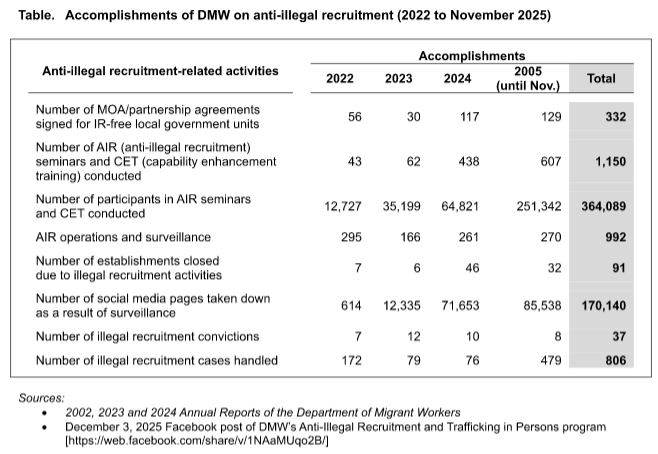
As to convictions, the DMW’s first 47 months yielded only 37 convictions coming from local courts. These convictions included that of Alejandro Leveriza Jr. last Nov. 29.
Leveriza (alias “Al”) was nabbed by the National Bureau of Investigation in January 2009 for duping 15 job applicants of a million pesos through Shellisa Travel and Tours International. The travel agency advertised chambermaid jobs in Macau, the United Arab Emirates, and other countries, and required a P40,000 “processing fee” from applicants.
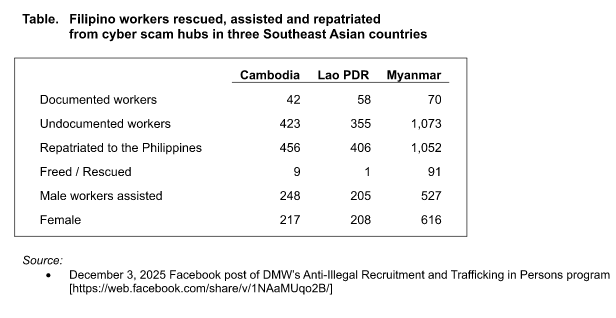
The country also continues to be on its toes rescuing illegally-recruited and trafficked Filipinos working in cyber scam hubs in Cambodia, the Lao People’s Democratic Republic, and Myanmar. This year alone, and covering the three countries, DMW assisted 2,021 victims, with 1,914 of them repatriated to the Philippines.
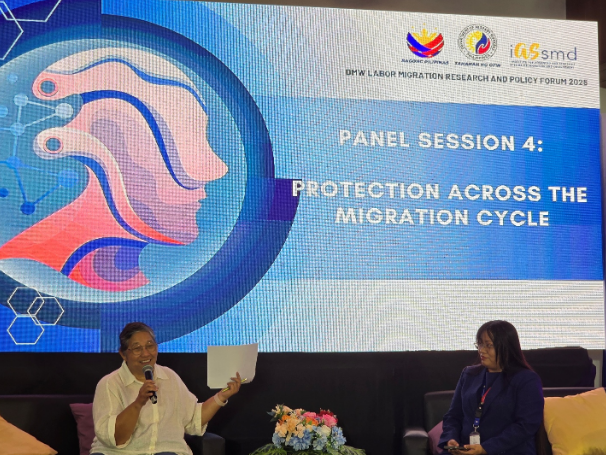
At a research and policy forum in Makati City, veteran recruitment sector leader Raquel Bracero reveals that fellow Filipinos abroad are the ones using TikTok and Facebook to directly hire Filipinos in host countries.
“They would say that [such online recruitment] is legal in the host country,” Bracero said at a panel session. In Taiwan, for example, this president of the licensed agency Peridot International Resources said that Filipinos are “willing to pay” amounts ranging from P300,000 to P500,000 for salaries amounting to NT$1,000 monthly.
Illegal recruitment activities, Bracero adds, affect “not just the vulnerable sector (such as less-skilled workers) but also skilled workers and professionals.”
Director Atty. Geraldine Marquez of DMW’s Migrant Workers Protection Bureau (MWPB) said that the Philippines’ anti-illegal recruitment and trafficking efforts are well in-place and respond to the realities of cyber-induced recruitment.
“Enhanced case handling has been there for a matter of time. Standardized protocols, unified digital case tracking systems, and strengthened capacities for cyber-enabled and cross-border trafficking ensure that (DMW’s) processes match the realities of modern-day exploitation,” Marquez said.
Given DMW’s creation on December 30, 2021, by virtue of the signing of Republic Act 11649, the agency has released updated rules and regulations governing the recruitment and employment of land-based OFWs in July 2023.
But Bracero scratches her head about dealing with fellow Filipinos allegedly acting as “scammers” and recruiting compatriots abroad.
“Ma’am, it’s okay,” Bracero quotes some Filipinos abroad as saying. “It is just in the Philippines that (online recruiting) ain’t legal. Thus, recruitment agencies face challenges always having to explain to these Filipino workers… and even to foreign employers.”
———————————————————————————————————————–
Jeremaiah Opiniano teaches journalism and research methods at the University of Santo Tomas.
