
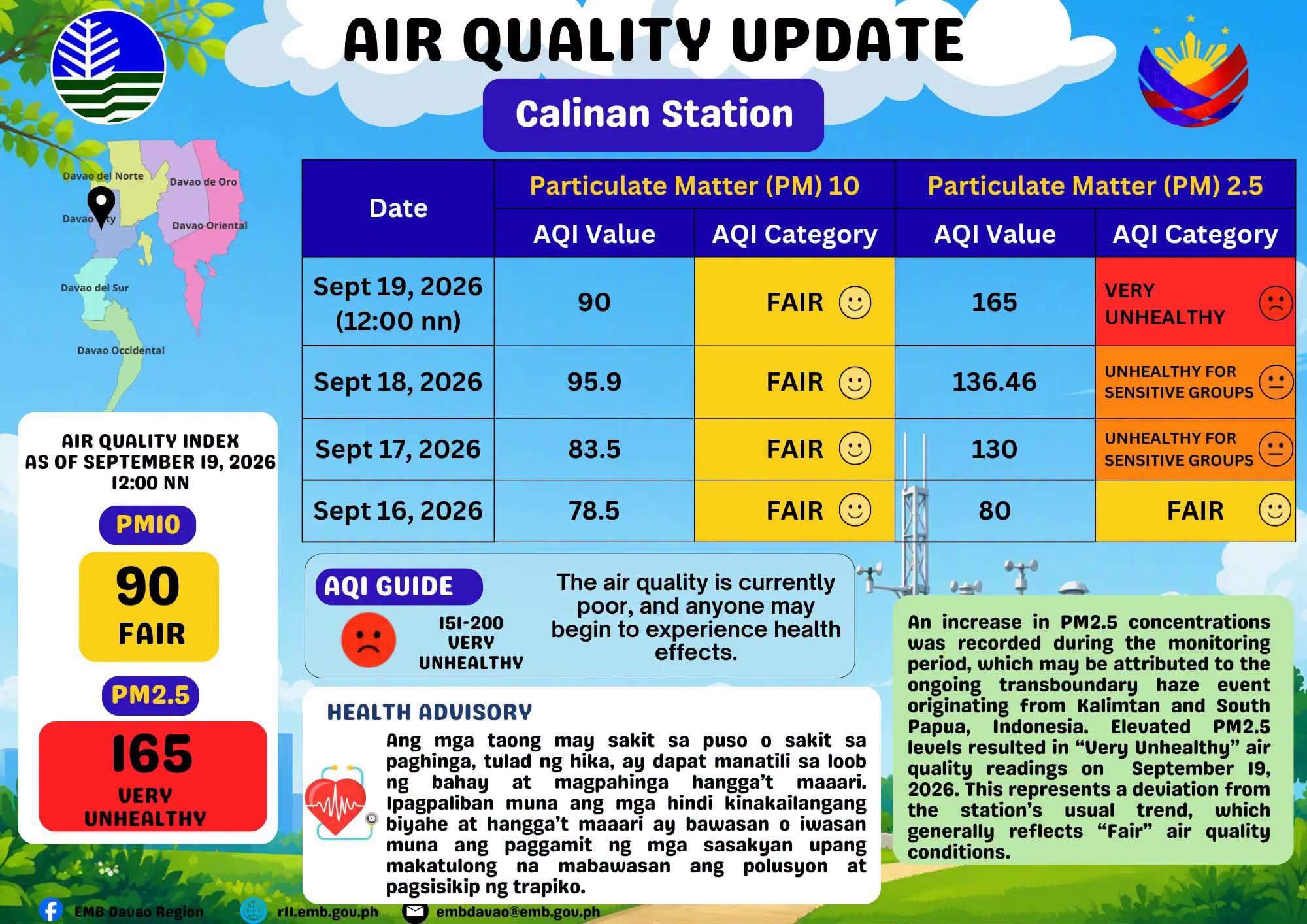
FINE PARTICULATE pollution in parts of Davao City climbed to unhealthy levels in the past few days as the Environmental Management Bureau XI urged sensitive groups to stay indoors.
EMB’s Calinan Monitoring Station recorded a “very unhealthy” reading on Sept. 19, which the bureau linked to the rise in PM2.5 concentration due to the transboundary haze event originating from Kalimantan and South Papua in Indonesia.
At Calinan, the PM2.5 air quality index (AQI) reached 165 as of 12 noon on Sept. 19, which fell in the “very unhealthy” range of 151 to 200.
The AQI guide for that category says the air quality is poor and anyone may begin to experience health effects.
The reading is a sharp climb from 80, or “fair,” on Sept. 16, and from 130 and 136.46 on Sept. 17 and 18, both “unhealthy for sensitive groups.”
The station’s PM10 readings stayed in the “fair” range throughout, at 90 on Sept. 19.
EMB said the PM2.5 spike deviates from Calinan’s usual trend, which generally reflects “fair” air quality.
The agency urged people with heart or breathing conditions, such as asthma, to stay indoors and limit breathing outdoor air as much as possible. Residents are also urged to postpone non-essential trips and reduce or avoid vehicle use to help cut pollution and traffic congestion.
Meanwhile, the Digos Station in Davao del Sur recorded PM2.5 levels in the “unhealthy for sensitive groups” category for three straight days.
The AQI was 101 on Sept. 17, 119.9 on Sept. 18, and 115.77 as of noon on Sept. 19, up from a “good” 41.66 on Sept. 16.
Its PM10 readings remained “fair,” at 55.7 on Sept. 19. EMB said the station usually records “good” to “fair” air quality.
In Malita, Davao Occidental, the PM2.5 AQI rose to 101.21 as of noon on Sept. 19, moving from “fair” into “unhealthy for sensitive groups” for the first time in the four-day monitoring period. It was 86.76 the day before and 69.55 on Sept. 17. PM10 remained “good” at 45.6.
Farther north, the Tagum Station in Davao del Norte showed a steady but milder rise, where PM2.5 climbed from 41.9 (“good”) on Sept. 16 to 51 on Sept. 17, 60.93 on Sept. 18, and 74.98 on Sept. 19, all “fair” since the 17th.
The AQI guide describes the range as acceptable for the general public.
For “unhealthy for sensitive groups” readings, EMB advised that some children and older adults may experience discomfort.
Refrain from open burning
Meanwhile, environmental groups reminded the public not to burn dry leaves and twigs, crop waste, and household trash to avoid aggravating air quality.
Atty. Mark Peñalver, executive director of the Davao City-based Interfacing Development Interventions for Sustainability (IDIS), said open burning, a prohibited act under RA 9003, produces particulate matter 10 and 2.5 and other environmental contaminants.
This includes highly toxic dioxins that can severely affect the air quality and pose adverse health effects.
“While we cannot extinguish the haze-causing fires in Indonesia, we can avoid exacerbating its effects by properly managing our discards and not burning them,” Peñalver said.
Aileen Lucero, National Coordinator of the EcoWaste Coalition based in Quezon City, appealed to waste generators not to set farm and household waste on fire and to abide by RA 9003.
“We also ask the authorities to closely monitor the operations of existing disposal sites and the rehabilitation of closed dumps to prevent spontaneous landfill fires from occurring,” Lucero stressed.