

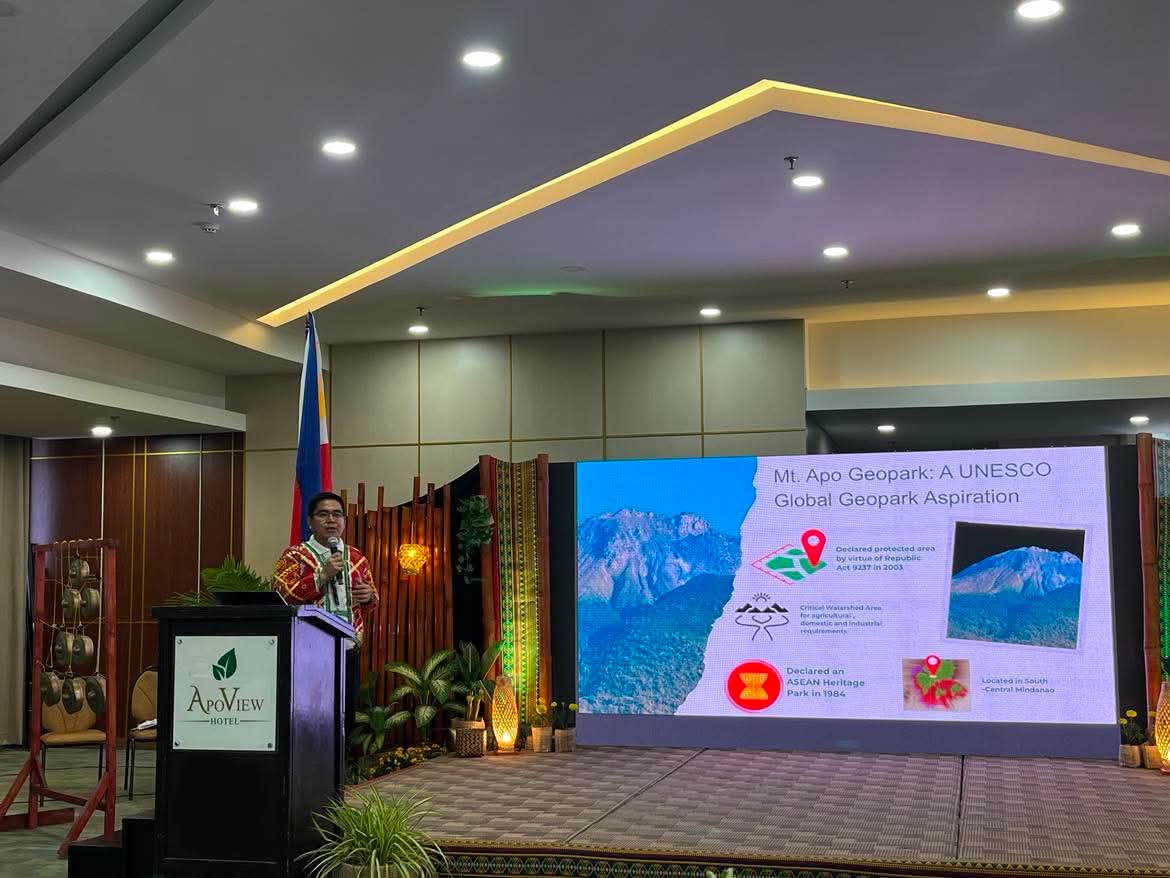
OFFICIALS of the Mount Apo Natural Park (MANP) presented their official bid to international evaluators to secure the status of UNESCO Global Geopark and become the second site in the Philippines, after Bohol, to receive the designation.
Dr. Guy Martini of France and Chenggong Zhang of China arrived in Davao City on Sunday, Aug. 16, to conduct a five-day on-site validation mission.
The evaluators will verify the self-evaluation document and application covering conservation, education, and sustainable community-led development submitted jointly by the Department of Environment and Natural Resources (DENR) regional offices XI and XII.
During the Partners in Stewardship: Mt. Apo Geopark Stakeholders’ Dialogue at Apo View on Sunday, protected area superintendent Clint Michael Cleofe outlined the framework of the 640-square-kilometer (64,000-hectare) protected area.
First declared a national park in 1936 and legally gazetted under Republic Act 9237 in 2003, Mount Apo traverses seven local government units across two administrative regions XI and XII.
Cleofe detailed the primary grounds anchoring Mount Apo’s international geological significance: geological tectonics, clean energy, biodiversity and indigenous culture.
MANP has globally rare double-verging arc-arc collisions of the Molucca Sea Plate and the Philippine Sea Plate, which gave rise to the country’s highest peak.
Located within MANP is a world-class geothermal production field operated by the Energy Development Corporation and Philippine National Oil Corporation.
Cleofe added that there is a high level of species endemicity directly linked to the mountain’s varied abiotic features.
MANP has a deep cultural integration with three resident indigenous groups: the Bagobo Tagabawa, Bagobo Klata, and Obu-Manobo.
Following initial activities with the Bagobo Klata community, the two-person UNESCO evaluation team will visit Indigenous Cultural Communities in Digos City and Santa Cruz, Davao del Sur, to meet with members of the Bagobo Tagabawa and Obu-Manobo tribes.
Initial preparation for the application started in 2022, culminating in the formal submission of the application.
In addition to cultural heritage sites, the itinerary includes visits to local schools, community-based eco-tourism programs such as Lake Agco hot springs, and the Mount Apo Geothermal Production Field operated by the Energy Development Corporation in Cotabato Province.
The evaluators will compile a report to be vetted by member states of the UNESCO International Geoparks and Geosciences Programme.
DENR XI regional director Ma. Mercedes Dumagan emphasized Mt. Apo’s landscape possesses geological, biological, and cultural values “that deserve not only national recognition but also a place among the world’s most outstanding territories.”
For Martini, working on Geopark is “looking much more than simply a territory well-managed” but “to come back to a knowledge and a sense of the place, a holistic sense.”
“By mixing an effusion with all our heritage, the cultural, the natural, the geological, and the intangible, we can maybe develop in this territory a new policy of sustainable development towards our population, making our local population proud to be there,” Martini said.
Zhang, on the other hand, said he looks forward to visiting geo-sites and meeting the communities, as their role as evaluators is to help “tell the beautiful story of Mt. Apo to the whole world.”
“We are here not just to conduct the evaluation. We are here to help; we are not to judge. We want to see how you successfully connect geo-heritage, clean geothermal energy, and community development,” he said.
A final decision from UNESCO on Mount Apo’s nomination is expected by 2027 following the completion of the full evaluation cycle.