



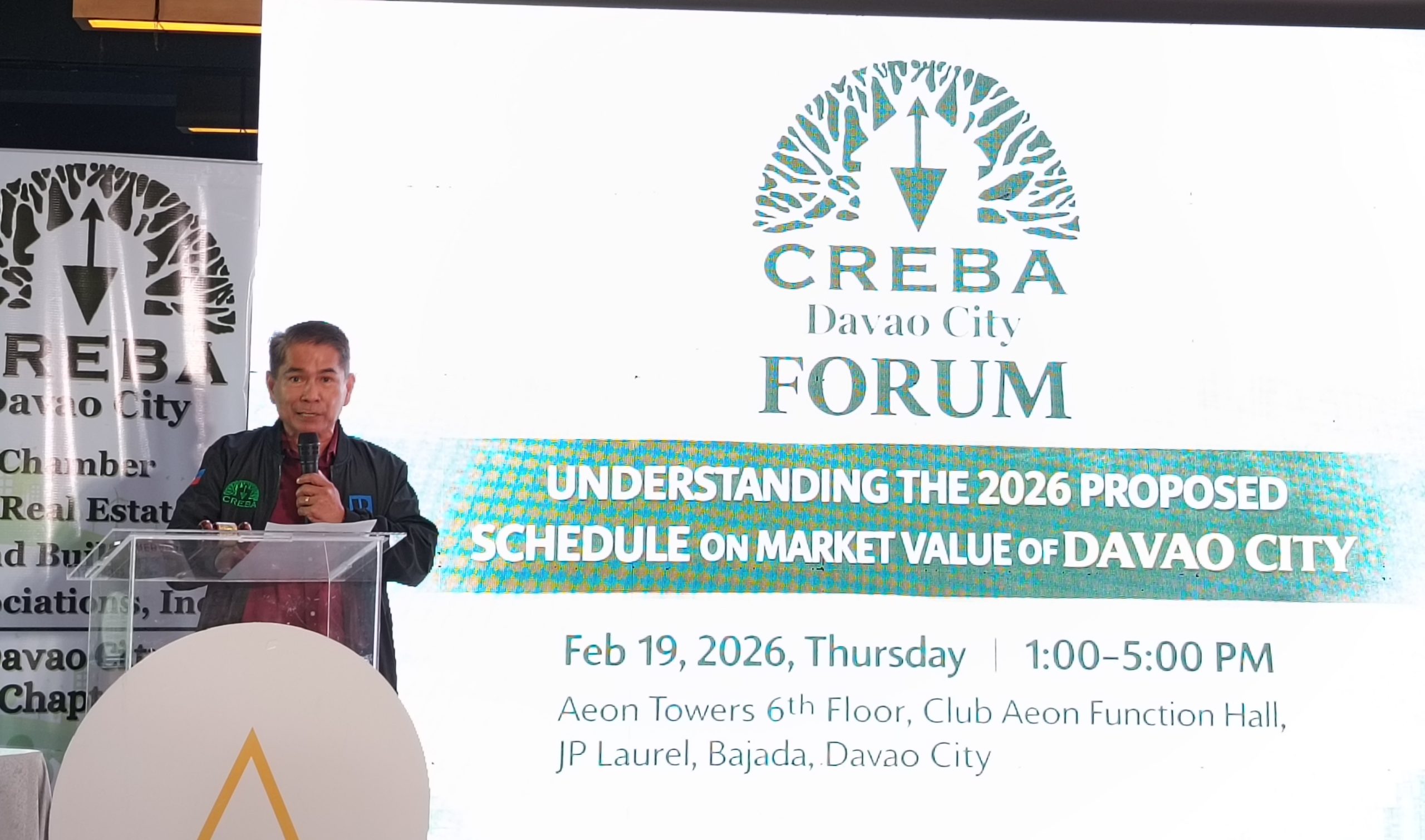
STAKEHOLDERS of the real estate industry in the city raised concerns about the Proposed Schedule of Market Value (SMV) for 2026, and called for a more transparent valuation basis.
This follows the sudden increase of 300-800% in market values of properties as reflected in the SMV for 2026, as prepared by the City Assessor’s Office.
The Chamber of Real Estate and Builders’ Association, Inc. (Creba) Davao City Chapter; Davao City Chamber of Commerce and Industry, Inc. (DCCCII); Davao Board of Realtors Foundation, Inc. (DBFRI); and real estate brokers in the city collectively called for reassessment
“We recognize that the schedule of market values for Davao City is far more than a technical document; it is a very critical policy instrument, because it affects taxation, equity, investor confidence, valuation benchmarks, and ultimately the economic competitiveness of Davao City,” Creba Davao president Engr. Oscar Tabije said during the Creba Forum on Understanding the 2026 Proposed SMV on Feb. 19.
Tabije stated that policies with economic impact, such as the SMV, must be carefully studied, openly discussed, and clearly understood prior to implementation.
This was also echoed by DBFRI president Miraluna Cerbo, who questioned the irony of the government’s initiative to provide affordable housing, yet the market value of properties is skyrocketing.
“The government is promoting affordable housing, so how can we afford that? Land prices are already high, then you add the taxes, on the side of a realtor, how can we sell to those less fortunate clients?” Cerbo said.
DCCCII representative Luisa Abaya said the institution has submitted a position paper to the city government as early as December 2025 to provide a more transparent presentation of valuation basis, economic and social impact assessment, and a comprehensive review of tax rate.
Abaya cited the disparity, such as in the agricultural sector, especially the banana industry, where the range of market value increases from 300-1200%.
“The disproportionate increase directly threatens food security and small landowner viability,” she stressed.
Meanwhile, the urban residential or subdivision properties showed a 200% market value increase, impacting the middle-income homeowners.
The proposed 2026 land market values in Davao City show significant increases across nearly all classifications—residential, commercial, industrial, and agricultural—when compared to 2017 levels.
In urban areas, the market values per square meter have risen sharply, often doubling or even tripling for specific sub-classifications.
For commercial lands, the highest-tier commercial land (C1) increased from ₱33,820/sq.m. in 2017 to ₱60,100/sq.m. in 2026, while lower-tier commercial lands (e.g., C8) also saw growth, rising from ₱4,800/sq.m. to ₱8,200/sq.m.
Meanwhile, top-tier regular residential land (R1) rose from ₱15,890/sq.m. to ₱24,900/sq.m. (reclassified as RR1). The lowest recorded value for regular residential land increased from ₱310/sq.m. (R12) to ₱1,200/sq.m. (RR8).
The Residential (Subdivision) category saw even more dramatic jumps. First-class subdivision land (R1) moved from ₱15,890/sq.m. to ₱37,000/sq.m. (SR1) while Mid-tier subdivision land (R4) increased from ₱4,920/sq.m. to ₱15,100/sq.m. (SR4).
For agricultural values that are measured per hectare, substantial percentage increases are driven by productivity classifications.
Banana (Lakatan) 1st-class lands rose from ₱271,000/ha to ₱3,473,800/ha, while Cacao: 1st-class lands increased from ₱350,000/ha to ₱719,730/ha.
Durian 1st-class lands, on the other hand, saw a rise from ₱790,000/ha to ₱1,254,800/ha. while cassava 1st-class lands increased from ₱240,000/ha to ₱1,048,600/ha.
Councilor Danilo Dayanghirang backed the industry’s opposition and reested for them to submit a position paper to their office to be tackled in a committee hearing with the committee on finance, ways, means, and appropriation.
“We are really in an economically hard up, they even increased the VAT. In some areas, the prices are going up. What is sad is the new law making it uniform in the assessment of properties, discarding the market adjustment,” Dayanghirang said, noting the city cannot afford to have more additional taxes.
Engr. Sheila Coloma, City Assessor’s Real Property Valuation Division head, said the proposed SMV underwent two consultations in the last quarter of last year.
Coloma said the CAO is welcome to another round of consultations, targeted for the first week of March.
The CAO completed the SMV for 2026 in November, which can be accessed through the link: https://bit.ly/ProposedDavaoSMV2026.
In compliance with Section 15 of Republic Act No. 12001, or the Real Property Valuation and Assessment Reform Act (RPVARA), and Regional Memorandum Order No. 001-2024 issued by the Department of Finance – Bureau of Local Government Finance, the publication of the Proposed SMV is mandatory.

