

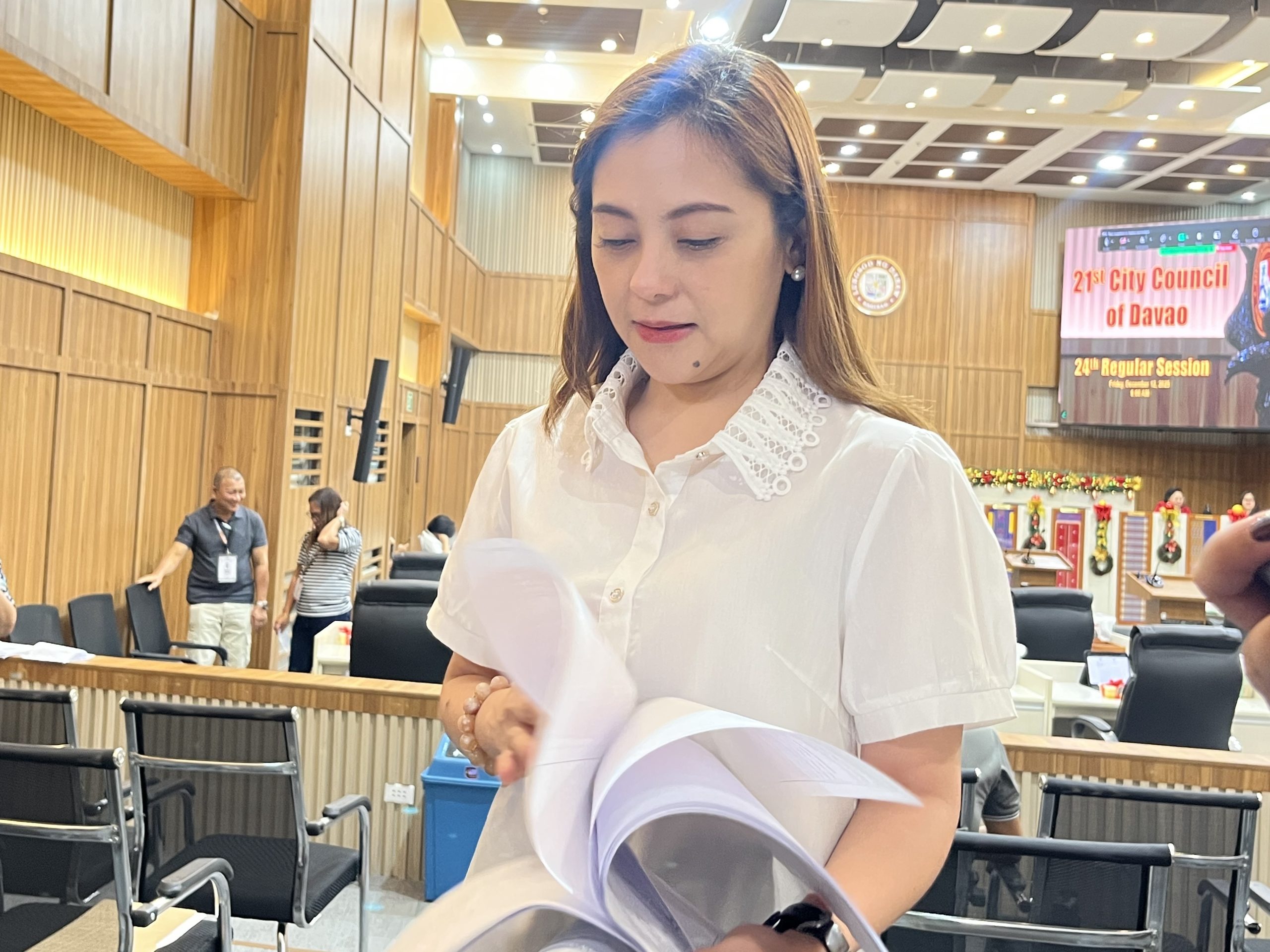
THE AMENDMENTS for the Local Investment Code were approved during the 21st city council session on Friday, Dec. 12.
April Marie Dayap, chief of the Davao City Investment and Promotion Center (DCIPC), told reporters that the Investment Code is more comprehensive for businesses and investors who wish to invest in the city.
“In the hope that we will be able to attract more investors in the city, our approach is more comprehensive in terms of preferred investment areas that we would like Davao City to attract investors,” Dayap said.
In the amended Code, Section 17 outlines the list of priority investment areas that were more defined in terms of coverage.
Agri-business, more particularly on and limited to agro-processing; modern post-harvest facilities, technology and services: cold storage and blast freezing, nitrogen freezing facilities and individual quick freezing/ heat vapor treatment facilities; packing facilities for agricultural produce; trucking and agri-logistics services; and agri-economic zones, and exports.
Meanwhile, tourism is particularly focused on and limited to: recreational facilities, retirement villages, hotels with Department of Tourism star rating of 2 and better; theme parks, conventions/exhibition/trade display centers/museums; eco and agri-tourism parks, nature sports.
Under tourism: Historico-cultural heritage projects such as shrines, monuments, and landmarks, local historical sites/properties, and cultural properties/cultural treasures are included.
For sports tourism: International sporting events/meets; sports complexes/arena/plaza; gymnasium/court, golf courses, and E-Sports.
For the Halal Industry: protection and processing centers for Halal products; Halal-related business enterprises, including International Halal Certifiers; and common service facilities.
For light manufacturing: It included pharmaceuticals and cosmetics; construction and related materials such as wood-based (doors, windows, plywood and veneer, moldings); metal-based; non-metal based; chemical-based (e.g. PVC, plastics, vinyl, paints).
Bio-technology, garments and footwear, and Food manufacturing are covered in Light Manufacturing.
Meanwhile, Property Development is focused on residential property development for economic and socialized housing; business parks and industrial estates classified as special economic zones as determined by the Philippine Economic Zone Authority and IT parks, buildings and centers, and modern facilities for industrial leasing.
On the other hand, Health covers general hospitals (Level 1 to 3); services involving advanced imaging, biomolecular technology, diagnostic technology, and minimally invasive surgeries such as adrenalectomy, cancer surgery, heart surgery, kidney transplant, neurosurgery, orthopedic surgery, among others; Specialized treatment centers; and Healthcare facilities in preferred districts, laboratories for communicable and infectious diseases and healthcare waste management.
Education centers on specialized schools and skills training institutions (Centers of Excellence (COE) as recognized by the Commission on Higher Education (CHED), innovation centers, and business incubation hubs, healthcare training facilities, research and development facilities, and testing laboratories.
Technology covers contact/call centers, business process outsourcing, knowledge process outsourcing, computer software programs, applications development, pioneer technology start-ups, financial technology, innovation, and data centers.
Eco-Industry, on the other hand, focuses on establishment of toxic and hazardous waste management facilities; river system rehabilitation; clean development mechanism projects; waste management (4Rs – Reduction, Reuse, Recycling, Recovery); sewage treatment facilities; risk preparedness programs for disaster prevention, preparedness and emergency response; other innovative products/services that positively influence the environment as determined by DCIPC and approved by the board.
Also added in Eco-Industry are conventional and renewable energy sources.
Under Electric Vehicles: EVs and charging station component; manufacturing component; human resource development component; research and development component, and ev distribution
Infrastructure focuses on, but is not limited to: solicited PPP projects as contained in the inclusive list made by the Davao City Government PPP program; unsolicited PPP Projects; telecommunication projects; international gateway facilities; activities that directly support government infrastructure projects as determined by DCIPC and as approved by the board. logistics, and charging/refueling stations for alternative energy vehicles.
Also added are the inclusive business activities, are micro-small and medium enterprises involved in activities in the PIA; social enterprises (enterprises that support ses or indigenous peoples); and investments in preferred districts, which shall be limited to Baguio District; Calinan District, Marilog District, and Paquibato District.
For the tax incentives under the
The Investment Code gives incentives to new projects and MSMEs, such as an exemption from the payment of business tax for a maximum period from three years to five years from the actual Start of Commercial Operation. The exemption shall be implemented on a graduated basis as follows: 100% for the first three years; and 60% for the 4th year; and 40% for the fifth year.
The mayor’s permit exemption has also extended from three to five years. They will also be exempted from the payment of amusement tax for four years from the start of their commercial operation.