


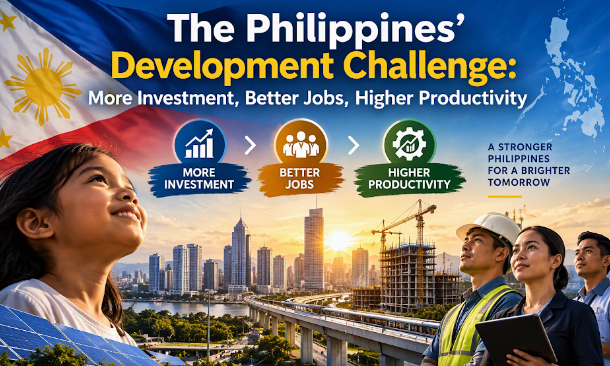
THE CHALLENGE is not simply to restore faster growth, but to raise productivity, revive investment, and create better jobs so that economic progress translates into lasting prosperity for ordinary Filipinos.
The Philippines has reached an important milestone: it has attained upper-middle-income country status. Yet the achievement also raises a more demanding question. Can the country turn this progress into a stronger productive economy, better-paying jobs and a sustained improvement in household living standards?
The World Bank’s East Asia and Pacific Economic Update, released on October 6, 2026, offers a useful regional perspective. It projects economic growth of 4.5% for East Asia and the Pacific in 2026, but the benefits are unevenly distributed. Vietnam’s growth forecast has been raised to 7.4%, Malaysia’s to 5.1%, and Thailand’s to 2.0%, partly reflecting stronger demand for high-tech goods linked to the global artificial intelligence boom. By contrast, the World Bank’s August 3 Philippines Economic Update projected Philippine growth of 3.7% in 2026 and 5.2% in 2027. These are forecasts, not final outcomes, but the difference highlights the Philippines’ development challenge.
The lesson is not that every economy must follow the same path or become a technology exporter. Countries able to attract productive investment, connect businesses to expanding markets and improve the capabilities of workers and firms are better placed to benefit from changing global demand.
Growth must translate into productive capacity

The latest Philippine national accounts underline the urgency. The Philippine Statistics Authority reported on August 7 that GDP grew by just 2.3% year-on-year in the second quarter of 2026. Household consumption increased by 2.8%, but gross capital formation—a broad measure of investment in fixed assets and inventories—fell by 9.2%. Industry contracted by 2.4%, while services grew by 4.5%.
Consumption remains essential to livelihoods and business activity. But sustained development also requires investment in machinery, transport, power, digital connectivity, productive facilities and skills. When investment weakens, the economy risks expanding too slowly to generate enough productive capacity and quality employment for a growing workforce.
The World Bank’s Philippines Country Growth and Jobs Report 2025 identified a related structural concern: more than 90% of the country’s growth since 2010 came from capital accumulation, while the contribution of total factor productivity—the efficiency with which labour and capital are used—was below 10%. This does not mean investment was unnecessary. It means that investment must do more than add physical assets; it must help businesses produce more value, compete more effectively and generate better jobs.
The immediate task is therefore to restore confidence in both public and private investment, improve the predictability of policy and ensure that infrastructure spending delivers reliable services and measurable economic returns.
Learn from ASEAN’s opportunities, not just its growth rates
Vietnam and Malaysia show how participation in regional and global supply chains can help economies benefit from shifts in world demand. Their latest growth upgrades reflect, in part, the expansion of high-tech production and exports associated with the AI investment boom. The Philippines cannot reproduce these gains simply by announcing an ambition to attract technology industries. It needs competitive infrastructure, reliable electricity, skilled workers, efficient logistics and a business environment in which firms can invest and expand.
But the Philippine opportunity is broader than manufacturing or high technology. The country has established strengths in services, tourism and a globally connected workforce. It can build on these strengths by moving towards higher-value services, improving tourism infrastructure and standards, and helping domestic businesses supply more goods and services to regional markets.
Agriculture deserves particular attention. Better farm-to-market roads, storage, irrigation, cold chains, market information and access to finance can reduce losses and improve farmers’ earnings. Food processing and stronger links between farms, logistics providers, hotels and retailers can retain more value within the country. Tourism and agribusiness are especially relevant because they can create employment across a range of skill levels, including outside major urban centres. The World Bank’s October regional assessment specifically identifies both as sectors with considerable potential for job creation at scale.
ASEAN integration should consequently be judged not only by trade agreements or export totals, but also by whether Philippine firms become more productive, local suppliers gain access to larger markets, and workers secure better opportunities.
Make electricity and infrastructure part of the jobs agenda
The cost of doing business remains a major constraint. The World Bank’s August Philippines update identified electricity prices—among the highest in ASEAN—as a drag on household welfare and business competitiveness. High energy costs affect manufacturers, small retailers, hotels, cold-storage operators, and farmers who need irrigation or refrigeration. They also reduce the money households have available for other spending.
This is not simply an energy-sector problem. It is a development and employment problem.
The World Bank presented a scenario in which renewable energy reaches 35% of the energy mix by 2030, in line with government targets. Combined with investment in transmission, storage and grid flexibility, and reforms to strengthen market competition, that pathway could reduce residential electricity prices by as much as 28% in the near term, create approximately 161,000 jobs and lift around 730,000 Filipinos out of poverty. These are modeled potential outcomes, not guaranteed results. They nevertheless illustrate how energy reform can contribute simultaneously to affordability, competitiveness and employment.
The practical priorities are to expand reliable power supply, improve transmission and distribution, accelerate viable renewable projects, strengthen competition and make infrastructure decisions more predictable. Transport, ports and digital networks also need to connect regional producers and smaller businesses to customers, rather than merely serve established economic centres.
Better jobs must be the test of development
The latest labour-market figures show why headline growth alone is insufficient. The Philippine Statistics Authority reported on October 7 that unemployment fell to 5.3% in August 2026 from 6.0% in July. Yet it remained above the 3.9% recorded a year earlier. The number of unemployed people was estimated at 2.77 million, while 5.90 million employed people—11.9% of the employed workforce—wanted additional hours or work.
The distinction matters. A person counted as employed may still have inadequate hours, low earnings or an insecure livelihood. Development policy must therefore focus not only on the number of jobs but also on their productivity, stability and capacity to raise household incomes.
The regional challenge is formidable. The World Bank estimates that 320 million young people will enter the East Asia and Pacific workforce by 2035, while only 110 million jobs are expected to be created. This is a regional projection, not a forecast for the Philippines alone, but it underlines the importance of preparing workers for productive employment.
For the Philippines, training programmes need closer links with employers and actual vacancies. Technical and vocational education, apprenticeships and workplace-based learning should equip people with skills that firms need, while strengthening foundational education, digital literacy, communication and problem-solving. Support for small and medium-sized enterprises is equally important: these businesses need easier access to finance, technology, management expertise and markets if they are to expand and employ more people.
Use technology to improve the wider economy
The World Bank’s October report focuses on artificial intelligence, but its broader lesson is about productivity. Countries do not need to develop every new technology themselves to benefit from it. For many Philippine businesses, the more immediate gains may come from adopting affordable tools that already exist.
Small firms could use digital systems to manage inventory, bookkeeping, customer service and logistics. Farmers could gain better access to weather information, prices and buyers. Tourism operators could improve bookings and customer communication. Public agencies could use digital tools to reduce processing delays and make services easier to access.
Such gains depend on more than technology. Businesses need affordable connectivity, reliable electricity, financing and workers who can use these tools effectively. Government must also strengthen data protection, cybersecurity and safeguards against misuse. Digitalisation should simplify public services and lower costs for citizens and firms, not create additional layers of paperwork.
Turn the agenda into sustained action

The Philippines does not lack development plans. The challenge is to implement a connected set of priorities consistently.
First, revive productive investment by improving policy predictability, strengthening infrastructure governance and reducing unnecessary regulatory delays. Second, lower structural business costs, especially electricity and logistics, while expanding reliable digital infrastructure. Third, raise productivity in agriculture, tourism, services and smaller enterprises, so that more local businesses can participate in regional value chains. Fourth, align education and skills programmes with actual labour-market demand. Finally, make public spending accountable for results: infrastructure should improve connectivity, training should lead to employability, and business support should help firms become more competitive.
These priorities must be pursued together. Training will have limited value if firms are not investing. Infrastructure will yield lower returns if businesses cannot access finance or markets. New technology will not deliver broad gains if smaller firms and less-connected communities are left behind.
The Philippines has achieved upper-middle-income status, but sustaining that progress requires more than a favourable classification or a temporary improvement in growth. The next development leap must be measured in productive businesses, stronger regional economies, lower costs, better jobs and rising real incomes.
The central question is no longer simply how quickly the economy can grow. It is whether the country can turn its economic potential into opportunities that reach a much wider share of Filipinos.