

BY KRISTINE NOVA S. TUCONG, RSW, MMCEAI
DAVAO CITY – The story of Jess, who died at age 12, Brenda, whose family relies on a daily pittance of coins from caroling, and Linda, whose family hops from one available house to another, mirror the untold painful stories of being homeless and a stranger in one’s own country, as the government also grapples with the unrecorded number and accounts of internal migrants.
Jess was only 12 years old when she contracted pneumonia from someone in the neighborhood in a poor village here. She was in Davao City to live with her sister, who took care of her elementary education to ease the burden on their widowed mother in Don Marcelino town, Davao Occidental.
Jess’ attending physician declared her death in July 2025 as due to multiple organ failure secondary to severe pediatric community-acquired pneumonia–high risk with hypoxia. The family’s grief did not end there; she could not be buried immediately due to a lack of money to pay for her wake at a local funeral home, which ballooned to P30,000 in 16 days.
Her sister, Cel, and her husband only eked out a living from the latter by driving a rented tricycle around the place. With each day adding to the burden of the cost of the wake. Jess’s remains had to undergo multiple injections of formalin to prevent rapid decomposition.
Brenda (not her real name), another internal migrant, viewed a life of constantly moving around as living in a community facing limited access to clean water and proper sanitation facilities, and serious health risks were often just around the corner, hitting residents, particularly children, at their most vulnerable point.
Brenda grew up in Tagum, Davao del Norte, in a family that depended on ‘pagpanaygon’ or street caroling as their primary source of income. She looked helplessly at her parents working tirelessly to keep food on the table and send their children to school. Yet money often fell short of meeting the family’s growing needs.
In the end, Brenda and her siblings were unable to finish their education. Her family was forced to move repeatedly, eventually relocating from Davao Oriental to Davao City, where she lived from 2022 to 2025. Over the years, Brenda experienced multiple displacements caused by demolition, fire incidents, and other natural and man-made calamities. Within Davao City, the family moved from SIR Phase 1 before finally settling in Purok 23B Aroma Street, Barangay Bucana, Davao City. Each move meant starting over—rebuilding not only their home, but their sense of stability.
Shaping lives
These constant movements and uncertainty of abode shaped many of these families, who lived in poverty-stricken villages and themselves had little or no access to opportunities for livelihood, food, and education.
Brenda did carry no resentment, however, toward her parents. Rather, she spoke of them with pride, recognizing the sacrifices they made and the strength it took to provide for their family despite overwhelming challenges.
At her family’s current residence in Purok 23-B Aroma, she said she would witness daily realities of struggle among her neighbors, who she said face circumstances even more difficult than her own.
In moments when she feels powerless, she turns to prayer, drawing strength and hope from her faith. If given the opportunity to help others, Brenda said her priority would be the residents of Purok 23-B.
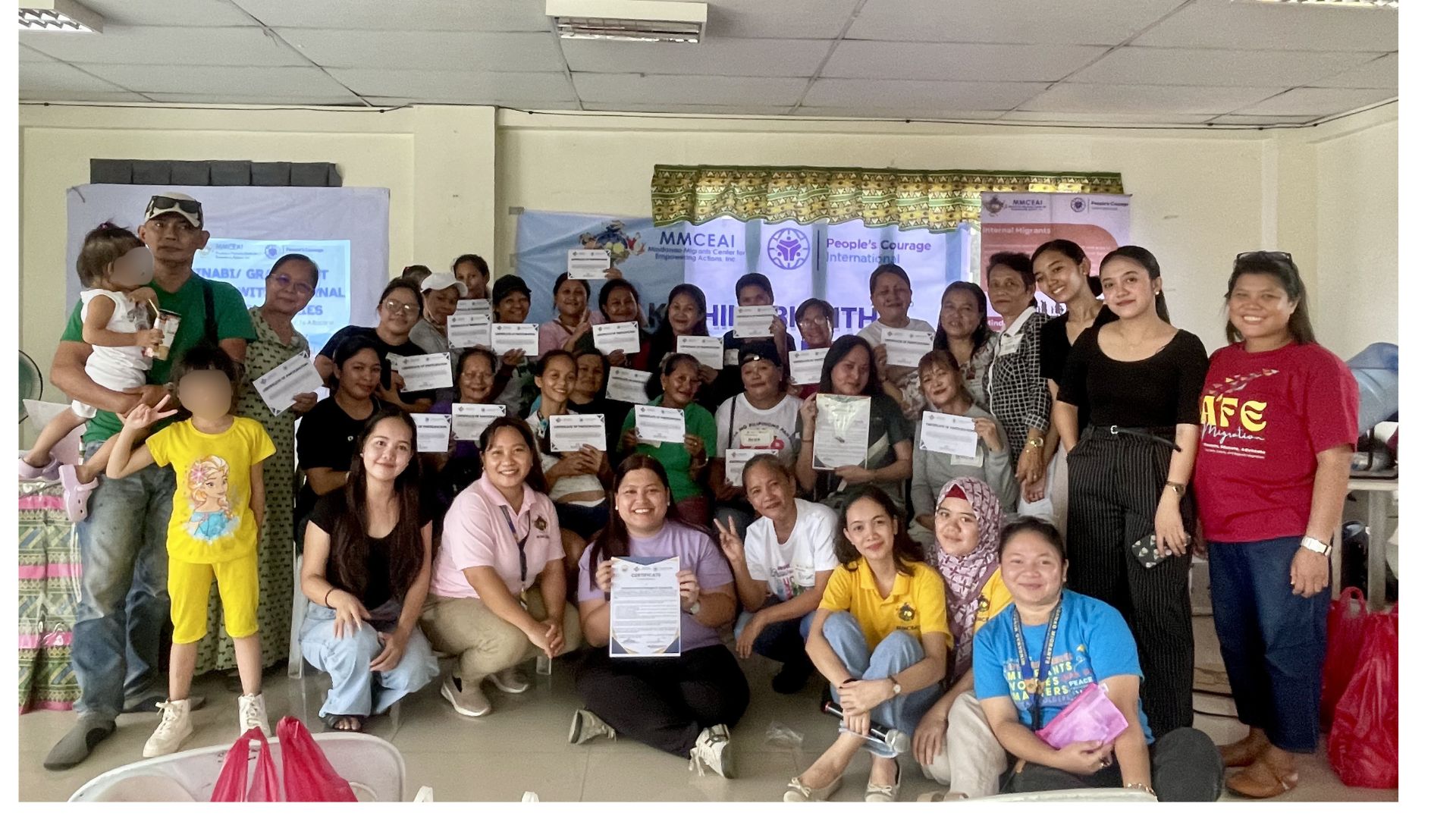
In one community gathering called Pakighinabi organized by the Mindanao-based Mindanao Migrants’ Center for Empowering Actions, Inc. (MMCEAI), Linda shared her journey with other attendees as an internal migrant, one marked by displacement, uncertainty, and quiet strength.
Originally from Toril, she relocated to Barangay Agdao Proper, Davao City, after moving in with her partner, navigating the familiar yet often invisible struggles faced by many internal migrants as they try to rebuild stability in a new community.
Her voice wavered as she recalled one of the most devastating moments her family endured: a fire that reduced the house they were renting to ashes. In an instant, they lost not only their home, but also their sense of security. With nowhere to stay and no clear understanding of where to turn for help, the family was left vulnerable—caught between survival and uncertainty. Like many internal migrants, they feared being overlooked, undocumented, and unheard in the aftermath of the crisis.
Hope springs eternal, however, as communities and organizations help.
In the case of Jess’s sister, Cel refused to give up. She knocked on doors, approached neighbors, local offices, and even party-list groups in her desperate search for help. While some offered support, it was still not enough.
Language barriers deepened the family’s suffering. Jess’s mother rita, who stayed in the hospital until Jess’s death, spoke only B’laan. She could not understand Cebuano, and thus, could not question or negotiate the hospital and funeral procedures. Left powerless, she simply agreed to whatever was asked, even if it meant more expenses.
Jess’s lack of a birth certificate further complicated the matter. Without this basic identity document, she had limited access to legal protection and services, mirroring the situation of many internal migrants who are left invisible in the system.
Relief came when the MMCEAI stepped in, Cel would recall. She was linked to her barangay, the Malasakit Center, and various agencies. The Department of Social Welfare and Development (DSWD) granted P20,000 in burial assistance. The funeral home, moved by the family’s plight, provided a discount.
On August 1, 2025, after weeks of anguish, Jess was finally brought home to Don Marcelino, Davao Occidental, where she was laid to rest.
Linda’s travails appeared to head off after she said that the community profiling conducted by MMCEAI, supported by People’s Courage International, became an unexpected lifeline during their darkest moment.
Because her family had been properly profiled and documented as renters and internal migrants in Barangay Agdao Proper, “we are now officially recognized as residents”. This recognition proved critical. It gave them legitimacy, visibility, and the confidence to seek help and enabled the barangay and partner institutions to respond swiftly and appropriately.
The profiling records became more than just data; they became proof of their presence, their needs, and their belonging in the community, Inorisa Elento, MMCEAI executive director, said. Through this process, assistance was accessed faster, coordination was smoother, and the family felt seen and supported at a time when they needed it most.
Linda urged fellow community members to open their doors, to respond, and to participate when interviewers or profilers come. She reminded everyone that profiling “is not merely a formality or paperwork” but a crucial step toward protection and support, especially for internal migrants who often live on the margins and are most vulnerable during emergencies.
Cel herself was first identified by community profilers under the Harmonizing Initiatives for the Rights and Welfare of Internal Migrants in Davao Region (HIR-IM Project), supported by People’s Courage International (PCI) and MMCEAI.
Her case confirmed the reality that many internal migrants face: lack of access to services, absence of legal documents, financial insecurity, and exclusion from local programs because they are not registered city residents, the MMCEAI said
Challenges
Jess’s story is not just about one child’s untimely death. It is about the systemic challenges that internal migrant families encounter every day, navigating unfamiliar systems, bearing the weight of poverty, and coping with loss far away from home.
Elento said there is no current tracking system to monitor the number, frequency, and condition of internal migrants.
The International Organization of Migration said there are two types of migration: international and internal. International migration occurs when people cross State boundaries to live in another country for a minimum length of time. Internal migration is when people move within the same country. Rural-urban migration is when people move specifically from rural areas to urban locations within the same country.
While conditions merit an immediate round of assistance, it is difficult, however, to get the actual number of families transferring for good to another city or province for various reasons and circumstances. Some move in groups, but relocation is often a decision made by one family to survive. Yet, no receiving or host local government has a dedicated policy to keep track of them, although an old and practically stagnant
Registry of Barangay Inhabitants and Migrants may need to be activated and funded as a matter of policy, Elento said.
Only once was this tracking of residents done, during the COVID-19 pandemic, but Elento said it was implemented as a necessary kind of border control to prevent the spread of the infection. “It is a form applicable only for and during that period, and not applicable to the issue of internal migration.”
The MMCEAI believed that the RBIM may be a good policy to start the tracking mechanism, if only to ensure the documentation of migrants who needed assistance.
The IOM said that giving attention to internal migrants is related to human security. “The vulnerability of migrants throughout the migration cycle is evident at all stages and in a wide variety of manifestations during pre-departure, transit, entry, stay and return.”