
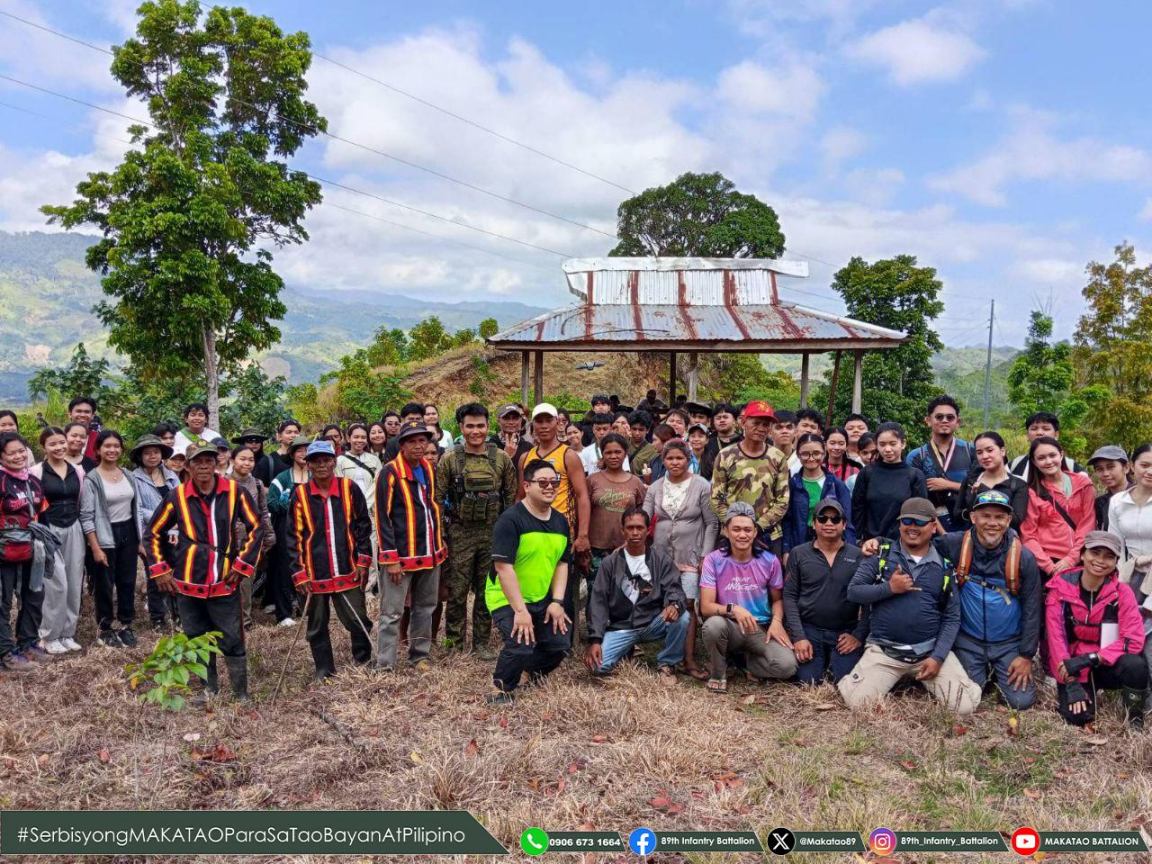
ONE HUNDRED and thirty Evolutionary Biology (BIO48) students from Central Mindanao University (CMU) successfully completed a two-day field research expedition at Mount Malimumu in Barangay Magkalungay, San Fernando, Bukidnon, on April 24-25, 2026.
The expedition, led by Dr. Noel E. Lagunday of the Institute of Biological Sciences and student representative Rodge Danniellette A. Tan, marks a significant shift in the utilization of the highland terrain.
Once utilized as a base of operations by the New People’s Army (NPA), the area is now declared free of insurgent influence and open for academic and environmental exploration.
To ensure the safety of the researchers, the Alpha Company of the 89th Infantry Battalion provided security throughout the two-day study.
The successful venture was the result of extensive multi-sectoral coordination. Before deploying, the university team engaged with the Local Government Unit of San Fernando, the Municipal Tourism Office, the Municipal Environment and Natural Resources Office, and the Indigenous Peoples Mandatory Representative.
The expedition also received a cultural blessing, with Datu Tagyaman Sinangkap (Barangay IPMR) and Bae Layden Esteban (Barangay Tribal Chieftain) leading a traditional ritual to ensure the success and safety of the study.
San Fernando Mayor Rogelio C. Yeke praised the academic institution for adhering to local security protocols.
He emphasized that under Executive Order No. 049, or the “Culture of Security,” all activities within the municipality require prior documentation and coordination to maintain stability.
“Any activity conducted in the area must be properly documented and coordinated… to maintain the peace we have worked hard to achieve,” Yeke noted.
Lieutenant Colonel Antonio G. Bulao I, commander of the 89th Infantry Battalion, highlighted the event as a model for cooperation between civil society and the military.
“Our mandate is to protect the people from the threat of terrorism. This activity is a testament to the effective synergy among the academic sector, the local government, the Indigenous Cultural Community, and the security forces,” Bulao stated. “We remain ready to support similar academic and developmental initiatives in formerly conflict-affected areas.”