


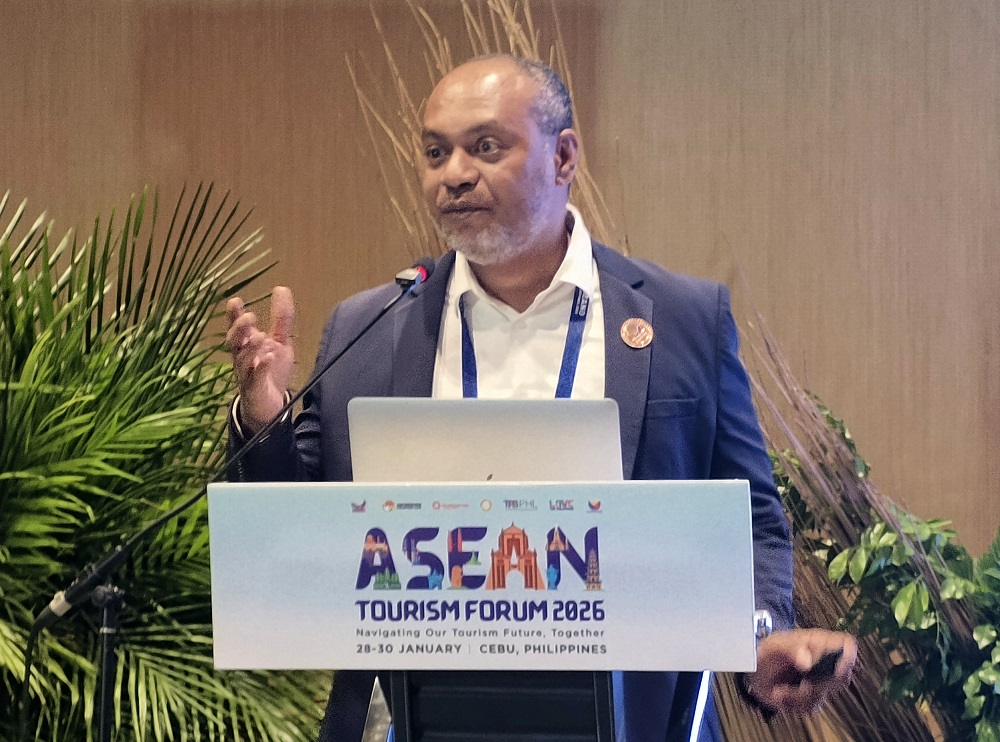
THE MACTAN Expo Centre at the New Mactan Newtown became the epicenter of Southeast Asian diplomacy and economic planning from January 28 to 30, as tourism ministries gathered for a series of media briefings and updates during the ASEAN Tourism Forum.
The event underscored a historic turning point for the region, which collectively welcomed a record-breaking 144 million international visitors in 2025, finally eclipsing pre-pandemic benchmarks.
Among the standout performers, Malaysia solidified its status as the most-visited in the region, recording 42.20 million foreign visitors in 2025—an 11.2% increase over the previous year. Baizuri Baharum, senior director at the Malaysia Tourism Promotions Board, attributed this dominance to robust regional connectivity and visa-free travel for major markets like China and India.
Looking toward the Visit Malaysia 2026 campaign, the nation plans to further increase flight frequencies and develop unique tourism products to extend the average length of guest stays.
Vietnam followed with its own record-breaking milestone, as Nguyen Quy Phuong of the Viet Nam National Authority of Tourism reported 21.2 million arrivals.

This 20.4% surge was fueled by eased visa policies and a significant rise in high-value demand from Russia, Western Europe, and India.
Indonesia also celebrated a triumphant 2025, with Ni Made Ayu Marthini, deputy for marketing, announcing 15.39 million arrivals. This figure exceeded national targets and marked a six-year high, with the UAE emerging as a rapidly growing market alongside the steady backbone of ASEAN visitors, which account for over 40% of the total.

Indonesia has now set its sights on 16 million visitors for 2026, focusing on “quality tourism” and deeper regional collaboration.
Singapore, represented by Kwan Su Min of the Singapore Tourism Board, reported a steady 16.9 million arrivals.

The island nation is playing a long game, projecting tourism receipts of up to $50 billion by 2040 and aiming to triple its MICE revenue by 2030. Strategic investments, such as the upcoming Changi Airport Terminal 5, are designed to handle 50 million passengers, ensuring Singapore remains a premier global hub.
The briefings also highlighted the transformative power of infrastructure in the region’s emerging markets. Phouthone Dalalom of the Lao People’s Democratic Republic reported that Laos surpassed its annual goals with 4.5 million visitors, an 11% increase driven largely by the China-Laos Railway.
Similarly, Antonio da Silva, director general of Timor-Leste’s Ministry of Tourism, spoke on the nation’s historic accession to ASEAN in October 2025. As the 11th member, Timor-Leste plans to eschew mass tourism in favor of authentic, untouched nature and cultural discovery, leveraging its new membership to gain regional market access and investment.
However, the forum was not without its narratives of struggle and transition. Cambodia faced a difficult year, with Prak Vuthy reporting a 16.9% drop in arrivals to 5.54 million, a decline largely blamed on the Cambodia-Thailand border conflict and lingering connectivity issues.
Despite this, the nation pins its hopes on the new $2.3 billion Techo International Airport to revitalize its global reach.
The host nation, the Philippines, also faced a period of modest growth. Undersecretary Verna Buensuceso and COO Marga Nograles reported 6.48 million arrivals, a 0.76% increase that lagged behind regional peers despite generating ₱694 billion in receipts.

To bridge this gap, the Philippines is pivoting toward digital nomad visas, VAT refunds for tourists, and the promotion of Muslim-friendly destinations and gastronomy.
In a surprising turn, the briefings were marked by the absence of representatives from Thailand and Myanmar. Thailand saw its arrivals dip by 7.2% to 32.9 million, while Myanmar recorded a slight decline to 973,000 visitors amid ongoing internal challenges.
Despite these outliers, the prevailing sentiment was one of collective strength. The consensus among the ministers remains clear: the future of Southeast Asian tourism lies in a borderless approach where competition gives way to a “unified destination” identity, ensuring the 2025 record is merely the baseline for future growth.