


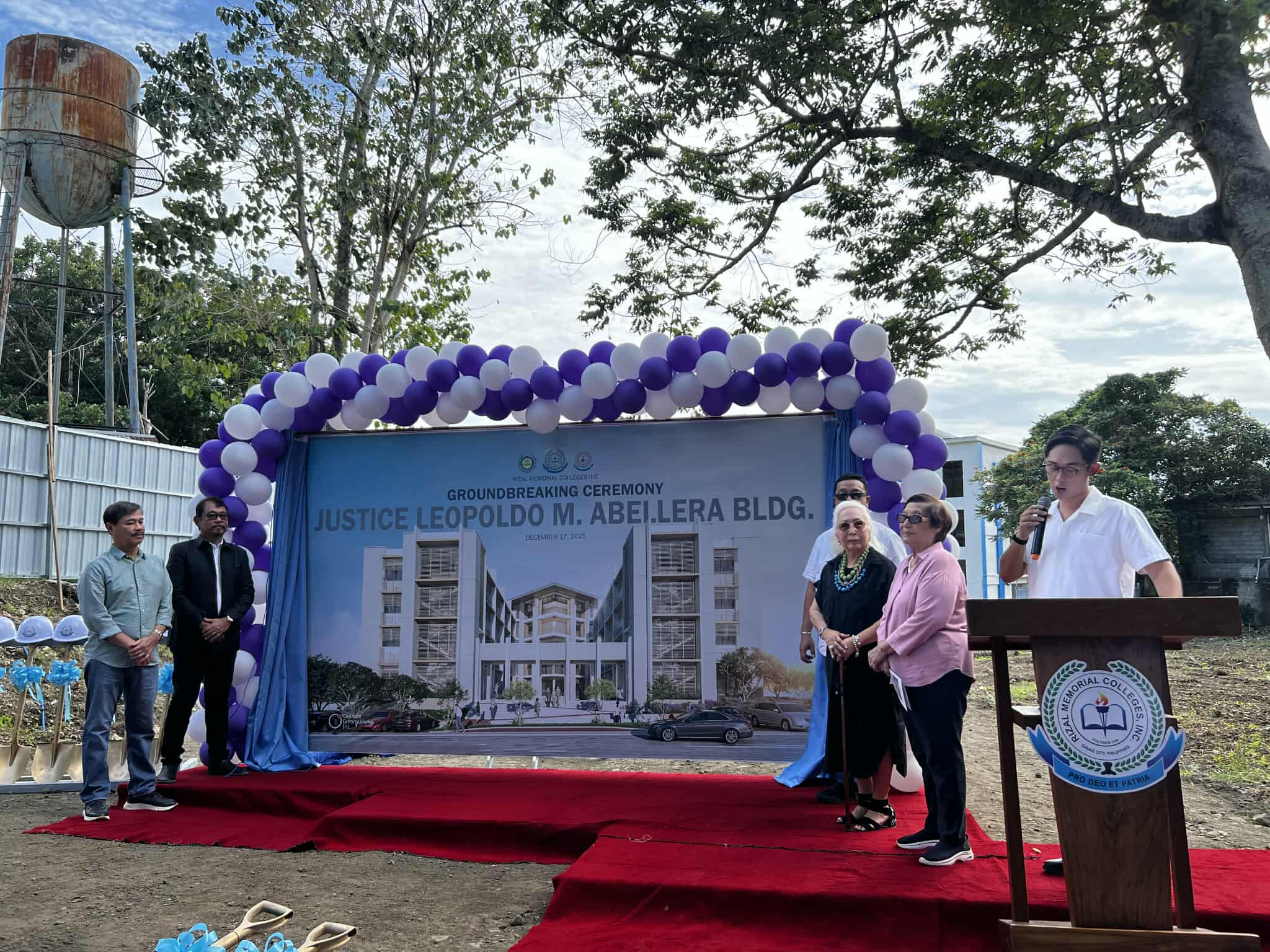
RIZAL Memorial Colleges Inc. (RMC) has announced the construction of a state-of-the-art Juris Building, scheduled for completion and opening in 2027.
The new facility will be named the Justice Leopoldo Abellera Building, honoring the late jurist’s enduring legacy of service, vision, and dedication to education and justice.
Speaking during the project announcement, Lorenzo Raphael Magno, RMC vice president for administration and finance, said the building will become the future home of the institution’s College of Law.
“The Justice Leopoldo Abellera Building is named in honor of my great-grandfather, the Honorable Leopoldo M. Abellera — a man whose life was deeply rooted in the pursuit of justice, education, and service to the Filipino people,” Magno said.
Justice Abellera served with distinction as an associate justice of the Court of Appeals and held key government posts during the administration of President Ferdinand E. Marcos, his classmate at the University of the Philippines College of Law.
According to Magno, the building embodies three core pillars: justice grounded in education, opportunities accessible to all, and the relentless pursuit of academic excellence.
“It will serve as the central hub for our law students — shaping future advocates, jurists, and public servants who will carry forward the same commitment to integrity, leadership, and service that Justice Abellera exemplified,” he added.
Meanwhile, RMC board of directors chairperson Leo Tereso A. Magno stressed that the project goes beyond infrastructure.
“This building, named in honor of my late grandfather, is not merely a law school facility. It represents a promise — a commitment to the people of Davao and Mindanao,” he said, adding that the structure will also house RMC’s graduate schools and other academic units.
For his part, RMC College of Law dean Ramon Edison Batacan disclosed that the five-story facility will feature 29 tiered classrooms, a modern law library, a cafeteria, and an amphitheater-style lecture hall designed to foster interactive learning.
“We follow the Harvard standard. The stairways are not merely for passage — they are designed as functional spaces where students can study or wait for classes. Even the hallways are intentionally student-friendly,” Batacan explained.
