
AS SOCIAL media school threats continue to rise across the region, authorities issued a warning that fake names or dummy accounts will not exempt perpetrators from prosecution.
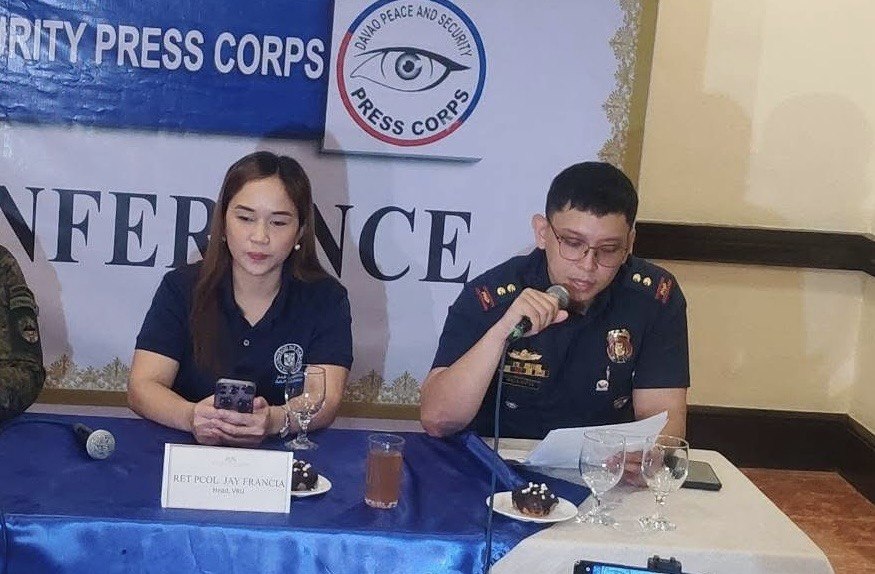
Speaking at the Davao Peace and Security Press Briefing at The Royal Mandaya Hotel on Wednesday, Aug. 12, PCAPT Cedric Suanco, head of the Anti-Cybercrime Unit-Davao, emphasized that they treat digital threats with utmost urgency.
“Social media is not a place where a person can make comments without consequences,” Suanco said. “Whether the threat was made as a joke or out of anger, such statements must be taken seriously and properly investigated.”
Data presented by the Regional Anti-Crime Unit XI revealed a sharp uptick in social media threats in Davao City and nearby areas.
Investigators recorded six cases in 2025, but that number has already climbed to 10 cases in 2026 so far, bringing the total to 16 incidents over two years. Authorities noted that most of the targeted institutions are schools located within Davao City.
Suanco explained that investigators have identified recurring patterns behind these online posts. For instance, perpetrators were mainly young people seeking online attention or following viral tre
They also noted that the online threats coincided with upcoming school examination schedules.
Finally, these accounts were mostly dummy profiles created specifically to post the online threat.
Suanco said details of their investigation remain confidential for now, especially those involving minors.
Suanco explained that threatening messages—such as posts claiming “Papatayin ko kayo (I will kill you),” “Mamaril ako sa school (I will shoot up the school),” or “May bomba sa school (There is a bomb at school)”—fall under Article 282 of the Revised Penal Code (RPC) for Grave Threats.
Because these threats are posted online, perpetrators face elevated charges under Republic Act No. 10175 (Cybercrime Prevention Act of 2012).
“Under RA 10175, all crimes in the RPC or special laws committed through information and communications technology carry a much heavier, higher penalty,” Suanco warned.
Addressing the misconception that fake profiles offer protection, the cybercrime chief clarified that law enforcement routinely unmasks anonymous users through lawful warrants, digital forensics, and coordination with online platform providers to obtain IP addresses and account logs.
“We are reminding everyone that dummy accounts are not a shield,” Suanco said. “Do not assume that dummy accounts will not be identified.”
What to do when you read online threat
To prevent mass panic while ensuring legal action can be taken, Anti-Cybercrime Davao outlined a three-step guide for students, teachers, parents, and the general public:
- Do Not Share or Repost: Avoid sharing or resharing the threatening post publicly, as this causes widespread panic.
- Report it immediately to the nearest police station, school authorities, or anti-cybercrime authorities
- Preserve Digital Evidence: Take a clean screenshot of the post. Be sure to capture the account name, full profile URL/ID, exact timestamp, and complete text or media. Do not alter or edit the image, and save the original web link if possible.
- Allow Law Enforcement to Act: Cybercrime investigators will issue formal preservation requests to service providers to prevent the account holder from deleting or deactivating evidence before court orders are secured.
“Think before you post, think before you threaten, and if you see a threat, report it,” Suanco urged. “Social media is not outside the reach of the law.”