

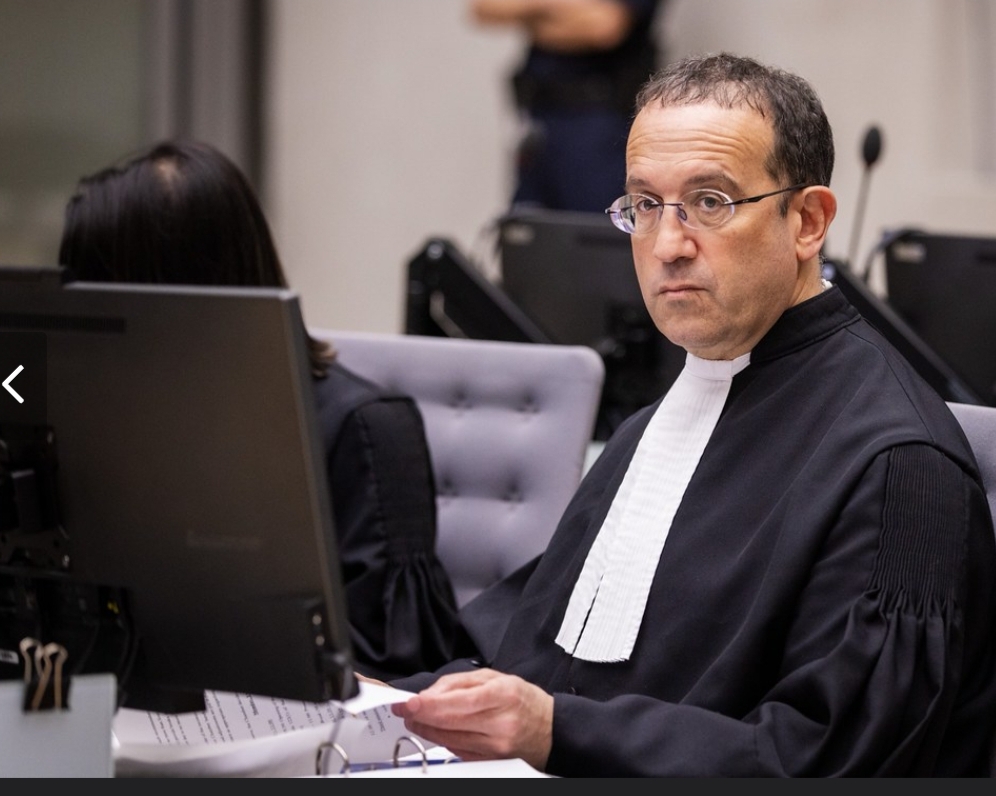
THE LEAD defense counsel for former President Rodrigo Duterte accused the Marcos administration of covertly orchestrating his client’s “unconstitutional” arrest.
Addressing the ICC Pre-Trial Chamber I on Tuesday, Kaufman alleged the existence of a covertly recorded telephone call that proves a “scheme” to funnel witnesses to The Hague while providing President Ferdinand Marcos Jr. with “plausible deniability.”
Kaufman claimed the defense recently received a transcript—disclosed by the prosecution as “exonerating evidence”—detailing a conversation between four unidentified parties.
According to Kaufman, one party boasted of being a “silent partner” to President Marcos Jr., managing the delivery of witnesses to the ICC despite the President’s public “cast-iron undertaking” that the Philippine government would not assist the court.
“President Ferdinand Marcos Jr. set out to neutralize Rodrigo Duterte and his legacy,” Kaufman told the court, pointedly using the prosecution’s own terminology.
‘Cherry-picked’ rhetoric
The defense dismissed the prosecution’s case as being built on “political demagoguery” and “spicy gossip” rather than forensic reality. Kaufman argued that Duterte’s infamous “tough tongue” was a tool for law and order, not a mandate for murder.
The defense presented its own “speech counter,” claiming that for every one speech the prosecution uses to prove incitement, there are 3.5 speeches where Duterte explicitly ordered police to operate within the bounds of law and self-defense.
“Abuse your authority, and there will be hell to pay,” Kaufman quoted from a 2016 Duterte speech, arguing this was the “exonerating evidence” the prosecution intentionally ignored.
Attack on the investigation’s integrity
Kaufman further alleged that the entire investigation was “contaminated” from the start. He targeted ICC Chief Prosecutor Karim Khan—who has since been disqualified from the case—accusing him of a “one-track crusade” and failing to disclose prior ties to witnesses as a private lawyer in 2018.
The defense painted a picture of Davao City’s transformation from a “communist outpost” to a global safety standard as the true legacy of the Duterte administration. Kaufman argued that the “Davao Model” was not a code for violence, but a blueprint for the “Selfless Public Service” that led to Duterte’s landslide 2016 victory.
As the four-day confirmation of charges hearing continues, the defense maintains that without Duterte’s “bombastic rhetoric,” there would be no case.